. 2018 Apr 30;8(1):6709.
doi: 10.1038/s41598-018-24755-8.

Galactic Cosmic Radiation Induces Persistent Epigenome Alterations Relevant to Human Lung Cancer

Affiliations

Galactic Cosmic Radiation Induces Persistent Epigenome Alterations Relevant to Human Lung Cancer

E M Kennedy et al. Sci Rep. .

Abstract

Human deep space and planetary travel is limited by uncertainties regarding the health risks associated with exposure to galactic cosmic radiation (GCR), and in particular the high linear energy transfer (LET), heavy ion component. Here we assessed the impact of two high-LET ions 56Fe and 28Si, and low-LET X rays on genome-wide methylation patterns in human bronchial epithelial cells. We found that all three radiation types induced rapid and stable changes in DNA methylation but at distinct subsets of CpG sites affecting different chromatin compartments. The 56Fe ions induced mostly hypermethylation, and primarily affected sites in open chromatin regions including enhancers, promoters and the edges ("shores") of CpG islands. The 28Si ion-exposure had mixed effects, inducing both hyper and hypomethylation and affecting sites in more repressed heterochromatic environments, whereas X rays induced mostly hypomethylation, primarily at sites in gene bodies and intergenic regions. Significantly, the methylation status of 56Fe ion sensitive sites, but not those affected by X ray or 28Si ions, discriminated tumor from normal tissue for human lung adenocarcinomas and squamous cell carcinomas. Thus, high-LET radiation exposure leaves a lasting imprint on the epigenome, and affects sites relevant to human lung cancer. These methylation signatures may prove useful in monitoring the cumulative biological impact and associated cancer risks encountered by astronauts in deep space.


Conflict of interest statement

The authors declare no competing interests.

Figures
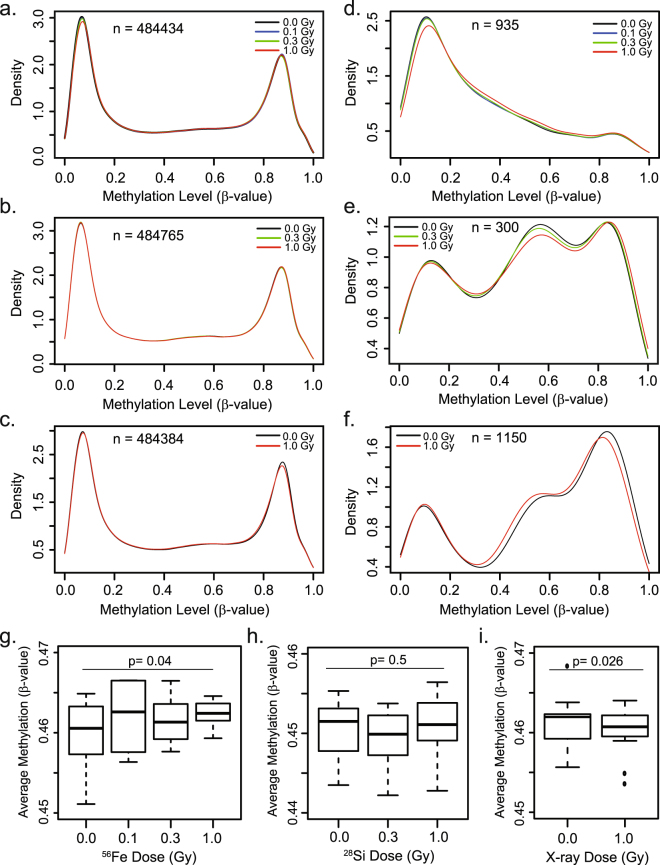
Figure 1
Figure 1
Global impact of high- vs. low- LET radiation on DNA methylation. (af) Density plots showing the impact of the indicated dose of each radiation source on the distribution of DNA methylation values (β values) across all time points, for all evaluable (>484,000 CpG sites on the array passing QC) CpG sites (ac) or the subset of CpG sites whose methylation status was found to be significantly associated with increasing dose of 56Fe, 28Si or X ray exposure (df). (gi) For each sample, the average methylation (β value) across all evaluable CpGs (>484,000 CpG sites) was determined. Box plots representing the distribution of the average methylation level across all 12 samples (3 replicates x 4 time points) for the indicated dose/source. The line represents the median average methylation level, boxes the first and third quartiles, whiskers represent the interquantile distance. Note the trend towards hypermethylation with increasing 56Fe ion dose (p = 0.04) and towards hypomethylation with X ray dose (p = 0.026). No significant directional trend was observed with 28Si exposure. P-values were determined as a regression of the mean beta value across all samples with dose, with covariates for time, batch and array.
Figure 2
Figure 2
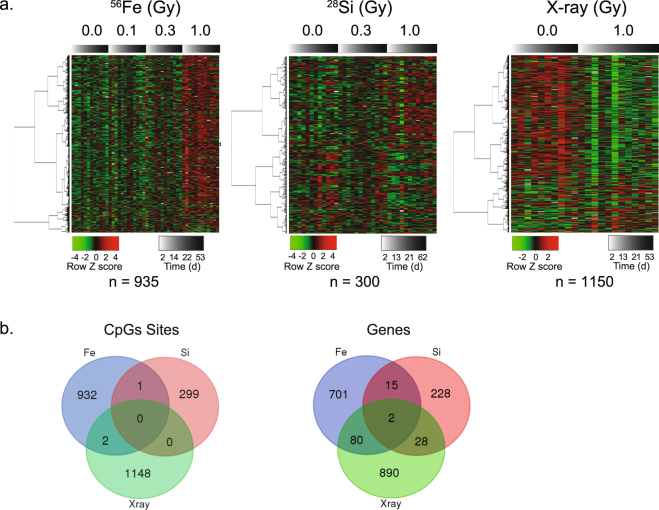
Differential effects of High- (56Fe, 28Si) or low-LET radiation dose on the methylation status of individual CpG sites. A linear mixed effects model was used to identify DNA methylation changes significantly associated with dose, source, or time-after-exposure (see Methods). This analysis identified 935 CpG sites whose methylation status was moderately (p < 0.001) associated with 56Fe dose (849 hyper; 86 hypo); 300 CpG sites associated with 28Si dose (158 hyper, 142 hypo) and 1150 CpG sites associated with X ray dose (252 hyper; 898 hypo). (a) Heatmap showing the methylation status (low, green to high, red) of the 56Fe, 28Si or X ray significant CpG sites (rows) for each replicate sample analyzed (columns). Samples (columns) are arranged from left to right by increasing time after exposure (shaded gray bar, n = 3 for each time point) for the indicated dose (n = 12 for each indicated dose; 4 time points in triplicate). (b) Overlap between individual CpGs sites (left) or nearest RefSeq gene (right) among CpGs differentially methylated in response to 56Fe,28Si, X ray. Note the largely distinct CpGs affected by each radiation type.
Figure 3
Figure 3
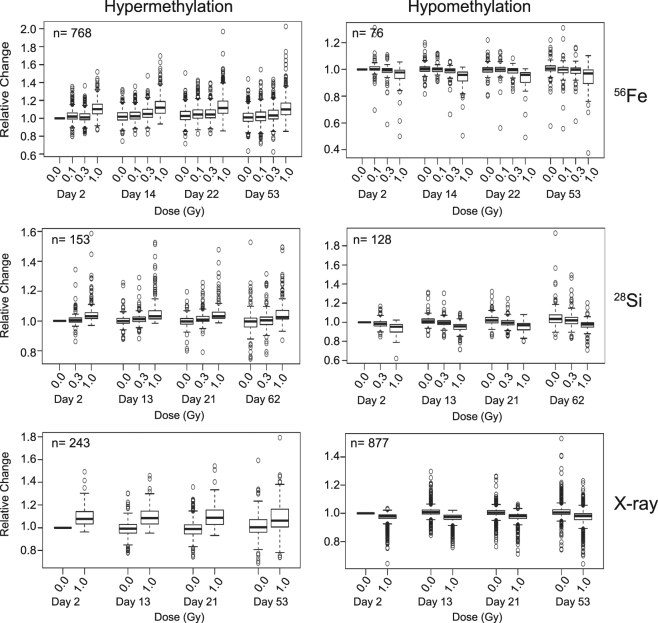
Fate of Radiation-induced changes in DNA methylation over time. CpG sites exhibiting a change in methylation level significantly associated with radiation dose were normalized to their individual initial methylation levels as extrapolated from the 48 h, unexposed cultures. Shown is the distribution of the change in methylation of CpG sites undergoing hyper- or hypo-methylation in response to the indicated radiation source relative to the internal control (unexposed) cultures at 48 h. Line represents the median, boxes the first and third quartile, and whiskers extend to maximum value that is 1.5 times the interquartile range. For clarity, CpG sites whose methylation level was also independently associated with time-after-culture were excluded. Note that irradiation-induced methylation changes occur early (within 48 h) and largely persist over time.
Figure 4
Figure 4
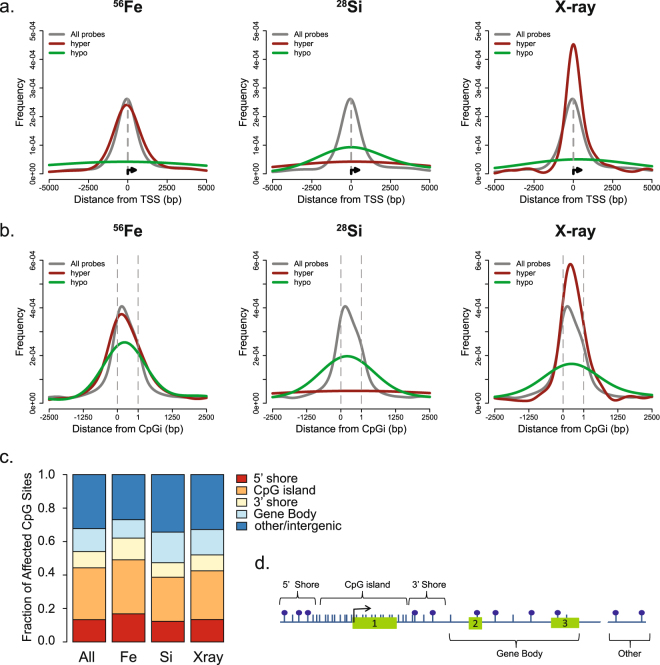
Genomic location of CpG sites significantly associated with radiation dose. (a) Average distance of all CpGs on the array (gray), or the subset that underwent hyper (red) or hypo (green) methylation in response to increasing 56Fe, 28Si or X ray dose relative to the transcription start site (TSS) of the nearest gene oriented to the direction of transcription. (b) Average distance of all CpGs on the array (gray), or the subset that underwent hyper (red) or hypo (green) methylation in response to increasing 56Fe, 28Si or X ray dose relative to the nearest CpG island. The distribution within the CpG island is scaled to size (dotted gray lines), and includes a fixed distance of +/−2.5 kb in either direction from the CpG island edge. (c) Fraction of 56Fe, 28Si or X ray affected CpG sites that lie within the indicated gene compartment relative to that of All CpG sites interrogated on the array. CpG sites were annotated to the nearest CpG island associated RefSeq gene. CpG islands defined by UCSC criteria, 5′ and 3′ shores are 2,000 bp from the 5′ and 3′ CpG island edge. Gene bodies were considered the region from the 3′ edge of the CpG island +2 kb, to the transcription end site (TES). CpG sites not overlapping one of these features were considered to be intergenic/other. (d) A schematic of the genomic compartments described in C. Shown is a hypothetical gene (exons-green boxes) for which the TSS (black arrow) is embedded in a CpG island promoter. Blue ticks represent CpG sites, blue balls as methylated CpG sites. The TES would be the end of exon 3.
Figure 5
Figure 5
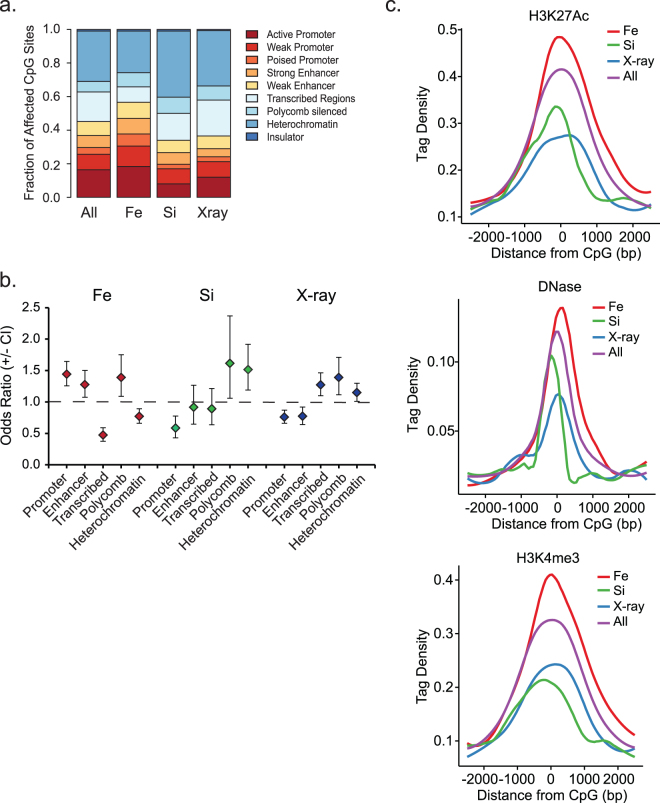
HZE-particles of distinct LETs affect methylation of CpG sites in different genomic chromatin compartments. CpG sites were annotated to a chromatin-based functional genomics annotation, ChromHMM, established by Ernst et al. using 14 different chromatin features from ENCODE data from human epithelial cells (HMEC). Shown is the fraction (a) and relative enrichment (b) of 56Fe, 28Si or X ray affected CpG sites that overlap in the indicated compartment, relative to that of ‘All’ CpG sites on the array. Data represent the odds ratios determined by Fishers exact +/− the 95th confidence interval. (c) Normalized average tag densities of H3K27 acetylation ChIP-seq (Top), DNaseI-seq (Middle) or H3K4me3 ChIP-seq (Bottom) surrounding all assayed CpGs (All), or the subset of CpGs whose change in methylation was significantly associated with 56Fe, 28Si or X ray dose. Data are derived from ENCODE CHIP-seq and DNAse-I seq data from A549 lung cancer cells. Note the over-representation of H3K4me3, H3K27ac, and DNaseI accessibility at 56Fe-affected sites.
Figure 6
Figure 6
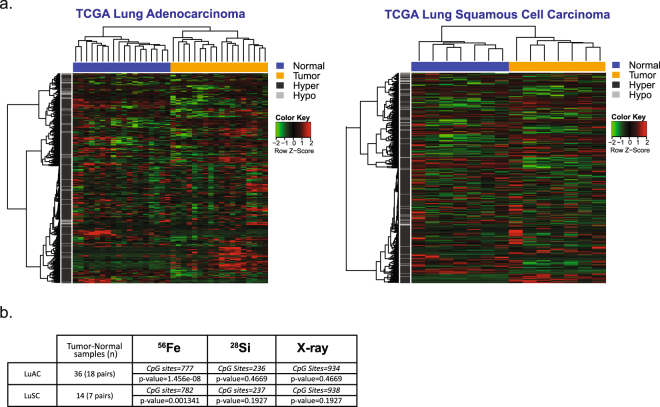
The 56Fe-specific methylation ‘signature’ discriminates lung tumor from normal tissue in primary tissue samples. (a) DNA methylation status of the CpG sites significantly associated with Fe dose (n = 777) in normal bronchial epithelial cells was extracted for 25 lung tumor-normal pairs (18 adenocarcinomas, 7 squamous cell carcinomas) available in the TCGA project and used in unsupervised hierarchical cluster analysis (complete linkage, Manhattan distance metric). (b) An equivalent number of CpGs were chosen at random and used to group tissue samples using the same approach, and the process was repeated 1,000 times to estimate significance. The 56Fe-sensitive CpGs outperformed any random set by several orders of magnitude. The methylation status of the 28Si or the X ray affected sites had no significant association with tumor-specific differences in methylation (see Methods).

Comment in

References

    1. Held KD. Effects of low fluences of radiations found in space on cellular systems. Int. J. Radiat. Biol. 2009;85:379–390. doi: 10.1080/09553000902838558. - DOI - PubMed
    1. Hu W, et al. Effects of shielding on the induction of 53BP1 foci and micronuclei after Fe ion exposures. J. Radiat. Res. 2014;55:10–16. doi: 10.1093/jrr/rrt078. - DOI - PMC - PubMed
    1. Lebel EA, et al. Analyses of the Secondary Particle Radiation and the DNA Damage It Causes to Human Keratinocytes. J. Radiat. Res. 2011;52:685–693. doi: 10.1269/jrr.11015. - DOI - PubMed
    1. Mukherjee B, Camacho CV, Tomimatsu N, Miller J, Burma S. Modulation of the DNA-damage response to HZE particles by shielding. DNA Repair (Amst). 2008;7:1717–1730. doi: 10.1016/j.dnarep.2008.06.016. - DOI - PubMed
    1. Durante M, Cucinotta FA. Heavy ion carcinogenesis and human space exploration. Nat. Rev. Cancer. 2008;8:465–472. doi: 10.1038/nrc2391. - DOI - PubMed

Publication types