


International Comparison of Abdominal Fat Distribution Among Four Populations: The ERA-JUMP Study
- PMID: 29715072
- PMCID: PMC5931176
- DOI: 10.1089/met.2017.0132
International Comparison of Abdominal Fat Distribution Among Four Populations: The ERA-JUMP Study
Abstract
Background: Abdominal fat distribution varies across groups with different races or environments. Whether environmental factors, apart from racial differences, affect abdominal fat distribution is unknown.
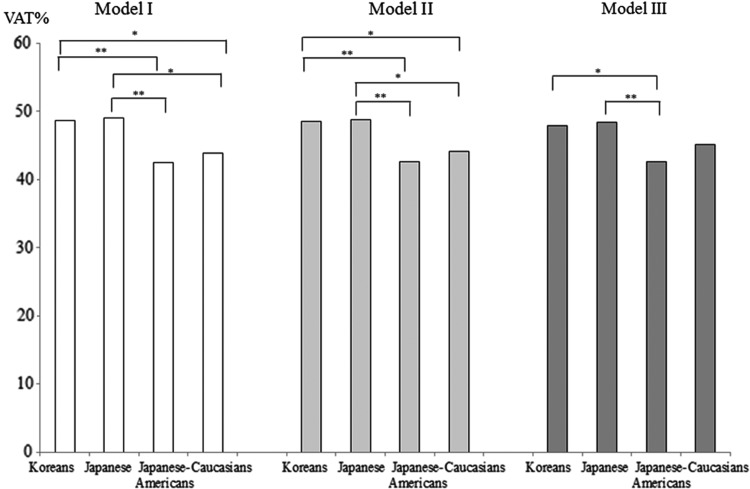
Methods: We compared the abdominal fat distribution of four groups; different races with similar environments (Caucasians vs. Japanese Americans), different environments with an identical race (Japanese Americans vs. Japanese), and similar races with similar environments (Japanese vs. Koreans). A population-based sample of 1212 men aged 40-49 were analyzed: 307 Caucasians and 300 Japanese Americans in the United States, 310 Japanese in Japan, and 295 Koreans in Korea. We compared the proportion of visceral adipose tissue area to total abdominal adipose tissue area (VAT%) and other factors that can affect abdominal fat distribution (smoking, alcohol use, physical activity levels, and metabolic factors).
Results: VAT% was significantly higher in Japanese and Koreans than in Japanese Americans and Caucasians (50.0, 48.5, 43.2, 41.0%, respectively, P < 0.001). Even after adjustment for possible confounders, the significant VAT% difference remained in comparing groups with identical race but different environments (i.e., Japanese vs. Japanese Americans). In contrast, comparing groups with different races but similar environments (i.e., Caucasians vs. Japanese Americans), VAT% was not significantly different. Comparing groups with similar races and similar environments (i.e., Japanese vs. Koreans), VAT% did not significantly differ.
Conclusions: Environmental differences, apart from racial differences, affect the difference in abdominal fat distribution across different groups in middle-aged men.
Keywords: cross-sectional study; epidemiology; international study; subcutaneous adipose tissue; visceral adipose tissue.
Conflict of interest statement
No competing financial interests exist.
Figures
References
-
- Sironi AM, Sicari R, Folli F, et al. . Ectopic fat storage, insulin resistance, and hypertension. Curr Pharm Des 2011;17:3074–3080 - PubMed
-
- Tanaka S, Horimai C, Katsukawa F. Ethnic differences in abdominal visceral fat accumulation between Japanese, African-Americans, and Caucasians: A meta-analysis. Acta Diabetol 2003;40 Suppl 1:S302–S304 - PubMed
Publication types
MeSH terms
Grants and funding
LinkOut - more resources
Full Text Sources
Other Literature Sources