


A systematic review of the psychometric properties of the cross-cultural translations and adaptations of the Multidimensional Perceived Social Support Scale (MSPSS)
- PMID: 29716589
- PMCID: PMC5930820
- DOI: 10.1186/s12955-018-0912-0
A systematic review of the psychometric properties of the cross-cultural translations and adaptations of the Multidimensional Perceived Social Support Scale (MSPSS)
Abstract
Background: Social support (SS) has been identified as an essential buffer to stressful life events. Consequently, there has been a surge in the evaluation of SS as a wellbeing indicator. The Multidimensional Perceived Social Support Scale (MSPSS) has evolved as one of the most extensively translated and validated social support outcome measures. Due to linguistic and cultural differences, there is need to test the psychometrics of the adapted versions. However, there is a paucity of systematic evidence of the psychometrics of adapted and translated versions of the MSPSS across settings.
Objectives: To understand the psychometric properties of the MSPSS for non-English speaking populations by conducting a systematic review of studies that examine the psychometric properties of non-English versions of the MSPSS.
Methods: We searched Africa-Wide Information, CINAHL, Medline and PsycINFO, for articles published in English on the translation and or validation of the MSPSS. Methodological quality and quality of psychometric properties of the retrieved translations were assessed using the COSMIN checklist and a validated quality assessment criterion, respectively. The two assessments were combined to produce the best level of evidence per language/translation.
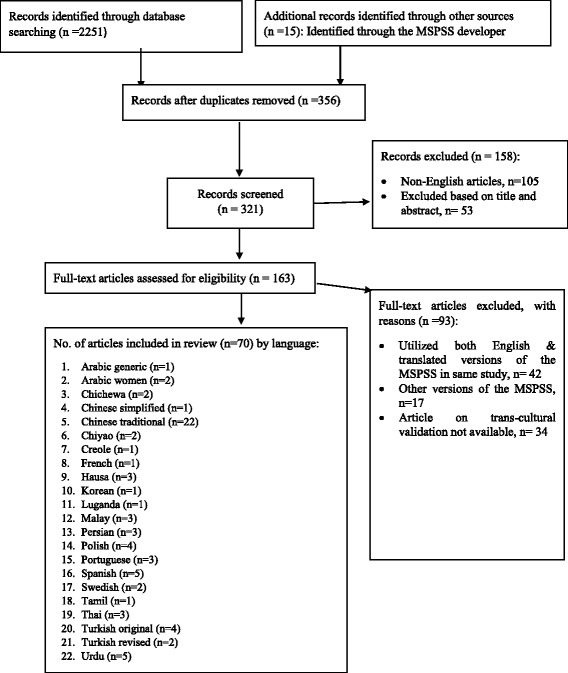
Results: Seventy articles evaluating the MSPSS in 22 languages were retrieved. Most translations [16/22] were not rigorously translated (only solitary backward-forward translations were performed, reconciliation was poorly described, or were not pretested). There was poor evidence for structural validity, as confirmatory factor analysis was performed in only nine studies. Internal consistency was reported in all studies. Most attained a Cronbach's alpha of at least 0.70 against a backdrop of fair methodological quality. There was poor evidence for construct validity.
Conclusion: There is limited evidence supporting the psychometric robustness of the translated versions of the MSPSS, and given the variability, the individual psychometrics of a translation must be considered prior to use. Responsiveness, measurement error and cut-off values should also be assessed to increase the clinical utility and psychometric robustness of the translated versions of the MSPSS.
Trial registration: PROSPERO - CRD42016052394.
Keywords: Adaptation; Multidimensional perceived social support; Reliability; Translation; Validation; Validity.
Conflict of interest statement
Ethics approval and consent to participate
This study was conducted as systematic review, so no ethical approval was sought and there was no need for informed consents.
Competing interests
The authors declare that they have no competing interests.
Publisher’s Note
Springer Nature remains neutral with regard to jurisdictional claims in published maps and institutional affiliations.
Figures
References
-
- Stewart RC, Umar E, Tomenson B, Creed F. Validation of the multi-dimensional scale of perceived social support (MSPSS) and the relationship between social support, intimate partner violence and antenatal depression in Malawi. BMC Psychiatry. 2014;14:180. doi: 10.1186/1471-244X-14-180. - DOI - PMC - PubMed
-
- Ekbäck M, Benzein E, Lindberg M, Årestedt K. The Swedish version of the multidimensional scale of perceived social support (MSPSS) - a psychometric evaluation study in women with hirsutism and nursing students. Health Qual Life Outcomes. 2013;11:168. doi: 10.1186/1477-7525-11-168. - DOI - PMC - PubMed
-
- Wilson A, Yendork JS, Somhlaba NZ. Psychometric properties of multidimensional scale of perceived social support among Ghanaian adolescents. Child Indic Res. 2016;10:101. doi: 10.1007/s12187-016-9367-1. - DOI
Publication types
MeSH terms
Grants and funding
LinkOut - more resources
Full Text Sources
Other Literature Sources
Medical
