Review
. 2018 Jul 1;98(3):1205-1240.
doi: 10.1152/physrev.00046.2017.

Myoediting: Toward Prevention of Muscular Dystrophy by Therapeutic Genome Editing

Affiliations
Review

Myoediting: Toward Prevention of Muscular Dystrophy by Therapeutic Genome Editing

Yu Zhang et al. Physiol Rev. .

Abstract

Muscular dystrophies represent a large group of genetic disorders that significantly impair quality of life and often progress to premature death. There is no effective treatment for these debilitating diseases. Most therapies, developed to date, focus on alleviating the symptoms or targeting the secondary effects, while the underlying gene mutation is still present in the human genome. The discovery and application of programmable nucleases for site-specific DNA double-stranded breaks provides a powerful tool for precise genome engineering. In particular, the CRISPR/Cas system has revolutionized the genome editing field and is providing a new path for disease treatment by targeting the disease-causing genetic mutations. In this review, we provide a historical overview of genome-editing technologies, summarize the most recent advances, and discuss potential strategies and challenges for permanently correcting genetic mutations that cause muscular dystrophies.


Figures
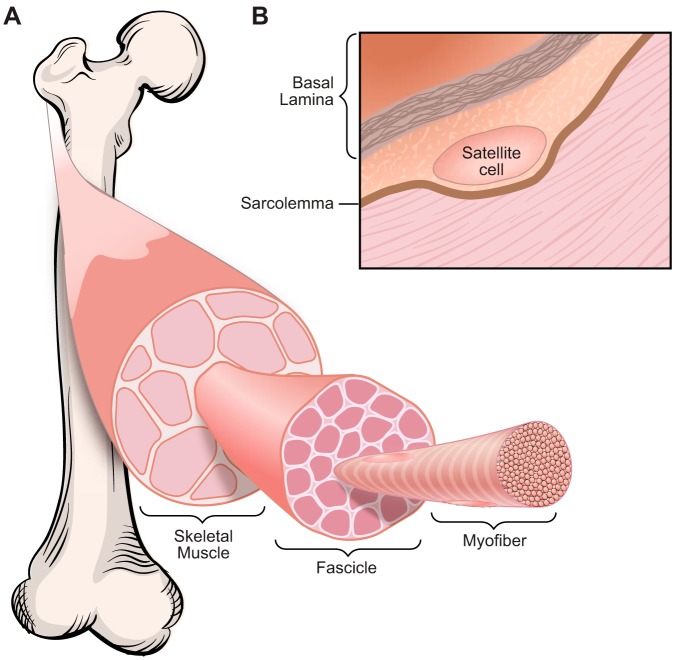
FIGURE 1.
FIGURE 1.
Skeletal muscle structure. A: skeletal muscle is composed of thousands of multinucleated myofibers. Bundles of myofibers form muscle fascicles, and groups of fascicles contribute to skeletal muscle structure. B: satellite cells are adult skeletal muscle stem cells, which reside between the sarcolemma and basal lamina of myofibers.
FIGURE 2.
FIGURE 2.
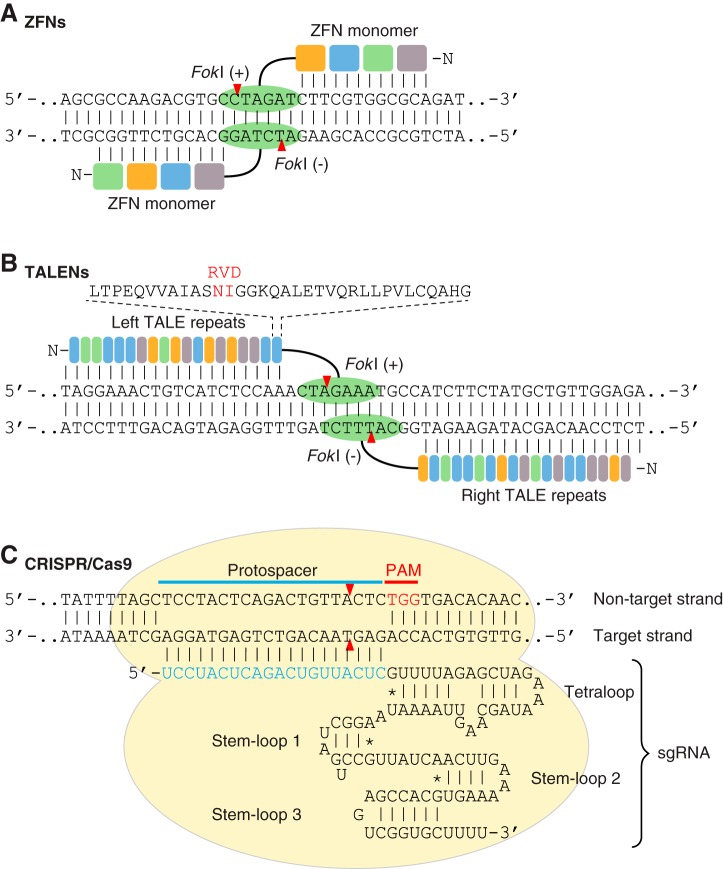
Programmable nucleases used for genome editing. A: a schematic illustration of a pair of zinc-finger nuclease (ZFN) monomers bound to DNA. ZFN is a chimeric endonuclease composed of multiple zinc finger domains (colored boxes) at the NH2 terminus for DNA binding and a Fok1 nuclease domain (green oval) at the COOH terminus for DNA cleavage. Dimerization of two Fok1 nucleases induces a DNA double-strand break (DSB) with 4 bp of 5′ overhang. B: a schematic illustration of a pair of transcription activator-like effector nucleases (TALENs) bound to DNA. TALEN is a chimeric endonuclease composed of multiple TALE repeats (colored rectangles) at the NH2 terminus and a Fok1 nuclease domain (green oval) at the COOH terminus. Each TALE repeat recognizes 1 bp of DNA, and the sequence specificity is determined by repeat-variable diresidues (RVD; shown in red). TALEN-mediated DNA DSBs are induced by dimerization of two Fok1 nucleases. C: a schematic illustration of the engineered CRISPR/Cas9 (clustered regularly interspaced short palindromic repeats-CRISPR associated protein 9) system from Streptococcus pyogenes. In the CRISPR/Cas9 system, target recognition is mediated by DNA hybridization with a single guide RNA (sgRNA), which is an engineered RNA chimera composed of CRISPR RNA (crRNA) and trans-activating crRNA (tracrRNA). CRISPR/Cas9-mediated DNA DSB requires a protospacer adjacent motif (PAM; shown in red), and cleavage is induced at the nucleotide 3 bp proximal to the PAM. Red arrowheads indicate cleavage site.
FIGURE 3.
FIGURE 3.
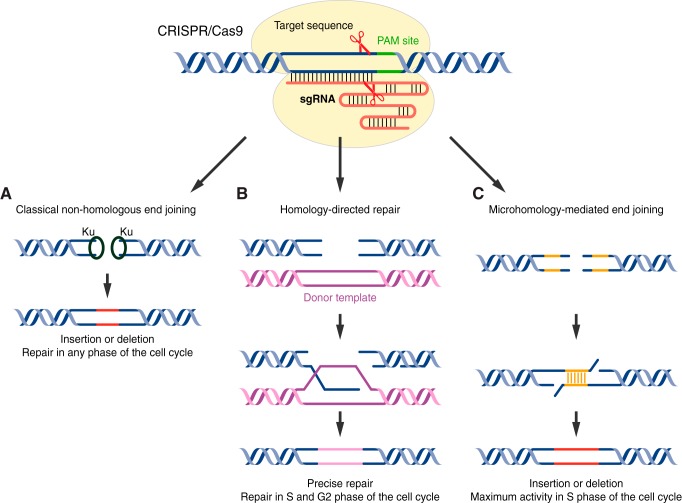
DNA repair pathways involved in CRISPR/Cas-induced DNA double-strand break repair. A: classical nonhomologous end joining (c-NHEJ) is a Ku-dependent DNA repair pathway that is active throughout the cell cycle. In the absence of a donor template, c-NHEJ generates insertions or deletions (INDELs; shown in red) in the genome. B: when a DNA double-strand break (DSB) is induced in the S or G2 phase of the cell cycle, homology-directed repair (HDR) can be triggered if a donor template is present (magenta), leading to precise repair of the genome. C: a Ku-independent microhomology-mediated end joining (MMEJ) pathway can be used for DNA DSB repair if the DNA breakage site shares sequence homology. MMEJ-mediated repair generates INDELs in the genome (red).
FIGURE 4.
FIGURE 4.
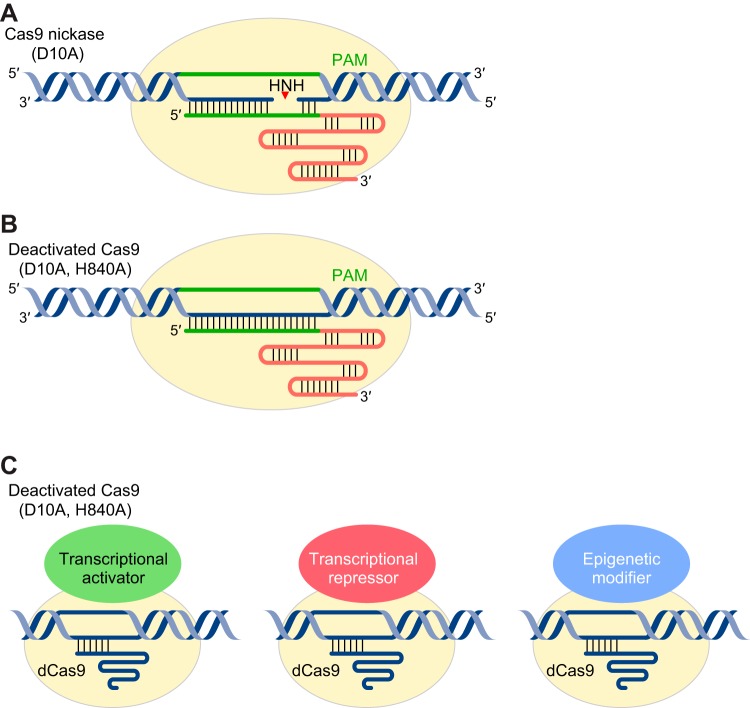
CRISPR/Cas9 with mutant nuclease domain. CRISPR/Cas9-mediated DNA double-strand break (DSB) is induced by two separate nuclease domains, in which the HNH domain cleaves the target strand and the RuvC domain cleaves the nontarget strand. A: D10A Cas9 nickase having a mutation in the RuvC domain is only active for target strand cleavage by the HNH nuclease domain. B: mutations at both RuvC and HNH nuclease domains (D10A, H840A) abolish the Cas9 nuclease activity, generating a deactivated Cas9 (dCas9). C: CRISPR/dCas9-mediated gene regulation is achieved by fusing dCas9 to transcriptional activation domains, transcriptional repression domains, or epigenetic modifiers.
FIGURE 5.
FIGURE 5.
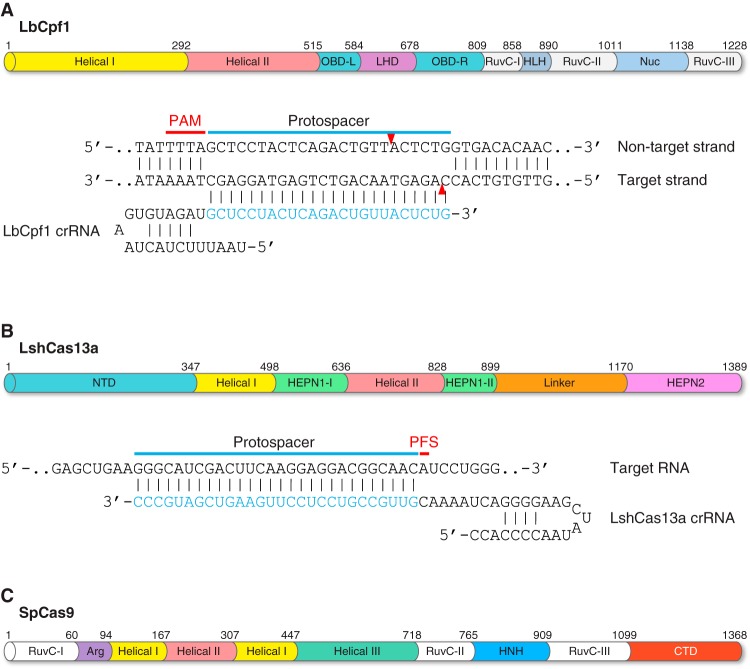
Novel CRISPR/Cas systems. Two novel class 2 CRISPR/Cas systems have been engineered for nucleic acid recognition and cleavage, such as Cpf1 (CRISPR from Prevotella and Francisella 1) and Cas13a (formerly C2c2). A: domain organization of the LbCpf1 protein discovered in Lachnospiraceae bacterium ND2006. All Cpf1 orthologs have two nuclease domains: 1) the RuvC domain which cleaves the nontarget DNA strand and 2) the Nuc domain which cleaves the target DNA strand. The LbCpf1 crRNA is shown hybridizing with its DNA target. The PAM is highlighted in red. Red arrowheads indicate cleavage site. B: domain organization of the LshCas13a protein discovered in Leptotrichia shahii. Cas13a has dual RNase activities, one specific for pre-crRNA processing and maturation, which is catalyzed by the helical-I domain, and the other one for RNA-guided single-stranded RNA (ssRNA) degradation, which is catalyzed by the HEPN1 and HEPN2 domains. The LshCas13a crRNA is shown hybridizing with its RNA target. CRISPR/Cas13a-mediated ssRNA cleavage is independent of a PAM; instead, it requires a 3′-protospacer flanking site (PFS; shown in red). C: domain organization of the SpCas9 protein discovered in Streptococcus pyogenes. The RuvC nuclease domain cuts the nontarget strand. The HNH nuclease domain cuts the target strand that hybridizes with the sgRNA. CTD, COOH-terminal domain.
FIGURE 6.
FIGURE 6.
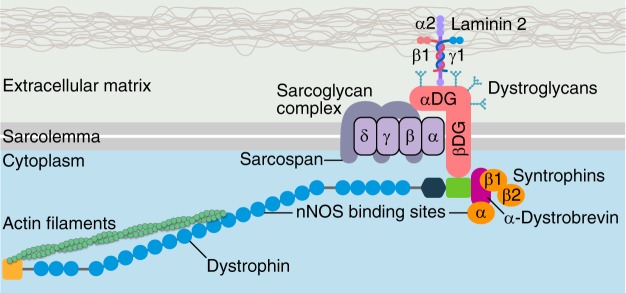
Structure of the dystrophin-glycoprotein complex (DGC). The main components of the DGC are the dystroglycan complex, sarcoglycan complex, and dystrophin. The DGC provides sarcolemma stability and integrity through interaction with laminin in the basement membrane on the extracellular matrix and actin in the cytoplasm. Other dystrophin-associated proteins include neuronal nitric oxide synthase (nNOS), dystrobrevins, syntrophins, and sarcospan. Mutations of the main components of the DGC cause muscular dystrophies, such as Duchenne or Becker muscular dystrophy (dystrophin mutation), and limb-girdle muscular dystrophy types 2C, 2D, 2E, and 2F (sarcoglycan mutations).
FIGURE 7.
FIGURE 7.
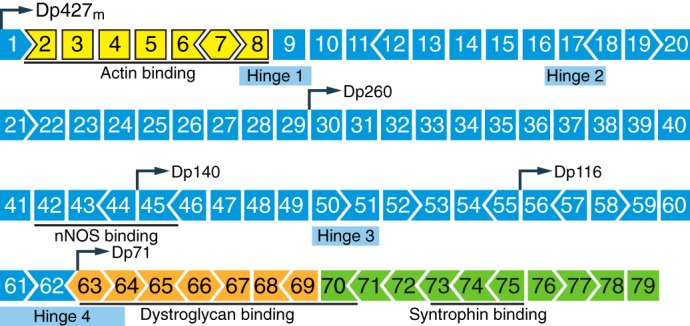
Structure of the dystrophin gene. The dystrophin gene has 79 exons. Different dystrophin isoforms can be transcribed from various promoters (demarcated as Dp, followed by a numeric number indicating isoform molecular weight in kilodaltons). The dystrophin protein expressed in skeletal muscle and heart is transcribed from the Dp427m promoter. Domains essential for binding with other DGC components or cytoskeletal proteins are underlined. Exons are color-coded according to the domain they encode: NH2 terminus (yellow), central rod domain (blue), cysteine-rich domain (orange), and COOH terminus (green).
FIGURE 8.
FIGURE 8.
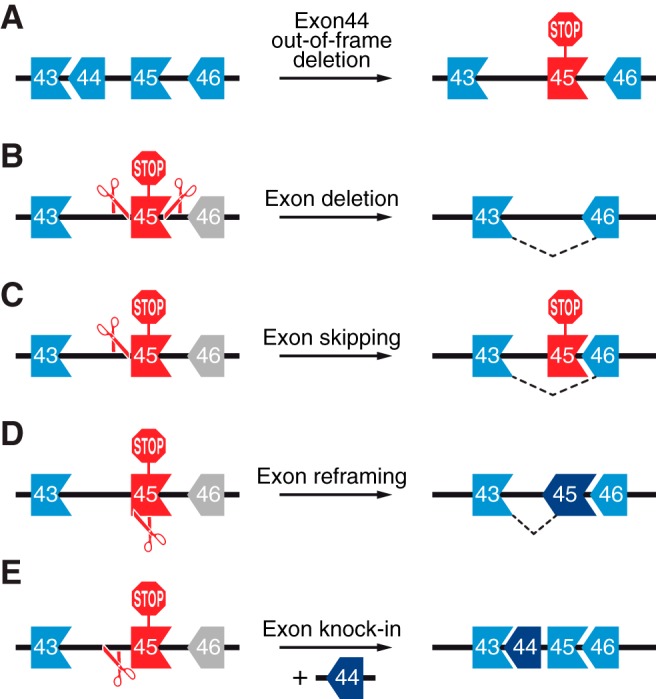
Strategies for CRISPR/Cas-mediated correction of DMD mutations. A: a schematic illustration showing arrangement of exons 43–46 of the DMD gene in terms of their reading frame compatibility. This genomic region is used here as an example to highlight the strategies for CRISPR/Cas9 correction of DMD mutations. An out-of-frame deletion of DMD exon 44 results in splicing of exon 43 to exon 45. This creates a premature stop codon in exon 45 (red STOP sign). B: exon deletion is used to restore the DMD reading frame. Two sgRNAs targeting introns 44 and 45 will generate two DNA DSBs flanking exon 45. This leads to excision of exon 45 and subsequent splicing of exon 43 to exon 46. C: exon skipping is mediated by a single sgRNA which targets the splice acceptor site of exon 45. The INDELs generated by NHEJ-mediated repair disrupt the splice acceptor site of exon 45, leading to splicing of exon 43 to exon 46. D: exon reframing is mediated by a single sgRNA targeting exon 45. The INDELs in exon 45 generated by NHEJ-mediated repair may restore the reading frame compatibility of exon 45 with exons 43 and 46. E: exon knock-in relies on HDR DNA repair pathway in the presence of a donor template. A single sgRNA targeting intron 44 will generate a DNA DSB and be repaired by HDR when exon 44 is used as a donor template, leading to exon 44 knock-in between exons 43 and 45.
FIGURE 9.
FIGURE 9.
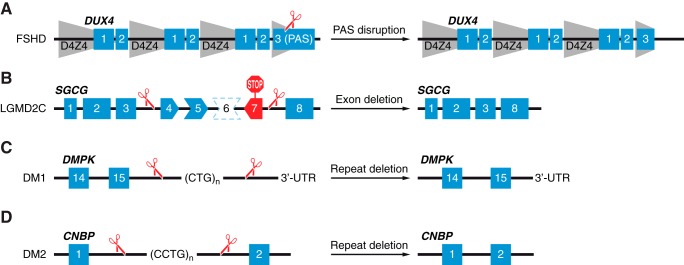
Strategies for CRISPR/Cas-mediated correction of other muscular dystrophies. A: FSHD type I and type II are caused by acquisition of a poly-adenylation signal on the permissive 4qA haplotype, leading to DUX4 transcript stabilization. The Cas9 nuclease is directed to the 4qA haplotype by specific gRNA(s) targeting the polyadenylation signal and converts the permissive 4qA haplotype to the nonpermissive 4qB haplotype. The gray shaded area depicts D4Z4 macrosatellite repeats. PAS indicates poly-adenylation signal on the permissive 4qA haplotype. B: LGMD2C is caused by loss-of-function mutation of the SGCG gene. An out-of-frame deletion of exon 6 (shown by a dotted line around exon 6) results in splicing of exon 5 to exon 7, which creates a premature stop codon in exon 7 (red STOP sign). Two sgRNAs that target introns 3 and 7 will generate two DNA DSBs flanking exons 4–7. This leads to excision of exons 4–7 and subsequent splicing of exon 3 to exon 8 and permanent restoration of the SGCG reading frame, since deletion of exons 4–7 of the SGCG gene was shown to partially restore function of γ-sarcoglycan (121). C: myotonic dystrophy type I (DM1) is caused by trinucleotide CTG repeat expansion in the 3′ untranslated region (3′-UTR) of the DMPK gene. Two sgRNAs can be designed to generate two DNA DSBs that flank the CTG repeats, leading to deletion of the CTG repeats. D: myotonic dystrophy type 2 (DM2) is caused by a tetranucleotide CCTG repeat expansion in intron 1 of the CNBP gene. Two sgRNAs can be designed to generate two DNA DSBs that flank the CCTG repeats, leading to deletion of the CCTG repeats.
FIGURE 10.
FIGURE 10.
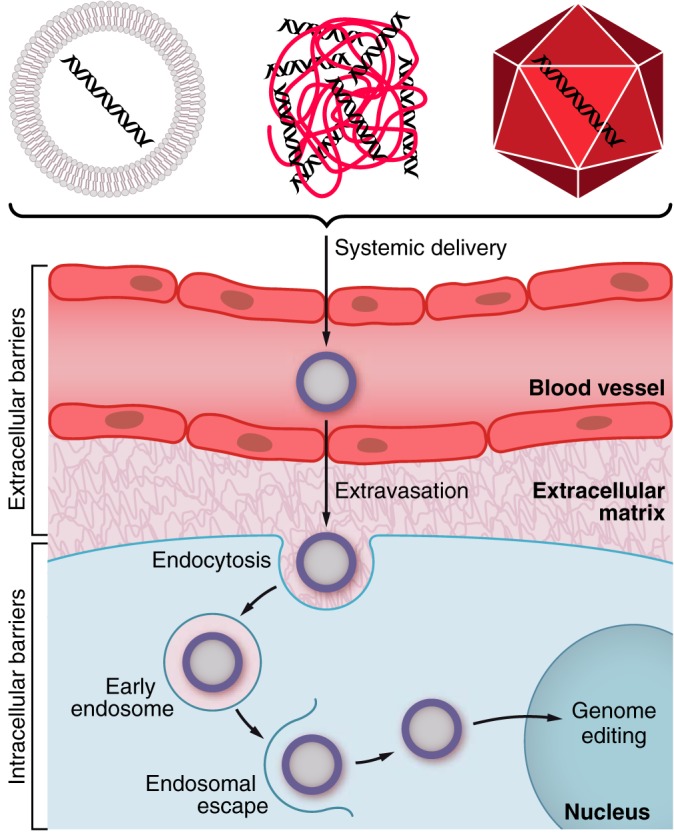
Systemic delivery of genome editing components. Nonviral (lipid-based carriers or polymeric carriers) and viral (rAAV) vector-based delivery of genome editing components into target tissue. Following administration, the delivery vectors pass through the blood vessel by extravasation to reach their target tissues. In the tissue, they undergo cytoplasmic trafficking, endosomal escape, and nuclear entry to perform genome editing in the nucleus.

References

    1. Aartsma-Rus A. Overview on DMD exon skipping. Methods Mol Biol 867: 97–116, 2012. doi:10.1007/978-1-61779-767-5_7. - DOI - PubMed
    1. Aartsma-Rus A, Ginjaar IB, Bushby K. The importance of genetic diagnosis for Duchenne muscular dystrophy. J Med Genet 53: 145–151, 2016. doi:10.1136/jmedgenet-2015-103387. - DOI - PMC - PubMed
    1. Aartsma-Rus A, Van Deutekom JC, Fokkema IF, Van Ommen GJ, Den Dunnen JT. Entries in the Leiden Duchenne muscular dystrophy mutation database: an overview of mutation types and paradoxical cases that confirm the reading-frame rule. Muscle Nerve 34: 135–144, 2006. doi:10.1002/mus.20586. - DOI - PubMed
    1. Abudayyeh OO, Gootenberg JS, Essletzbichler P, Han S, Joung J, Belanto JJ, Verdine V, Cox DBT, Kellner MJ, Regev A, Lander ES, Voytas DF, Ting AY, Zhang F. RNA targeting with CRISPR-Cas13. Nature 550: 280–284, 2017. doi:10.1038/nature24049. - DOI - PMC - PubMed
    1. Abudayyeh OO, Gootenberg JS, Konermann S, Joung J, Slaymaker IM, Cox DB, Shmakov S, Makarova KS, Semenova E, Minakhin L, Severinov K, Regev A, Lander ES, Koonin EV, Zhang F. C2c2 is a single-component programmable RNA-guided RNA-targeting CRISPR effector. Science 353: aaf5573, 2016. doi:10.1126/science.aaf5573. - DOI - PMC - PubMed

Publication types