


Surgical management of tumor-positive interval node in melanoma patients: An observational study
- PMID: 29718857
- PMCID: PMC6392795
- DOI: 10.1097/MD.0000000000010584
Surgical management of tumor-positive interval node in melanoma patients: An observational study
Abstract
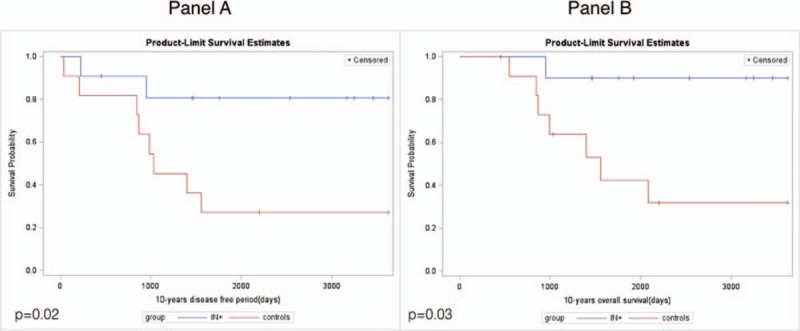
The presence of interval nodes (IN) in melanoma is testified in several studies and sometimes these lymph nodes can contain metastatic disease. Currently there are no guidelines about the management of patients with tumor-positive INs.We enrolled all patients affected by melanoma who underwent sentinel lymph node biopsy (SLNB) in a single institution. All patients with tumor-positive IN underwent the lymphadenectomy of the subsequent draining lymphatic field. Prognosis of IN+-patients was compared with subjects with positive SLNB in usual field through Kaplan-Meier and multivariate Cox regression analysis.Overall 596 subjects underwent lymphoscintigraphy and one or more INs were identified in 94 (15.8%) patients. The mean number of sentinel lymph nodes (SNs) identified per patient was significantly higher in patients with INs. Macrometastasis were more common in patients with INs. Matched pair analysis testified a statistically significant better prognosis in patients with positive-INs when compared with patients with positive SNs in usual side with the same demographic and clinical characteristics. These findings were confirmed both in analysis of 10-year recurrence-free period, then in 10-years overall survival analysis.Lymphadenectomy of the lymphatic draining field beyond positive-IN testify has proved to be a safe procedure that may improve prognosis in melanoma patients with tumor-positive INs. The better prognosis of patients with tumor-positive INs undergoing lymphadenectomy may be justified by the earlier treatment of lymphatic metastases. Further multicentric comparative studies are needed to evaluate possible impact of this procedure on prognosis of melanoma patients.
Conflict of interest statement
The authors have no funding and conflicts of interest to disclose.
Figures
References
-
- Rossi CR, De Salvo GL, Trifiro G, et al. The impact of lymphoscintigraphy technique on the outcome of sentinel node biopsy in 1313 patients with cutaneous melanoma: an Italian Multicentric Study (SOLISM-IMI). J Nucl Med 2006;47:234–41. - PubMed
-
- Macbeth F, Newton-Bishop J, O’Connell S, et al. Guideline development group. Melanoma: summary of NICE guide. BMJ 2015;351:h3708. - PubMed
-
- Doubrovsky A, De Wilt JH, Scolyer RA, et al. Sentinel node biopsy provides more accurate staging than elective lymph node dissection in patients with cutaneous melanoma. Ann Surg Oncol 2004;11:829–36. - PubMed
-
- Uren RF, Howman-Giles R, Thompson JF, et al. Lymphoscintigraphy to identify sentinel nodes in patients with melanoma. Melanoma Res 1994;4:395–9. - PubMed
Publication types
MeSH terms
LinkOut - more resources
Full Text Sources
Other Literature Sources
Medical
