


Effects of slow breathing rate on heart rate variability and arterial baroreflex sensitivity in essential hypertension
- PMID: 29718876
- PMCID: PMC6392805
- DOI: 10.1097/MD.0000000000010639
Effects of slow breathing rate on heart rate variability and arterial baroreflex sensitivity in essential hypertension
Abstract
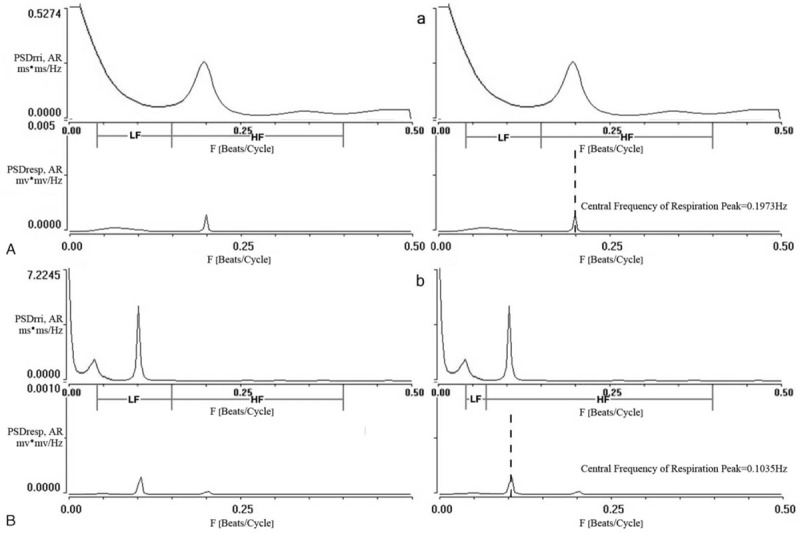
This study is to investigate the effects of slow breathing on heart rate variability (HRV) and arterial baroreflex sensitivity in essential hypertension.We studied 60 patients with essential hypertension and 60 healthy controls. All subjects underwent controlled breathing at 8 and 16 breaths per minute. Electrocardiogram, respiratory, and blood pressure signals were recorded simultaneously. We studied effects of slow breathing on heart rate, blood pressure and respiratory peak, high-frequency (HF) power, low-frequency (LF) power, and LF/HF ratio of HRV with traditional and corrected spectral analysis. Besides, we tested whether slow breathing was capable of modifying baroreflex sensitivity in hypertensive subjects.Slow breathing, compared with 16 breaths per minute, decreased the heart rate and blood pressure (all P < .05), and shifted respiratory peak toward left (P < .05). Compared to 16 breaths/minute, traditional spectral analysis showed increased LF power and LF/HF ratio, decreased HF power of HRV at 8 breaths per minute (P < .05). As breathing rate decreased, corrected spectral analysis showed increased HF power, decreased LF power, LF/HF ratio of HRV (P < .05). Compared to controls, resting baroreflex sensitivity decreased in hypertensive subjects. Slow breathing increased baroreflex sensitivity in hypertensive subjects (from 59.48 ± 6.39 to 78.93 ± 5.04 ms/mm Hg, P < .05) and controls (from 88.49 ± 6.01 to 112.91 ± 7.29 ms/mm Hg, P < .05).Slow breathing can increase HF power and decrease LF power and LF/HF ratio in essential hypertension. Besides, slow breathing increased baroreflex sensitivity in hypertensive subjects. These demonstrate slow breathing is indeed capable of shifting sympatho-vagal balance toward vagal activities and increasing baroreflex sensitivity, suggesting a safe, therapeutic approach for essential hypertension.
Conflict of interest statement
The authors have no funding and conflicts of interest to disclose.
Figures
References
-
- Santulli G, Trimarco B, Iaccarino G. G-protein-coupled receptor kinase 2 and hypertension: molecular insights and pathophysiological mechanisms. High Blood Press Cardiovasc Prev 2013;20:5–12. - PubMed
-
- Lee CK, Park KH, Baik SK, et al. Decreased excitability and voltage-gated sodium currents in aortic baroreceptor neurons contribute to the impairment of arterial baroreflex in cirrhotic rats. Am J Physiol Regul Integr Comp Physiol 2016;310:R1088–101. - PubMed
-
- Del Colle S, Milan A, Caserta M, et al. Baroreflex sensitivity is impaired in essential hypertensives with central obesity. J Hum Hypertens 2007;21:473–8. - PubMed
MeSH terms
LinkOut - more resources
Full Text Sources
Other Literature Sources
Research Materials
Miscellaneous
