Review
. 2018 Jul;59(7):1114-1131.
doi: 10.1194/jlr.R083121. Epub 2018 May 2.

Scavenger receptor B type 1: expression, molecular regulation, and cholesterol transport function

Affiliations
Review

Scavenger receptor B type 1: expression, molecular regulation, and cholesterol transport function

Wen-Jun Shen et al. J Lipid Res. 2018 Jul.

Abstract

Cholesterol is required for maintenance of plasma membrane fluidity and integrity and for many cellular functions. Cellular cholesterol can be obtained from lipoproteins in a selective pathway of HDL-cholesteryl ester (CE) uptake without parallel apolipoprotein uptake. Scavenger receptor B type 1 (SR-B1) is a cell surface HDL receptor that mediates HDL-CE uptake. It is most abundantly expressed in liver, where it provides cholesterol for bile acid synthesis, and in steroidogenic tissues, where it delivers cholesterol needed for storage or steroidogenesis in rodents. SR-B1 transcription is regulated by trophic hormones in the adrenal gland, ovary, and testis; in the liver and elsewhere, SR-B1 is subject to posttranscriptional and posttranslational regulation. SR-B1 operates in several metabolic processes and contributes to pathogenesis of atherosclerosis, inflammation, hepatitis C virus infection, and other conditions. Here, we summarize characteristics of the selective uptake pathway and involvement of microvillar channels as facilitators of selective HDL-CE uptake. We also present the potential mechanisms of SR-B1-mediated selective cholesterol transport; the transcriptional, posttranscriptional, and posttranslational regulation of SR-B1; and the impact of gene variants on expression and function of human SR-B1. A better understanding of this unique pathway and SR-B1's role may yield improved therapies for a wide variety of conditions.

Keywords: adrenal; bile; liver; steroids.


Figures
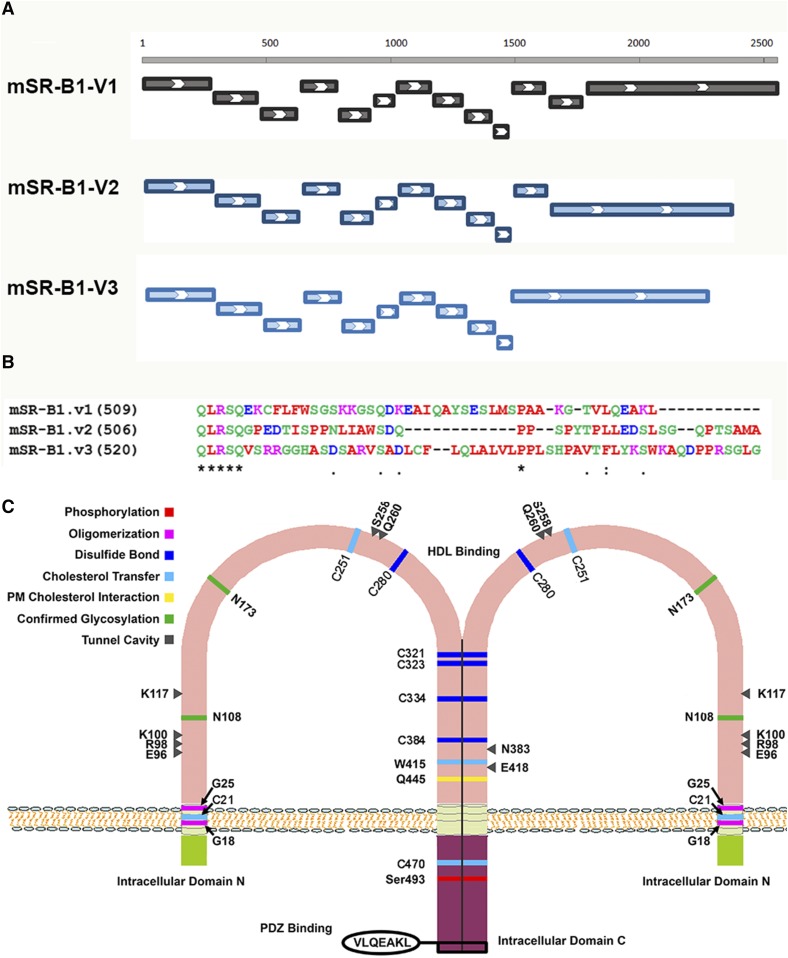
Fig. 1.
Fig. 1.
Gene exon organization (A) and C-termini sequences (B) of mouse SR-B1 variants and structural features of SR-B1 (C). A: Exon organization. Mouse SR-B1 variant 1 has 13 exons and 509 amino acids. Variant 2 arises from alternative splicing at the C-terminal end resulting in 12 exons and 506 amino acids. Genomic analysis shows that variant 3 has 11 exons and 520 amino acids. B: C-terminal sequences of mouse SR-B1 variants. C: Structural features of SR-B1. SR-B1 has an N-terminal and a C-terminal intracellular domain and an extended extracellular ectodomain. Several structural features are important for the function of SR-B1. An N-terminal transmembrane glycine motif (G15_G18_G25) was shown to be required for oligomerization and lipid transport. The C terminal of SR-B1 also contains sequences important for oligomerization. Six conserved cysteine residues (C251, C280, C321, C323, C334, and C384) found in the ectodomain of SR-B1 were also demonstrated to be involved in dimer/oligomer formation. Analysis of human SR-B1 revealed 11 putative N-linked glycosylation sites. Mutational analysis showed the importance of Asn-108 and Asn-173 for plasma membrane localization and for the ability to transfer lipid from HDL to cells. Structural analysis of SR-B1 homolog, LIMP-2, showed that there are eight amino acids that work coordinately to form a tunnel cavity that spans the entire length of the ectodomain allowing facilitated lipid transfer. E96, R98, K100, K117, W258, Q260, N383, and E418 are the amino acids that comprise the tunnel cavity to facilitate lipid transfer of SR-B1. The C-terminal intracellular domain contains an interacting domain (VLQEAKL) for binding with PDZ domain-containing proteins, through which the function of SR-B1 is regulated in a tissue-specific manner.
Fig. 2.
Fig. 2.
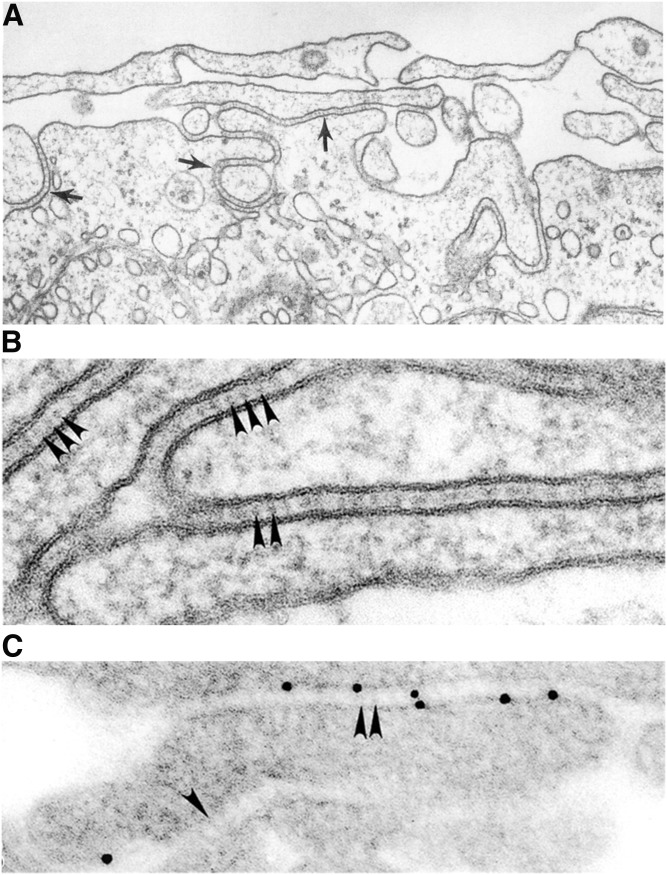
Microvillar channels in murine adrenocortical cells. A: Ultrastructure appearance of microvilli (denoted by arrows). B: High magnification of microvillar channels containing HDL (denoted by arrowheads). C: Localization of immunogold-labeled HDL in microvillar channels. This research was originally published in the Journal of Lipid Research (84). © The American Society for Biochemistry and Molecular Biology.
Fig. 3.
Fig. 3.
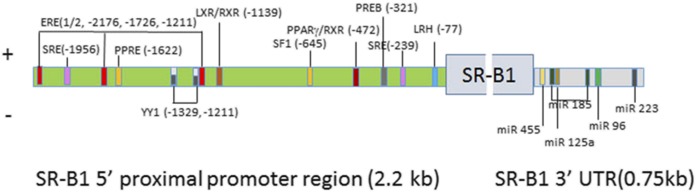
Regulation of SR-B1 expression. The 5′ proximal 2.2 kb region of the rat Scarb1 promoter contains binding sites for various regulatory factors for positive and negative regulation of Scarb1 expression. The 3′ UTR of the rat Scarb1 gene contains binding sites for miR-185, miR-96, and miR-223 for negative regulation of SR-B1 expression in liver and macrophages, as well as binding sites for miR-125a and miR-455 for negative regulation of SR-B1expression in steroidogenic tissues.
Fig. 4.
Fig. 4.
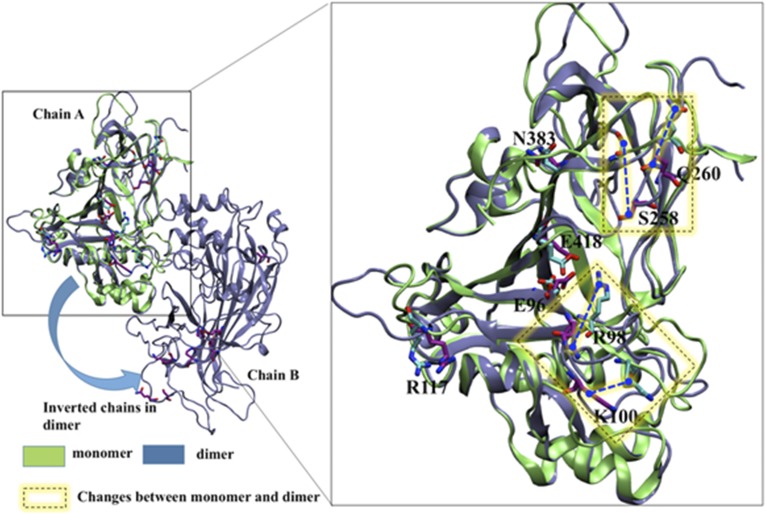
Structure of human SR-B1, both as a monomer and as a dimer. The monomer and dimer forms of human SR-B1 were built separately through homology modeling using MODELLER (246). From 200 generated models, the top ranked models were chosen for energy minimization through Amber molecular dynamics simulation (247). The energy-minimized structures were used for the structural analysis. The residues comprising the tunnel cavity are labeled, and the regions where conformational differences are observed between monomers and dimers are highlighted in yellow squares.

References

    1. Russell D. W. 2009. Fifty years of advances in bile acid synthesis and metabolism. J. Lipid Res. 50 (Suppl.): S120–S125. - PMC - PubMed
    1. Miller W. L., and Bose H. S.. 2011. Early steps in steroidogenesis: intracellular cholesterol trafficking. J. Lipid Res. 52: 2111–2135. - PMC - PubMed
    1. Glass C., Pittman R. C., Weinstein D. B., and Steinberg D.. 1983. Dissociation of tissue uptake of cholesterol ester from that of apoprotein A-I of rat plasma high density lipoprotein: selective delivery of cholesterol ester to liver, adrenal, and gonad. Proc. Natl. Acad. Sci. USA. 80: 5435–5439. - PMC - PubMed
    1. Brown M. S., and Goldstein J. L.. 1986. A receptor-mediated pathway for cholesterol homeostasis. Science. 232: 34–47. - PubMed
    1. Quarfordt S., Hanks J., Jones R. S., and Shelburne F.. 1980. The uptake of high density lipoprotein cholesteryl ester in the perfused rat liver. J. Biol. Chem. 255: 2934–2937. - PubMed

Publication types