. 2018 May 2;8(1):6889.
doi: 10.1038/s41598-018-25236-8.

Wolbachia significantly impacts the vector competence of Aedes aegypti for Mayaro virus

Affiliations

Wolbachia significantly impacts the vector competence of Aedes aegypti for Mayaro virus

Thiago Nunes Pereira et al. Sci Rep. .

Abstract

Wolbachia, an intracellular endosymbiont present in up to 70% of all insect species, has been suggested as a sustainable strategy for the control of arboviruses such as Dengue, Zika and Chikungunya. As Mayaro virus outbreaks have also been reported in Latin American countries, the objective of this study was to evaluate the vector competence of Brazilian field-collected Ae. aegypti and the impact of Wolbachia (wMel strain) upon this virus. Our in vitro studies with Aag2 cells showed that Mayaro virus can rapidly multiply, whereas in wMel-infected Aag2 cells, viral growth was significantly impaired. In addition, C6/36 cells seem to have alterations when infected by Mayaro virus. In vivo experiments showed that field-collected Ae. aegypti mosquitoes are highly permissive to Mayaro virus infection, and high viral prevalence was observed in the saliva. On the other hand, Wolbachia-harboring mosquitoes showed significantly impaired capability to transmit Mayaro virus. Our results suggest that the use of Wolbachia-harboring mosquitoes may represent an effective mechanism for the reduction of Mayaro virus transmission throughout Latin America.


Conflict of interest statement

The authors declare no competing interests.

Figures
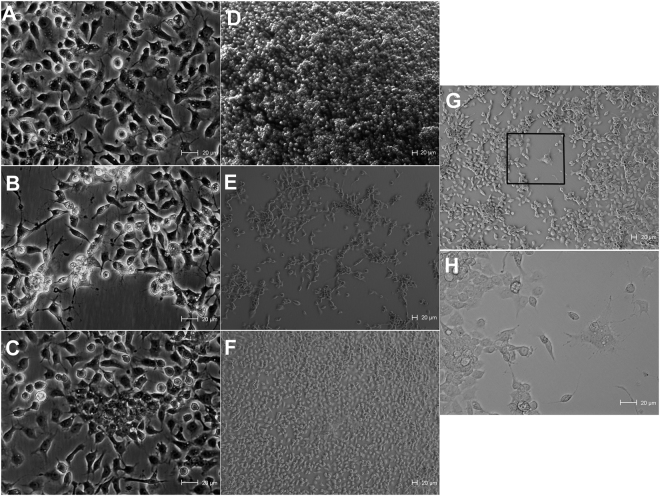
Figure 1
Figure 1
Optical microscopy of Ae. albopictus (C6/36) cell cultures infected by Mayaro or DENV. Uninfected C6/36 cells (A), MAYV-infected C6/36 cells (B), DENV-1-infected C6/36 cells (C). Cells were cultured in flasks and evaluated directly under optical microscopy without any preparation. These images were taken at 4 days post-infection (original magnification = 320x). Uninfected C6/36 cells (D), MAYV-infected C6/36 cells (E), DENV-1-infected C6/36 cells (F), these images were taken at 6 days post-infection (magnification = 100x). MAYV-infected C6/36 cells at 5 days post-infection (magnification = 100x) (G) the rare cytopathic effect caused by MAYV and (H) highlight for the cytopathic effect (magnification = 320x).
Figure 2
Figure 2
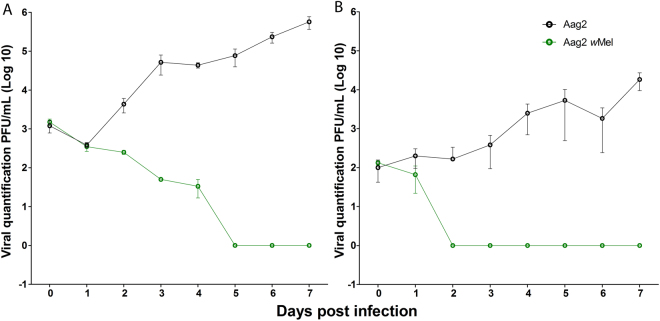
Kinetics of MAYV viral growth and the Wolbachia blocking effect. (A,B) Aag2 cells were challenged with two different MOIs: (A) MOI 0.1 and (B) MOI 0.01. Aag2 without Wolbachia (black line) maintained steady growth for both MOIs. The Aag2-wMel cell line (green line) had significant effect on MAYV growth. MOI of 0.1 exhibited a later blocking effect. Viral titration of MAYV-containing supernatant was determined by plaque assay for 3 days after infection in Vero cells. Cells were infected in triplicate, and the values represent means ± SD.
Figure 3
Figure 3
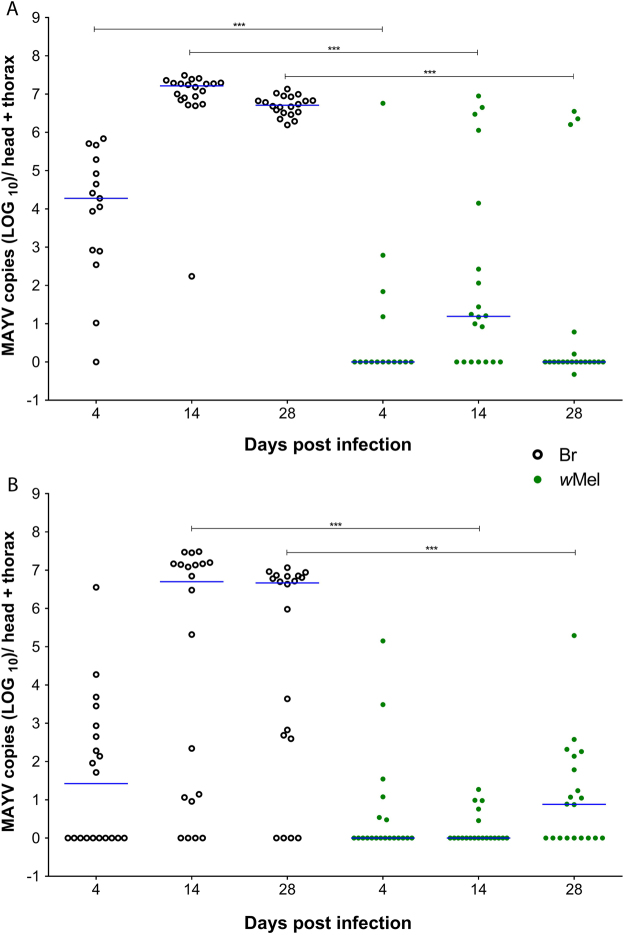
Susceptibility of Aedes aegypti and the ability of Wolbachia to block MAYV. (A,B) Mosquitoes were orally challenged with either (A) fresh virus or (B) frozen virus samples. Br mosquitoes (black circle) and wMel Wolbachia (green circle). Each circle represents a single adult female, and the blue lines indicate the median number of MAYV copies in each treatment. ∗∗∗P < 0.0001; Mann-Whitney U test.
Figure 4
Figure 4
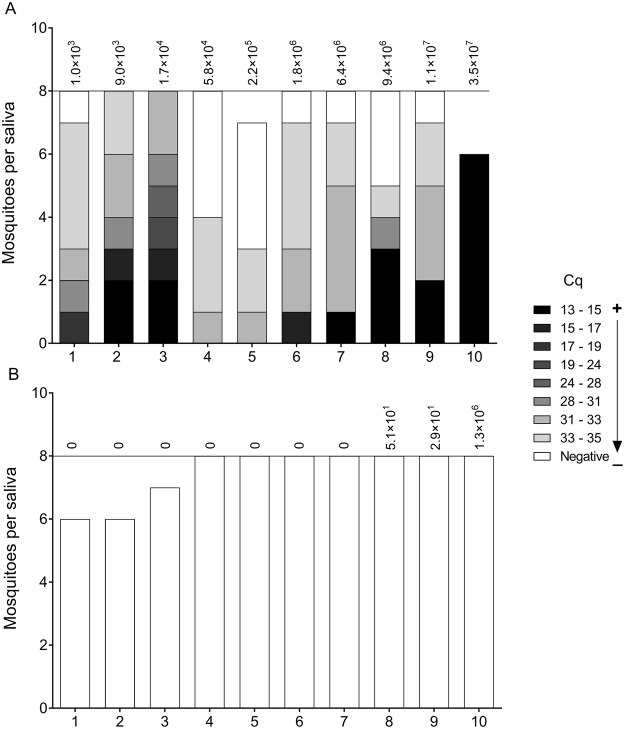
Injection of saliva into naive mosquitoes. Saliva was collected from Br and wMel mosquitoes infected with fresh virus at 7 dpi. All of the Br saliva samples (A) were infectious, but no infections were observed when saliva samples originated from wMel mosquitoes (B). The color gradient indicates the infection level and varies according to the quantification cycle (Cq). The most infected are shown in black and there is a color gradient toward the uninfected in white. Values at the top of the graphs show the MAYV copy numbers in the head and thorax of the mosquito that the saliva was collected from (as determined by RT-qPCR).
Figure 5
Figure 5
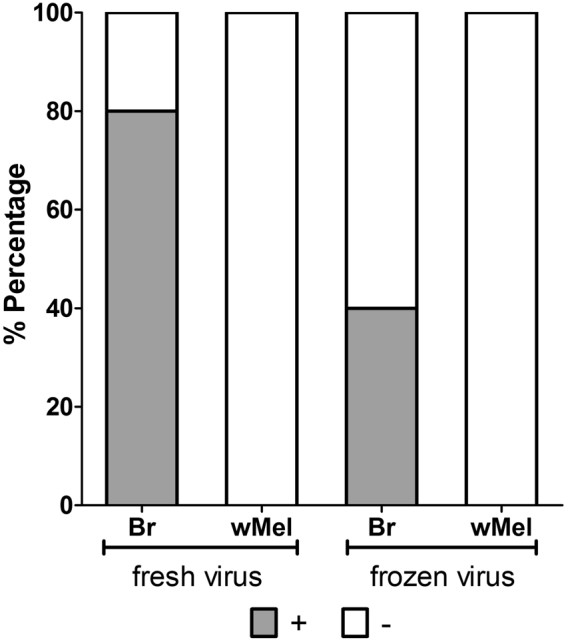
Quantification of MAYV directly from mosquito saliva through RT-PCR at 28 dpi. It was only possible to detect virus in Br mosquitoes (fresh and frozen). However, the numbers virus copies were lower when using frozen virus. It was not possible to detect virus in wMel mosquito saliva. The Fisher’s exact test showed no significant differences between fresh and frozen virus for Br mosquitoes (P = 0.1698).

References

    1. Lourenço de Oliveira, R. Biologia e comportamento do vetor. in DengueTeorias e práticas (ed. Valle, D.)75–92 (2015).
    1. Carvalho FD, Moreira LA. Why is Aedes aegypti Linnaeus so Successful as a Species? Neotrop. Entomol. 2017;46:243–255. doi: 10.1007/s13744-017-0520-4. - DOI - PubMed
    1. Anderson CR, Wilbur GD, George HW, Norman WA, Alick AR. Mayaro Virus: A New Human Disease Agent II. Isolation from Blood of Patients in Trinidad, B.W.I.1. Am. Soc. Trop. Med. Hyg. 1957;6:1012–1016. doi: 10.4269/ajtmh.1957.6.1012. - DOI - PubMed
    1. Tchankouo-Nguetcheu S, et al. Differential protein modulation in midguts of Aedes aegypti infected with chikungunya and dengue 2 viruses. PLoS One. 2010;5:e13149. doi: 10.1371/journal.pone.0013149. - DOI - PMC - PubMed
    1. Staples EJ, Fischer M. Chikungunya Virus in the Americas - What a Vectorborne Pathogen Can Do. N. Engl. J. Med. 2014;371:885–887. doi: 10.1056/NEJMp1407698. - DOI - PMC - PubMed

Publication types