


Household Chaos and Children's Cognitive and Socio-Emotional Development in Early Childhood: Does Childcare Play a Buffering Role?
- PMID: 29720785
- PMCID: PMC5926246
- DOI: 10.1016/j.ecresq.2015.09.003
Household Chaos and Children's Cognitive and Socio-Emotional Development in Early Childhood: Does Childcare Play a Buffering Role?
Abstract
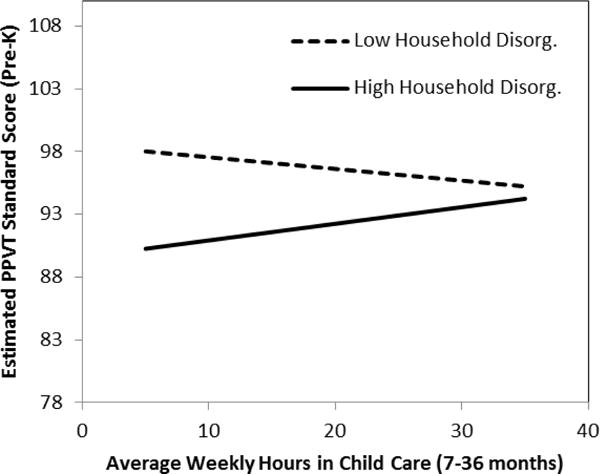
Evidence suggests that household chaos is associated with less optimal child outcomes. Yet, there is an increasing indication that children's experiences in childcare may buffer them against the detrimental effects of such environments. Our study aims were to test: (1) whether children's experiences in childcare mitigated relations between household chaos and children's cognitive and social development, and (2) whether these (conditional) chaos effects were mediated by links between chaos and executive functioning. Using data from The Family Life Project (n = 1,235)-a population-based sample of families from low-income, rural contexts-our findings indicated that household disorganization in early childhood was predictive of worse cognitive and social outcomes at approximately age five. However, these relations were substantially attenuated for children attending greater childcare hours. Subsequent models indicated that the conditional associations between household disorganization and less optimal outcomes at age five were mediated by conditional links between disorganization and less optimal executive functioning.
Keywords: Childcare; Cognitive Development; Executive Function; Household Chaos; Social Development.
Figures



References
-
- Bayley N. Bayley Scales of Infant Development. New York, NY: The Psychological Corporation; 1969.
-
- Benjamini Y, Hochberg Y. Controlling the false discovery rate: A practical and powerful approach to multiple testing. Journal of the Royal Statistical Society. Series B (Methodological) 1995;57(1):289–300. doi: 10.2307/2346101. - DOI
Grants and funding
LinkOut - more resources
Full Text Sources
Other Literature Sources
Medical