


Multicomponent Exercise Improves Physical Functioning but Not Cognition and Hemodynamic Parameters in Elderly Osteoarthritis Patients Regardless of Hypertension
- PMID: 29721504
- PMCID: PMC5867618
- DOI: 10.1155/2018/3714739
Multicomponent Exercise Improves Physical Functioning but Not Cognition and Hemodynamic Parameters in Elderly Osteoarthritis Patients Regardless of Hypertension
Abstract
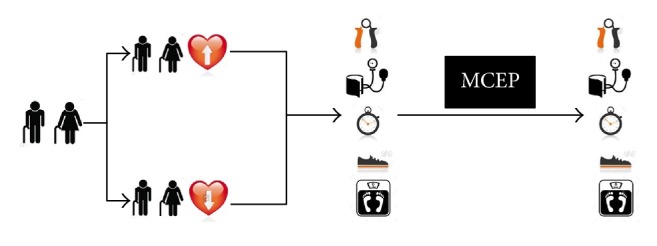
The present study aimed to investigate the impact of a 6-month multicomponent exercise program (MCEP) on physical function, cognition, and hemodynamic parameters of elderly normotensive (NTS) and hypertensive (HTS) osteoarthritis patients. A total of 99 elderly osteoarthritis patients (44 NTS and 55 HTS) were recruited and submitted to functional, cognitive, and hemodynamic evaluations before and after six months of a MCEP. The program of exercise was performed twice a week at moderate intensity. The physical exercises aggregated functional and walking exercises. Results indicate that 6 months of MCEP were able to improve one-leg stand and mobility (walking speeds) of osteoarthritis patients regardless of hypertension. On the other hand, cognitive and hemodynamic parameters were not altered after the MCEP. The findings of the present study demonstrate that 6 months of MCEP were able to improve the physical functioning (i.e., usual and maximal walking speed and balance) of osteoarthritis patients regardless of hypertensive condition.
Figures
Similar articles
-
Multicomponent Exercise on Physical Function, Cognition and Hemodynamic Parameters of Community-Dwelling Older Adults: A Quasi-Experimental Study.Int J Environ Res Public Health. 2019 Jun 20;16(12):2184. doi: 10.3390/ijerph16122184. Int J Environ Res Public Health. 2019. PMID: 31226762 Free PMC article.
-
Effects of Multicomponent Exercise on Functional and Cognitive Parameters of Hypertensive Patients: A Quasi-Experimental Study.J Aging Res. 2017;2017:1978670. doi: 10.1155/2017/1978670. Epub 2017 Mar 19. J Aging Res. 2017. PMID: 28409030 Free PMC article.
-
Multicomponent Exercise Improves Hemodynamic Parameters and Mobility, but Not Maximal Walking Speed, Transfer Capacity, and Executive Function of Older Type II Diabetic Patients.Biomed Res Int. 2018 Feb 14;2018:4832851. doi: 10.1155/2018/4832851. eCollection 2018. Biomed Res Int. 2018. PMID: 29651436 Free PMC article. Clinical Trial.
-
The role of exercise in the prevention and treatment of osteoporosis and osteoarthritis.Nurs Clin North Am. 2000 Mar;35(1):209-21. Nurs Clin North Am. 2000. PMID: 10673576 Review.
-
Osteoarthritis and therapeutic exercise.Am J Phys Med Rehabil. 2006 Nov;85(11 Suppl):S69-78; quiz S79-81. doi: 10.1097/01.phm.0000245509.06418.20. Am J Phys Med Rehabil. 2006. PMID: 17079981 Review. No abstract available.
Cited by
-
Effect of agility ladder training with a cognitive task (dual task) on physical and cognitive functions: a randomized study.Front Public Health. 2023 Jun 21;11:1159343. doi: 10.3389/fpubh.2023.1159343. eCollection 2023. Front Public Health. 2023. PMID: 37415705 Free PMC article. Clinical Trial.
-
Lower-limb locomotor function studies using walking speed as an assessment indicator: A bibliometric review from 2014 to 2024.Medicine (Baltimore). 2025 Jun 13;104(24):e42756. doi: 10.1097/MD.0000000000042756. Medicine (Baltimore). 2025. PMID: 40527814 Free PMC article. Review.
-
Multicomponent Exercise on Physical Function, Cognition and Hemodynamic Parameters of Community-Dwelling Older Adults: A Quasi-Experimental Study.Int J Environ Res Public Health. 2019 Jun 20;16(12):2184. doi: 10.3390/ijerph16122184. Int J Environ Res Public Health. 2019. PMID: 31226762 Free PMC article.
-
Resistance Training Combined With Cognitive Training Increases Brain Derived Neurotrophic Factor and Improves Cognitive Function in Healthy Older Adults.Front Psychol. 2022 Oct 14;13:870561. doi: 10.3389/fpsyg.2022.870561. eCollection 2022. Front Psychol. 2022. PMID: 36312128 Free PMC article.
-
The Effects of Multicomponent Training on Clinical, Functional, and Psychological Outcomes in Cardiovascular Disease: A Narrative Review.Medicina (Kaunas). 2025 Apr 29;61(5):822. doi: 10.3390/medicina61050822. Medicina (Kaunas). 2025. PMID: 40428780 Free PMC article. Review.
References
-
- Ogunbode A. M., Adebusoye L. A., Olowookere O. O., Alonge T. O. Physical functionality and self-rated health status of adult patients with knee osteoarthritis presenting in a primary care clinic. Ethiopian Journal of Health Sciences. 2014;24(4):319–328. doi: 10.4314/ejhs.v24i4.7. - DOI - PMC - PubMed
Publication types
MeSH terms
LinkOut - more resources
Full Text Sources
Other Literature Sources
Medical
