


Association between serum lipid levels, osteoprotegerin and depressive symptomatology in psychotic disorders
- PMID: 29721726
- PMCID: PMC6739273
- DOI: 10.1007/s00406-018-0897-z
Association between serum lipid levels, osteoprotegerin and depressive symptomatology in psychotic disorders
Abstract
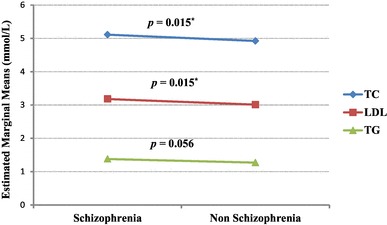
Although the relationship between positive and negative symptoms of psychosis and dyslipidemia has been thoroughly investigated in recent studies, the potential link between depression and lipid status is still under-investigated. We here examined the association between lipid levels and depressive symptomatology in patients with psychotic disorders, in addition to their possible inflammatory associations. Participants (n = 652) with the following distribution: schizophrenia, schizophreniform and schizoaffective disorder (schizophrenia group, n = 344); bipolar I, II, NOS, and psychosis NOS (non-schizophrenia group, n = 308) were recruited consecutively from the Norwegian Thematically Organized Psychosis (TOP) Study. Clinical data were obtained by Positive and Negative Syndrome Scale (PANSS), and Calgary Depression Scale for Schizophrenia (CDSS). Blood samples were analyzed for total cholesterol (TC), low-density lipoprotein (LDL), triglyceride (TG), C-reactive protein (CRP), soluble tumor necrosis factor receptor 1(sTNF-R1), osteoprotegerin (OPG), and interleukin 1 receptor antagonist (IL-1Ra). After adjusting for age, gender, BMI, smoking, and dyslipidemia-inducing antipsychotics, TC and LDL scores showed significant associations with depression [β = 0.13, p = 0.007; β = 0.14, p = 0.007], and with two inflammatory markers: CRP [β = 0.14, p = 0.007; β = 0.16, p = 0.007] and OPG [β = 0.14, p = 0.007; β = 0.11, p = 0.007]. Total model variance was 17% for both analyses [F(12, 433) = 8.42, p < 0.001; F(12, 433) = 8.64, p < 0.001]. Current findings highlight a potential independent role of depression and inflammatory markers, CRP and OPG in specific, in the pathophysiology of dyslipidemia in psychotic disorders.
Keywords: Bipolar; Cholesterol; Cytokines; Depression; Dyslipidemia; Schizophrenia.
Conflict of interest statement
On behalf of all authors, the corresponding author states that there is no conflict of interest.
Figures
References
-
- Saari K, Jokelainen J, Veijola J, Koponen H, Jones PB, Savolainen M, Jarvelin MR, Lauren L, Isohanni M, Lindeman S. Serum lipids in schizophrenia and other functional psychoses: a general population northern Finland 1966 birth cohort survey. Acta Psychiatr Scand. 2004;110(4):279–285. doi: 10.1111/j.1600-0447.2004.00358.x. - DOI - PubMed
-
- Andreassen OA, Djurovic S, Thompson WK, Schork AJ, Kendler KS, O’Donovan MC, Rujescu D, Werge T, van de Bunt M, Morris AP, McCarthy MI, International Consortium for Blood Pressure G, Diabetes Genetics R, Meta-analysis C, Psychiatric Genomics Consortium Schizophrenia Working G. Roddey JC, McEvoy LK, Desikan RS, Dale AM. Improved detection of common variants associated with schizophrenia by leveraging pleiotropy with cardiovascular-disease risk factors. Am J Human Genet. 2013;92(2):197–209. doi: 10.1016/j.ajhg.2013.01.001. - DOI - PMC - PubMed
MeSH terms
Substances
Grants and funding
- 609020 - Scientia Fellows/European Union Seventh Framework Programme (FP7-PEOPLE-2013-COFUND)
- 223273/F50/Research Council of Norway to NORMENT CoE, under the Centres of Excellence funding scheme
- SKGJ-MED-008/Stiftelsen Kristian Gerhard Jebsen
- 2014102/Regional Health Authority South Eastern Norway: "Regional Research Network Psychotic Disorders"
LinkOut - more resources
Full Text Sources
Other Literature Sources
Medical
Research Materials
Miscellaneous
