


Bisretinoid Photodegradation Is Likely Not a Good Thing
- PMID: 29721969
- PMCID: PMC6745705
- DOI: 10.1007/978-3-319-75402-4_49
Bisretinoid Photodegradation Is Likely Not a Good Thing
Abstract
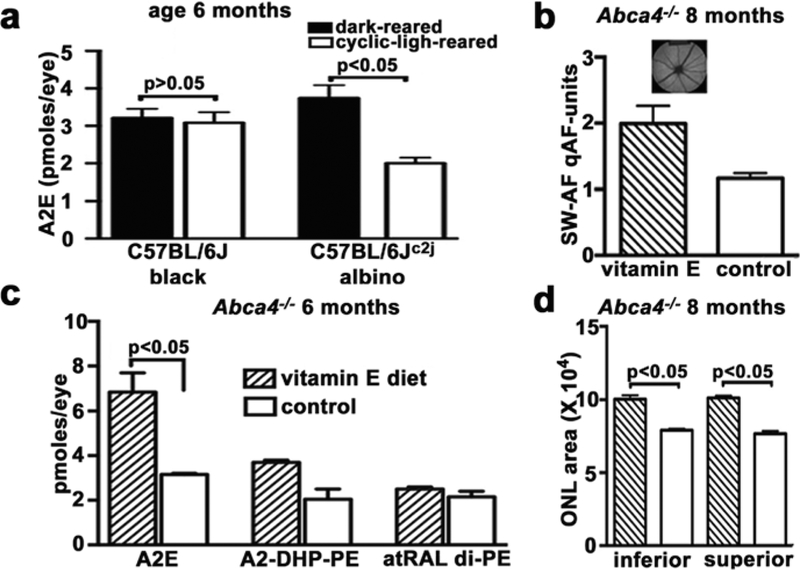
Retinaldehyde adducts (bisretinoids) accumulate in retinal pigment epithelial (RPE) cells as lipofuscin. Bisretinoids are implicated in some inherited and age-related forms of macular degeneration that lead to the death of RPE cells and diminished vision. By comparing albino and black-eyed mice and by rearing mice in darkness and in cyclic light, evidence indicates that bisretinoid fluorophores undergo photodegradation in the eye (Ueda et al. Proc Natl Acad Sci 113:6904-6909, 2016). Given that the photodegradation products modify and impair cellular and extracellular molecules, these processes likely impart cumulative damage to retina.
Keywords: ABCA4-associated disease; Age-related macular degeneration; Bisretinoid; Lipofuscin; Retinal degeneration; Retinaldehyde; Visual cycle; Vitamin E.
Figures
References
-
- Ben-Shabat S, Itagaki Y, Jockusch S et al. (2002) Formation of a nona-oxirane from A2E, a lipofuscin fluorophore related to macular degeneration, and evidence of singlet oxygen involvement. Angew Chem Int Ed 41:814–817 - PubMed
-
- Cruickshanks KJ, Klein R, Klein BEK et al. (2001) Sunlight and the 5-year incidence of early age-related maculopathy: the Beaver Dam Eye Study. Arch Ophthalmol 119:246–250 - PubMed
-
- Farboud B, Aotaki-Keen A, Miyata T et al. (1999) Development of a polyclonal antibody with broad epitope specificity for advanced glycation endproducts and localization of these epitopes in Bruch’s membrane of the aging eye. Mol Vis 5:11. - PubMed
Publication types
MeSH terms
Substances
Grants and funding
LinkOut - more resources
Full Text Sources
Other Literature Sources
Medical
