Review
. 2018 Jul 1:77:75-87.
doi: 10.1016/j.niox.2018.04.010. Epub 2018 May 1.

The nitric oxide-guanylate cyclase pathway and glaucoma

Affiliations
Review

The nitric oxide-guanylate cyclase pathway and glaucoma

Lauren K Wareham et al. Nitric Oxide. .

Abstract

Glaucoma is a prevalent optic neuropathy characterized by the progressive dysfunction and loss of retinal ganglion cells (RGCs) and their optic nerve axons, which leads to irreversible visual field loss. Multiple risk factors for the disease have been identified, but elevated intraocular pressure (IOP) remains the primary risk factor amenable to treatment. Reducing IOP however does not always prevent glaucomatous neurodegeneration, and many patients progress with the disease despite having IOP in the normal range. There is increasing evidence that nitric oxide (NO) is a direct regulator of IOP and that dysfunction of the NO-Guanylate Cyclase (GC) pathway is associated with glaucoma incidence. NO has shown promise as a novel therapeutic with targeted effects that: 1) lower IOP; 2) increase ocular blood flow; and 3) confer neuroprotection. The various effects of NO in the eye appear to be mediated through the activation of the GC- guanosine 3:5'-cyclic monophosphate (cGMP) pathway and its effect on downstream targets, such as protein kinases and Ca2+ channels. Although NO-donor compounds are promising as therapeutics for IOP regulation, they may not be ideal to harness the neuroprotective potential of NO signaling. Here we review evidence that supports direct targeting of GC as a novel pleiotrophic treatment for the disease, without the need for direct NO application. The identification and targeting of other factors that contribute to glaucoma would be beneficial to patients, particularly those that do not respond well to IOP-dependent interventions.


Figures

Fig. 1.
Fig. 1.
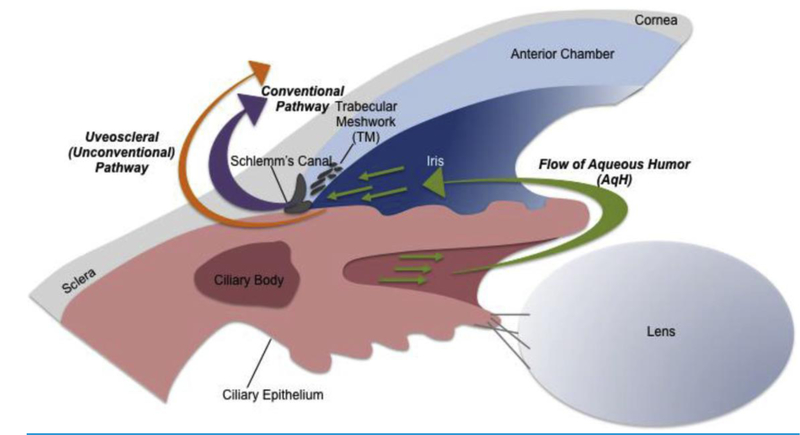
Flow of aqueous humor (AqH) in the eye. AqH is produced at the ciliary body and flows (green arrows) through one of two independent pathways that regulate AqH dynamics: the conventional pathway through the trabecular meshwork (TM) and Schlemm's canal (purple arrow) and the non-conventional pathway via the uveoscleral tract (orange arrow). Intraocular pressure (IOP) in the eye is established by the balance of (AqH) production and elimination in the anterior chamber.
Fig. 2.
Fig. 2.. The NO-GC-1-cGMP pathway.
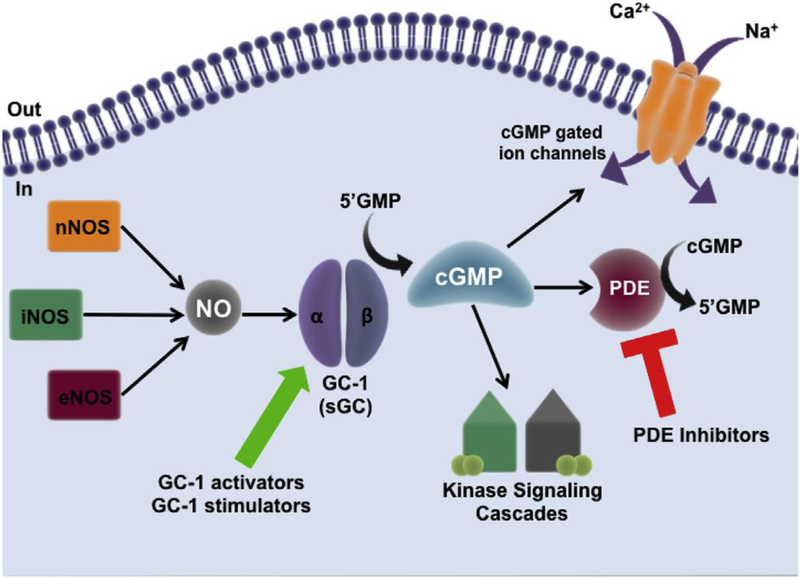
NO is produced from L-arginine by nitric oxide synthase (NOS) of which there are three isoforms: neuronal NOS1 (nNOS), endothelial NOS3 (eNOS) and inducible NOS2 (iNOS). NO targets guanylate cyclase-1 (GC-1), a heterodimeric protein capable of converting GMP to cGMP. cGMP produced by GC-1 can target cGMP-gated ion channels, and activate downstream kinase signaling cascades. Phosphodiesterase enzymes (PDE) bind to cGMP and catalyse its breakdown into GMP – PDEs act as important regulators of signal transduction mediated by cGMP. cGMP bioavailability in the cell can be modulated in two ways: 1) through the use of GC-1 stimulators and activators, which increase production of cGMP, or, 2) through the use of PDE inhibitors which prevent the breakdown of cGMP in the cell.
Fig. 3.
Fig. 3.. cGMP-mediated modulation of IOP through increase in AqH outflow.
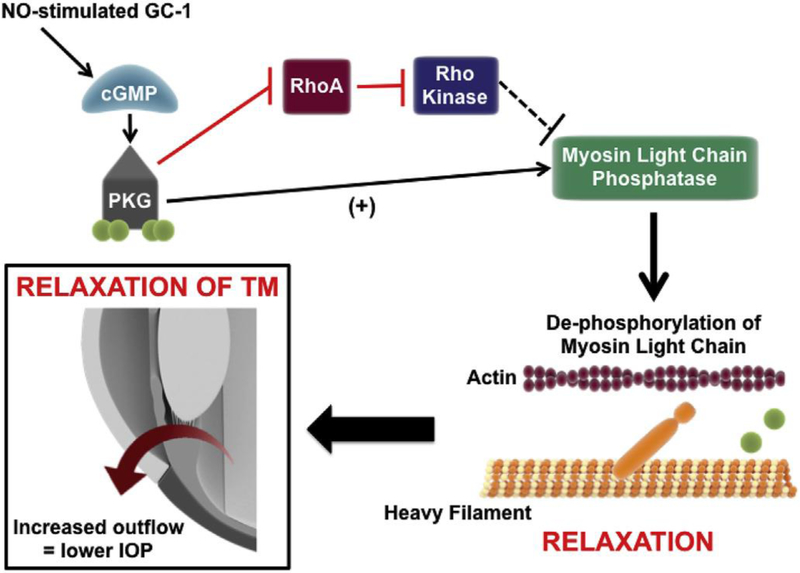
NO triggers production of cGMP by GC-1. cGMP activates protein kinase G (PKG). Activated PKG can phosphorylate numerous targets with multiple downstream effects, including inhibition of Rho A, thus preventing inhibition of myosin phosphatase by Rho Kinase. In addition to inhibition of Rho A, activated PKG can directly activate myosin light chain phosphatase (MLCP). Subsequent dephosphorylation of the regulatory light chain of myosin by MLCP prevents actin–myosin interaction, promoting cell relaxation. This in turn leads to a widening of the intercellular spaces in the juxtacanalicular TM and Schlemm's canal, thus facilitating conventional AqH outflow and relieving IOP.
Fig. 4. –
Fig. 4. –. GC-1-directed therapy for glaucoma is pleiotrophic in its action.
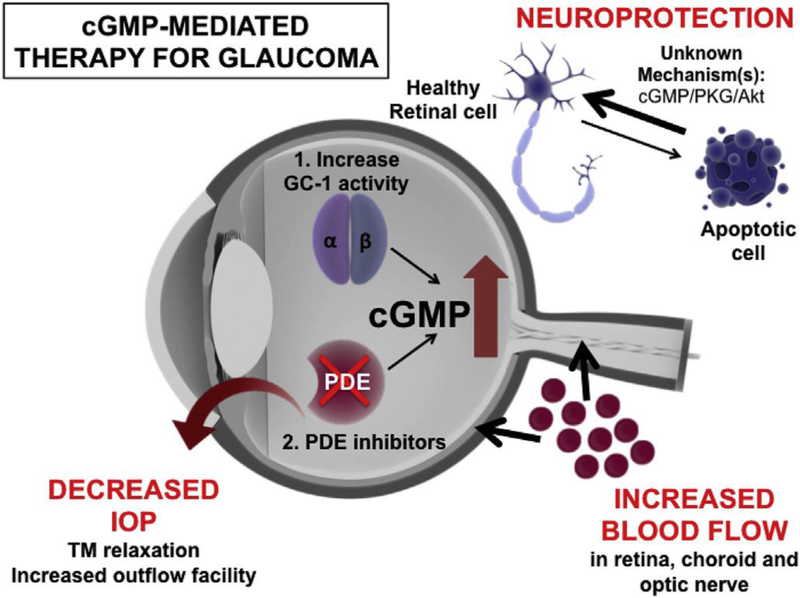
Increased levels of cGMP have been shown to have pleiotrophic targets that are beneficial in the treatment of glaucoma, including: relaxation of the TM to increase outflow facility which leads to decreases in IOP; increasing blood flow to the retina, choroid and optic nerve head; prevention of degeneration of retinal ganglion cells through mechanisms that may involve downstream kinase pathways. cGMP levels in the eye can be increased in two ways: 1) through the use of GC-1 stimulators and activators, which aim to increase production of cGMP; or 2) through the use of PDE inhibitors which prevent the breakdown of cGMP in the cell to increase bioavailability.

References

    1. Tham YC, Li X, Wong TY, Quigley HA, Aung T and Cheng CY. Global prevalence of glaucoma and projections of glaucoma burden through 2040: a systematic review and meta-analysis. Ophthalmology. 2014;121:2081–90. - PubMed
    1. Quigley HA and Broman AT. The number of people with glaucoma worldwide in 2010 and 2020. Br J Ophthalmol. 2006;90:262–7. - PMC - PubMed
    1. Calkins DJ. Critical pathogenic events underlying progression of neurodegeneration in glaucoma. Prog Retin Eye Res. 2012;31:702–19. - PMC - PubMed
    1. Heijl A, Leske MC, Bengtsson B, Hyman L, Bengtsson B, Hussein M and Early Manifest Glaucoma Trial G. Reduction of intraocular pressure and glaucoma progression: results from the Early Manifest Glaucoma Trial. Arch Ophthalmol. 2002;120:1268–79. - PubMed
    1. Iester M, De Feo F and Douglas GR. Visual field loss morphology in high- and normal-tension glaucoma. J Ophthalmol. 2012;2012:327326. - PMC - PubMed