Review
. 2018 Aug;129(8):1720-1747.
doi: 10.1016/j.clinph.2018.03.042. Epub 2018 Apr 17.

IFCN-endorsed practical guidelines for clinical magnetoencephalography (MEG)

Affiliations
Review

IFCN-endorsed practical guidelines for clinical magnetoencephalography (MEG)

Riitta Hari et al. Clin Neurophysiol. 2018 Aug.

Abstract

Magnetoencephalography (MEG) records weak magnetic fields outside the human head and thereby provides millisecond-accurate information about neuronal currents supporting human brain function. MEG and electroencephalography (EEG) are closely related complementary methods and should be interpreted together whenever possible. This manuscript covers the basic physical and physiological principles of MEG and discusses the main aspects of state-of-the-art MEG data analysis. We provide guidelines for best practices of patient preparation, stimulus presentation, MEG data collection and analysis, as well as for MEG interpretation in routine clinical examinations. In 2017, about 200 whole-scalp MEG devices were in operation worldwide, many of them located in clinical environments. Yet, the established clinical indications for MEG examinations remain few, mainly restricted to the diagnostics of epilepsy and to preoperative functional evaluation of neurosurgical patients. We are confident that the extensive ongoing basic MEG research indicates potential for the evaluation of neurological and psychiatric syndromes, developmental disorders, and the integrity of cortical brain networks after stroke. Basic and clinical research is, thus, paving way for new clinical applications to be identified by an increasing number of practitioners of MEG.

Keywords: Alzheimer’s disease and dementia; Analysis and interpretation; Artifacts; Brain maturation and development; Clinical neurophysiology; Dyslexia; Electroencephalography; Epilepsy; Evoked and event-related responses; Guidelines; Hepatic encephalopathy; Magnetoencephalography; Neural oscillations; Neuropsychiatric disorders; Pain; Parkinson’s disease; Preoperative evaluation; Source modeling; Spontaneous brain activity; Stroke; Transient and steady-state responses; Traumatic brain injury.


Figures

Fig. 1
Fig. 1
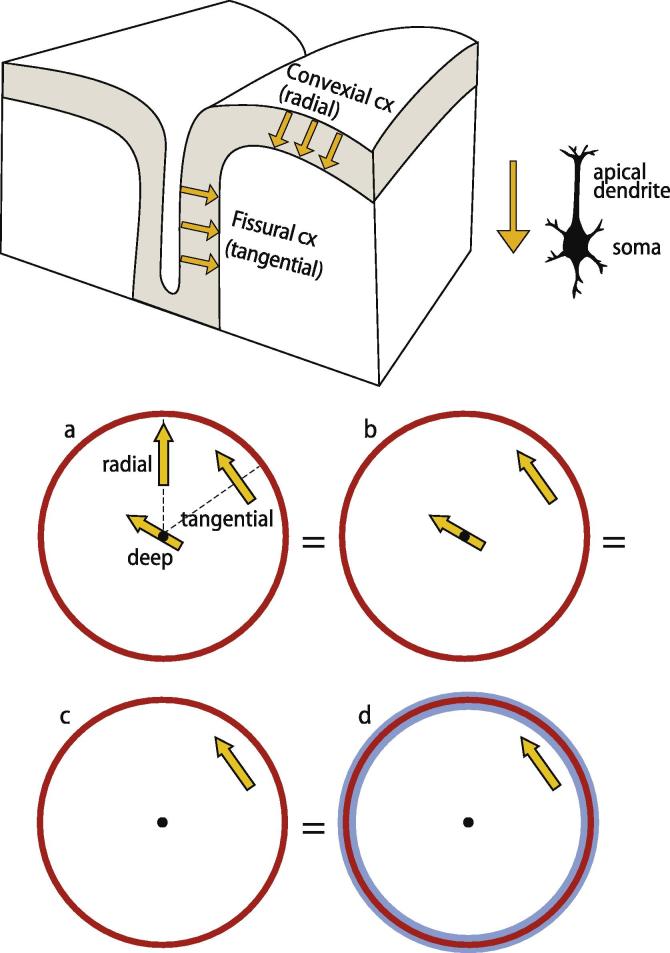
Top: Schematic presentation of convexial and fissural currents in a slab of cortex. The main axis of pyramidal neurons, which are considered to be the main sources of the MEG signals, is perpendicular with respect to the cortical surface. Thus, currents in the walls of fissures are tangential with respect to skull surface and, therefore, are the main contributors of MEG signals. The current direction as such depends on the activation type (excitation, inhibition) of the neuron and the site (superficial, deep) of activation. For more details, see, e.g., Hari and Puce (2017). Modified from Hari and Puce (2017) with the permission of Oxford University Press. Bottom: Currents in the brain and “brain in a nutshell”. Panel (a) shows all possible current orientations in a sphere. The tangential source produces a magnetic field outside the sphere (corresponding to the MEG signals) and is the same as in panels (b–d) exactly because radial currents do not produce external magnetic fields (and as any current in the middle of the sphere is radial). Moreover, concentric inhomogeneities, as in (d) do not dampen nor smear the magnetic field. In other words, all situations (a–d) are equal from MEG's point of view. Modified from Hari and Puce (2017) with the permission of Oxford University Press; the original figure is from Hari et al. (2000).
Fig. 2
Fig. 2
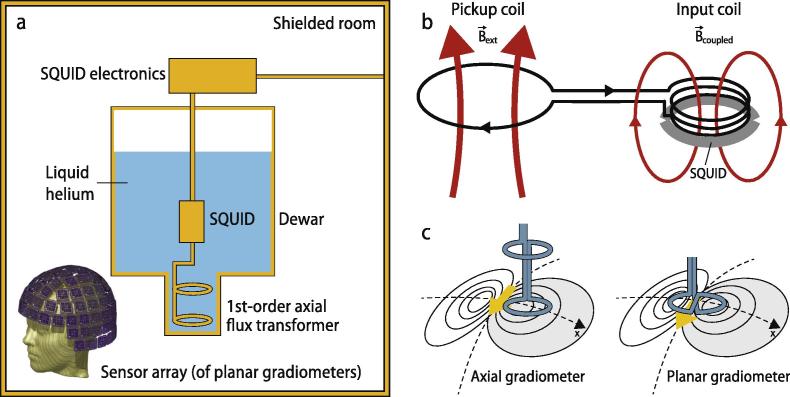
Schematics of MEG instrumentation. (a) A single-channel axial gradiometer and associated SQUID inside a dewar filled with liquid helium. Bottom depicts the sensor array of a 306-channel MEG helmet where each sensor unit contains two orthogonal planar gradiometers and one magnetometer. (b) Flux transformer and SQUID. The external magnetic field generates in the pickup coil (a part of the flux transformer that can take a shape of a magnetometer, or an axial or planar gradiometer) a current that flows in the superconducting loop where one part (input coil) then couples by means of a magnetic field into the SQUID. The electronics monitors the state of the SQUID. Modified from Hari and Puce (2017). (c) Axial and planar gradiometers. An axial gradiometer detects the largest signal a couple of centimeters away from the site of the local source (arrow), whereas the planar gradiometer detects the maximum signal just above the source. Note, however, that the signal in the planar gradiometer depends strongly on its orientation; be it rotated by 90 degrees, the obtained signal would in this case vanish. Thus, devices using planar gradiometers have two orthogonal planar gradiometers at the same sensor unit (see the bottom left insert in (a)). Modified from Hari and Puce (2017) with the permission of Oxford University Press.
Fig. 3
Fig. 3
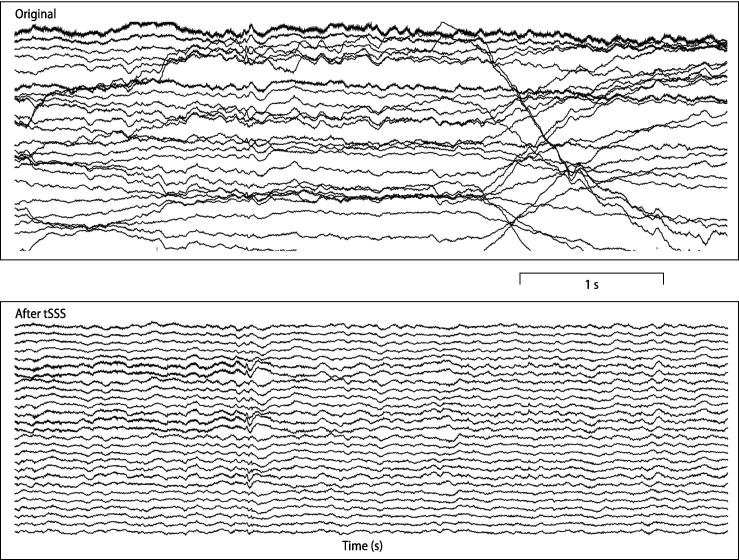
Effect of tSSS cleaning of slow artifacts caused by small residual magnetized particles left from skull drilling. Spontaneous MEG data were recorded with a CTF-275 device in an epileptic patient who underwent craniotomy and a temporal resection. Top panel: Original data. MEG signals from 27 channels are displayed. Bottom panel: tSSS-cleaned data. Filters correspond to the standard CTF data acquisition system with frequency band acquired from DC to 240 Hz. No additional filtering was performed. All traces are from first-order axial gradiometers with 5 cm baseline. Reference-channel information was not applied in these data. Data courtesy of Eliane Kobayashi (McGill University, Montreal, Canada).
Fig. 4
Fig. 4
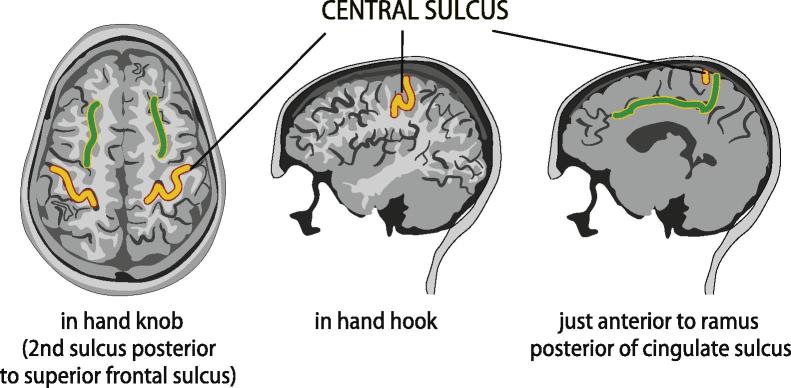
Locating the central sulcus in a structural MRI. A schematic guide to find the central sulcus on the basis of anatomical landmarks in axial (left), parasagittal (middle) and midsagittal (right) sections. The course of the central sulcus is displayed in yellow, and the superior frontal sulci (left) and cingulate sulcus (right) appear in green. This anatomical information should be complemented with MEG information: SEF recordings for pinpointing the somatosensory cortex just posterior to the central sulcus and cortex–muscle coherence recordings to identify the primary motor cortex just anterior to the central sulcus. Adapted from Hari and Puce (2017) with permission from Oxford University Press.
Fig. 5
Fig. 5
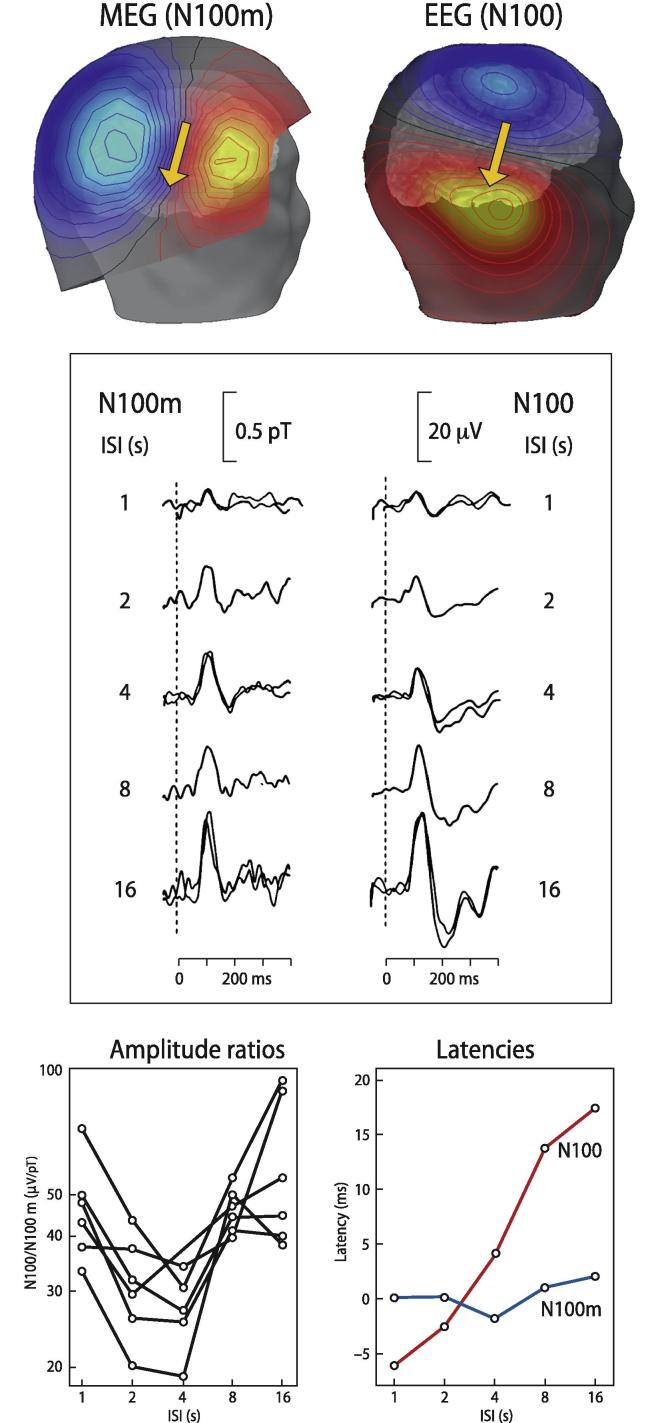
Auditory 100-ms evoked fields and potentials. Top panel: Field patterns for MEG (left, N100m) and EEG (right, N100) responses. These data were simulated for a current-dipole source (arrow) in the auditory cortex. Note that the MEG pattern is displayed about 3 cm above the scalp over the temporal lobe. In future MEG devices where the sensors can be placed very close to the scalp, the MEG field lines will be about 1/3 closer together. The red isocontour lines display magnetic field exiting the head and positive potentials. The blue isocontours depict magnetic fields entering the head and negative potentials. Middle panel: ISI dependence of N100m (recorded with an axial gradiometer from the right posterior maximum of the field pattern) and of N100 (recorded between vertex and right mastoid). Modified from Hari et al. (1982). Bottom left: Ratio of N100/N100m as a function of ISI. Because this relationship is not flat, the electric and magnetic 100-ms responses cannot have identical sources. Bottom right: N100 and N100m latencies as a function of ISI. Latencies also behave differently as a function of the ISI. Modified from Tuomisto et al. (1983).

Comment in

References

    1. Aine C.J. Highlights of 40 years of SQUID-based brain research and clinical applications. In: Supek S., Sulca A., editors. Advances in biomagnetism, BIOMAG2010 IFMBE proceedings. 2010. pp. 9–34.
    1. Airaksinen K., Mäkelä J.P., Taulu S., Ahonen A., Nurminen J., Schnitzler A., Pekkonen E. Effects of DBS on auditory and somatosensory processing in Parkinson's disease. Hum Brain Mapp. 2011;32:1091–1099. - PMC - PubMed
    1. Airaksinen K., Mäkelä J.P., Nurminen J., Luoma J., Taulu S., Ahonen A., Pekkonen E. Cortico-muscular coherence in advanced Parkinson's disease with deep brain stimulation. Clin Neurophysiol. 2015;126:748–755. - PubMed
    1. Albouy P., Weiss A., Baillet S., Zatorre R.J. Selective entrainment of theta oscillations in the dorsal stream causally enhances auditory working memory performance. Neuron. 2017;94(193–206):e5. - PubMed
    1. Attal Y., Bhattacharjee M., Yelnik J., Cottereau B., Lefèvre J., Okada Y., Bardinet E., Chupin M., Baillet S. Modelling and detecting deep brain activity with MEG and EEG. IRBM. 2009;30:133–138. - PubMed

Publication types

MeSH terms