


A new method for the assessment of endothelial function with peripheral arterial volume
- PMID: 29728052
- PMCID: PMC5935917
- DOI: 10.1186/s12872-018-0821-5
A new method for the assessment of endothelial function with peripheral arterial volume
Abstract
Background: Currently, many methodological approaches have been developed to assess peripheral endothelial function. However, a development of the noninvasive and automated technique for routinely assessing endothelial function is still required. We evaluated the potential value of a new method to measure peripheral endothelial function with reactive hyperemia peripheral arterial volume (RH-PAV) in patients with chest pain.
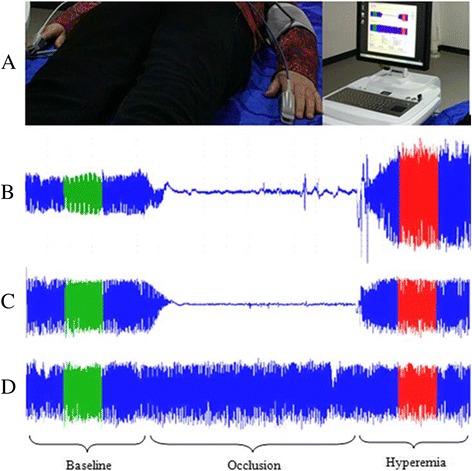
Methods: We used a novel oximeter-like probe to detect the peripheral arterial volume (PAV) of the finger and compared it with brachial flow-mediated dilation (FMD) performed in 93 consecutive patients with chest pain. The RH-PAV index was defined as the ratio of the digital pulse volume during reactive hyperemia relative to the baseline.
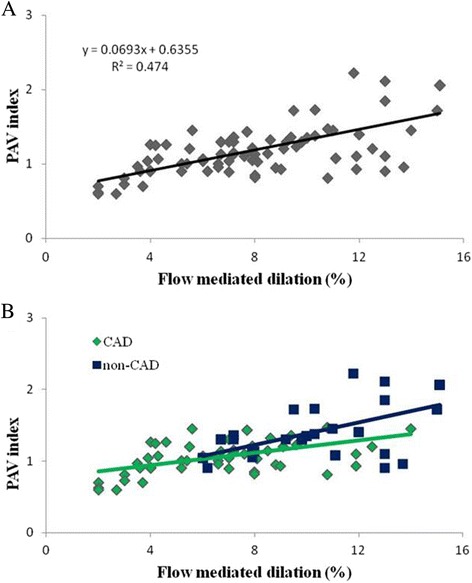
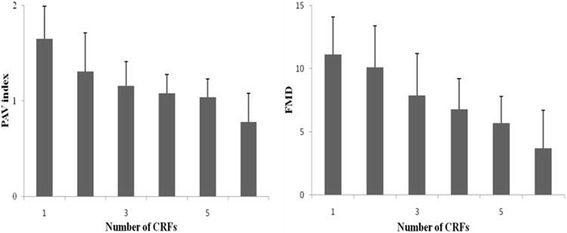
Results: Ninety-three patients (53 men, 58 ± 5 years) completed the study, and 53 patients demonstrated coronary artery disease (CAD) following scheduled coronary angiography. There was a moderate linear relationship between PAV and FMD (r = 0.69, p < 0.01). Similar to FMD, PAV was more impaired in patients who have more cardiovascular risk factors (CRFs). The subjects with CAD had lower PAV and FMD, compared with those without CAD (1.05 ± 0.23 VS. 1.41 ± 0.37, p < 0.01; 6.7% ± 2.9% VS. 10.4% ± 2.9%, p < 0.01, respectively), and the relationships between FMD and PAV were also significant in both CAD (r = 0.54, p < 0.01) and non-CAD (r = 0.62, p < 0.01) patients.
Conclusions: Endothelial function of digital artery assessed with the novel PAV method demonstrated a profile similar to that of brachial artery measured with FMD. The hyperemia PAV was decreased by factors which were considered to impair endothelial function, suggesting that PAV has the potential to be a novel method to study endothelial function.
Keywords: Endothelial function; Flow mediated dilation; Noninvasive measurement; Peripheral arterial volume; Photoplethysmography.
Conflict of interest statement
Ethics approval and consent to participate
This study was approved by the ethical review board of China-Japan Union Hospital of Jilin University (2017040603). All individuals signed the written informed consents to the use of their clinical data for the purpose of research in the study.
Competing interests
Author Ping Yang has been a consultant for Saintyear Medical Ltd., which owns patent rights to PAV technique. Other authors have nothing to disclose.
Publisher’s Note
Springer Nature remains neutral with regard to jurisdictional claims in published maps and institutional affiliations.
Figures
References
-
- Mozaffarian D, Benjamin EJ, Go AS, Arnett DK, Blaha MJ, Cushman M, Das SR, de Ferranti S, Despres JP, Fullerton HJ, et al. Heart disease and stroke Statistics-2016 update: a report from the American Heart Association. Circulation. 2016;133(4):e38–360. doi: 10.1161/CIR.0000000000000350. - DOI - PubMed
Publication types
MeSH terms
Substances
LinkOut - more resources
Full Text Sources
Other Literature Sources
Miscellaneous
