


Comment
doi: 10.1016/j.molmed.2018.04.007.
Epub 2018 May 2.
To Scar or Not to Scar
Affiliations
- PMID: 29729835
- PMCID: PMC5975241
- DOI: 10.1016/j.molmed.2018.04.007
Item in Clipboard
Comment
To Scar or Not to Scar
Trends Mol Med.
2018 Jun.
Abstract
A recent study indicates that reducing fibrotic scarring by genetically abrogating the proliferation of type A pericytes promotes axon regeneration and functional recovery after spinal cord injury. Questions remain regarding the identity of the cells being manipulated and the balance between the beneficial and detrimental effects of fibrotic scarring.
Keywords: astrocytic scar; axon regeneration; fibrotic scar; functional recovery; spinal cord injury.
Copyright © 2018 Elsevier Ltd. All rights reserved.
Figures
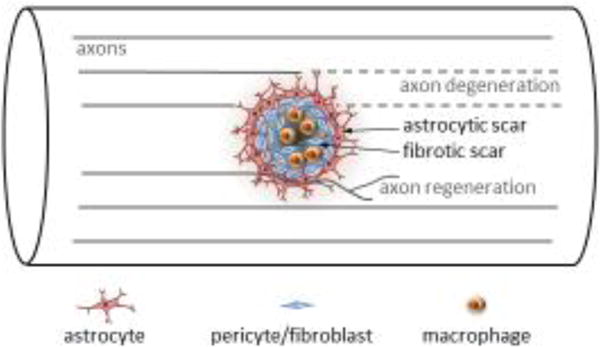
After spinal cord injury, a scar forms at the injury site including a fibrotic component that is encased by an astrocytic component. How the scarring process impacts repair and recovery remains an important question. Dias and colleagues suggest that reducing type A pericyte-mediated fibrotic scarring improves axon regeneration (which typically does not occur to a significant extent in the mammalian CNS) and functional recovery.
Comment on
-
Reducing Pericyte-Derived Scarring Promotes Recovery after Spinal Cord Injury.Cell. 2018 Mar 22;173(1):153-165.e22. doi: 10.1016/j.cell.2018.02.004. Epub 2018 Mar 1. Cell. 2018. PMID: 29502968 Free PMC article.
References
-
- Goritz C, et al. A pericyte origin of spinal cord scar tissue. Science. 2011;333:238–242. - PubMed
-
- Brazda N, Muller HW. Pharmacological modification of the extracellular matrix to promote regeneration of the injured brain and spinal cord. Prog Brain Res. 2009;175:269–281. - PubMed
-
- Slezak M, et al. Transgenic mice for conditional gene manipulation in astroglial cells. Glia. 2007;55:1565–1576. - PubMed
Publication types
MeSH terms
Grants and funding
LinkOut - more resources
Full Text Sources
Other Literature Sources
Medical
