. 2018 Aug 1:176:489-498.
doi: 10.1016/j.neuroimage.2018.05.005. Epub 2018 May 3.

Default mode network abnormalities in posttraumatic stress disorder: A novel network-restricted topology approach

Affiliations

Default mode network abnormalities in posttraumatic stress disorder: A novel network-restricted topology approach

Teddy J Akiki et al. Neuroimage. .

Abstract

Disruption in the default mode network (DMN) has been implicated in numerous neuropsychiatric disorders, including posttraumatic stress disorder (PTSD). However, studies have largely been limited to seed-based methods and involved inconsistent definitions of the DMN. Recent advances in neuroimaging and graph theory now permit the systematic exploration of intrinsic brain networks. In this study, we used resting-state functional magnetic resonance imaging (fMRI), diffusion MRI, and graph theoretical analyses to systematically examine the DMN connectivity and its relationship with PTSD symptom severity in a cohort of 65 combat-exposed US Veterans. We employed metrics that index overall connectivity strength, network integration (global efficiency), and network segregation (clustering coefficient). Then, we conducted a modularity and network-based statistical analysis to identify DMN regions of particular importance in PTSD. Finally, structural connectivity analyses were used to probe whether white matter abnormalities are associated with the identified functional DMN changes. We found decreased DMN functional connectivity strength to be associated with increased PTSD symptom severity. Further topological characterization suggests decreased functional integration and increased segregation in subjects with severe PTSD. Modularity analyses suggest a spared connectivity in the posterior DMN community (posterior cingulate, precuneus, angular gyrus) despite overall DMN weakened connections with increasing PTSD severity. Edge-wise network-based statistical analyses revealed a prefrontal dysconnectivity. Analysis of the diffusion networks revealed no alterations in overall strength or prefrontal structural connectivity. DMN abnormalities in patients with severe PTSD symptoms are characterized by decreased overall interconnections. On a finer scale, we found a pattern of prefrontal dysconnectivity, but increased cohesiveness in the posterior DMN community and relative sparing of connectivity in this region. The DMN measures established in this study may serve as a biomarker of disease severity and could have potential utility in developing circuit-based therapeutics.

Keywords: Diffusion MRI; Functional MRI; Graph theory; Intrinsic connectivity networks; PTSD; Veterans.


Conflict of interest statement

Disclosure

All other authors report no competing interests.

Figures
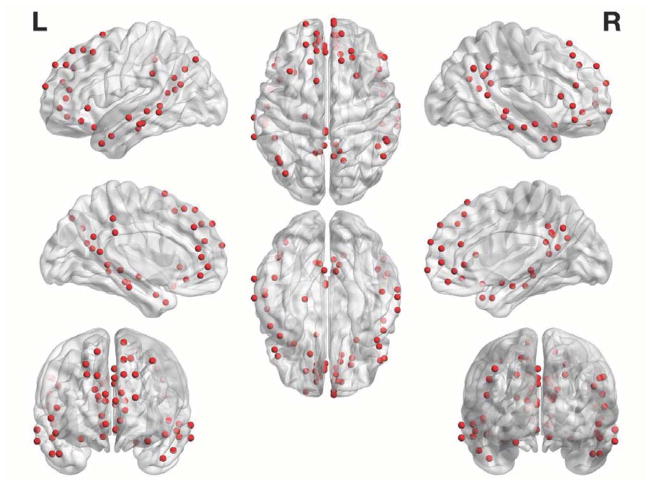
Figure 1
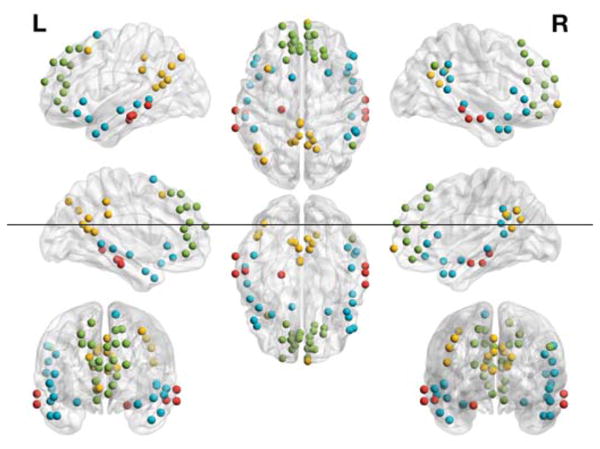
Figure 1. DMN Nodes
Figure depicts the 64 nodes from the functional atlas comprising the DMN that we used for the primary analysis.
Figure 2
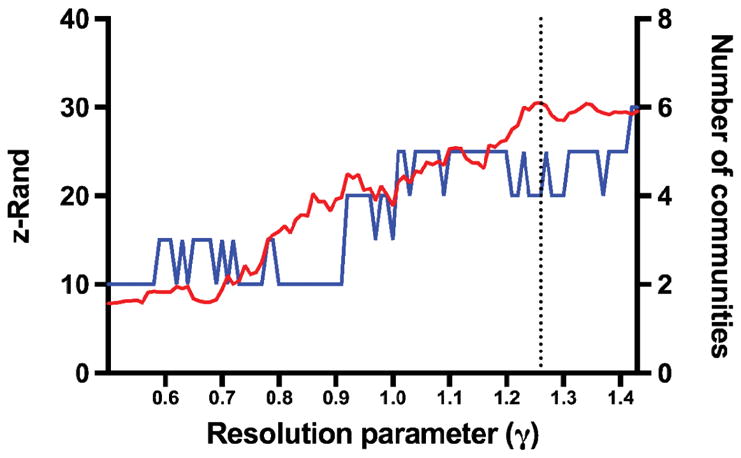
Figure 2. Identification of candidate resolution parameters
Plot representing the z-Rand scores and number of communities for each resolution parameter (γ). The number of communities were determined after the association-reclustering step. The dashed line represents the local z-Rand maximum (30.5), corresponding to γ = 1.26, at which the outputs of the Louvain algorithm were most stable (while the total number of communities remained ≤ 6).
Figure 3
Figure 3. The partition solution resulting in 4 DMN communities
A predominantly posterior community (yellow; PCC, precuneus, and left angular gyrus), a frontal community (green; vmPFC and dmPFC), an MT-parahippocampal (MT-P community (red; middle temporal and parahippocampal cortex), and an MT-inferior frontal (MT-IF) community (blue).
Figure 4
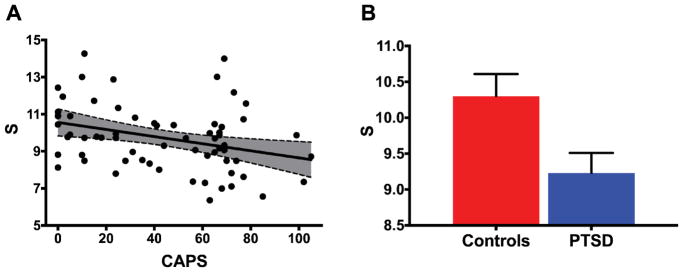
Figure 4. PTSD and DMN connectivity strength
(A) Scatter plot depicting the correlation between PTSD severity, as measured by the Clinician Administered PTSD Scale (CAPS), and DMN overall connectivity strength (S) [r(64) = −0.329, p = 0.0075]. The gray area is the 95% confidence band of the best-fit line. (B) Bar graph depicting means and standard error of S across groups [CC: mean = 10.30 ± 0.31; PTSD: mean = 9.23 ± 0.28; p = 0.014].
Figure 5
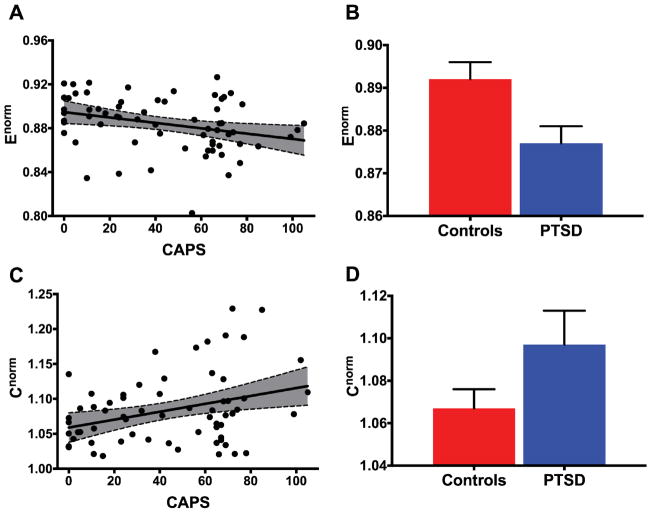
Figure 5. PTSD and DMN integration and segregation
(A–B) Scatter plots depicting the correlation between PTSD severity, as measured by the Clinician Administered PTSD Scale (CAPS), and DMN integration and segregation. The gray area is the 95% confidence band of the best-fit line. (A) represents the normalized global efficiency [Enorm: r(64) = −0.299, p = 0.0157]; (B) represents the clustering coefficient [Cnorm: r(64) = 0.334, p = 0.0065]. (C–D) Bar graphs depicting means and standard error of Enorm: [CC: mean = 0.892 ± 0.004; PTSD: mean = 0.877 ± 0.004; p = 0.01], and Cnorm: [CC: mean = 1.067 ± 0.009; PTSD: mean = 1.097 ± 0.008; p = 0.016], across the CC and PTSD groups.
Figure 6
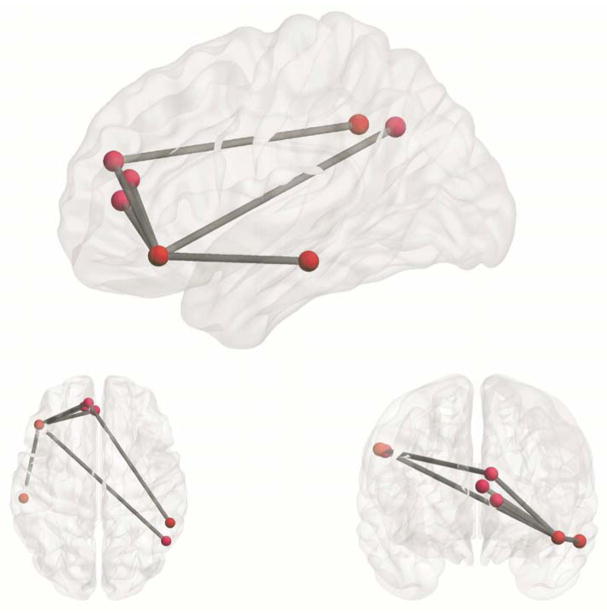
Figure 6. Sub-network within the DMN negatively associated with PTSD severity after correcting for family-wise error
Connections represent edges that were negatively associated with CAPS severity after correction for multiple comparisons with NBS. Note that all abnormal edges involve the PFC (mPFC and lateral orbitofrontal cortex).

References

    1. Abdallah CG, Southwick SM, Krystal JH. Neurobiology of posttraumatic stress disorder (PTSD): A path from novel pathophysiology to innovative therapeutics. Neuroscience Letters. 2017a;649:130–132. - PubMed
    1. Abdallah CG, Wrocklage KM, Averill CL, Akiki T, Schweinsburg B, Roy A, Martini B, Southwick SM, Krystal JH, Scott JC. Anterior hippocampal dysconnectivity in posttraumatic stress disorder: a dimensional and multimodal approach. Transl Psychiatry. 2017b;7:e1045. - PMC - PubMed
    1. Akiki TJ, Averill CL, Abdallah CG. A Network-Based Neurobiological Model of PTSD: Evidence From Structural and Functional Neuroimaging Studies. Current Psychiatry Reports. 2017;19:81. - PMC - PubMed
    1. Alexander-Bloch AF, Gogtay N, Meunier D, Birn R, Clasen L, Lalonde F, Lenroot R, Giedd J, Bullmore ET. Disrupted modularity and local connectivity of brain functional networks in childhood-onset schizophrenia. Front Syst Neurosci. 2010;4:147. - PMC - PubMed
    1. Andrews-Hanna JR, Reidler JS, Sepulcre J, Poulin R, Buckner RL. Functional-anatomic fractionation of the brain’s default network. Neuron. 2010;65:550–562. - PMC - PubMed

Publication types

MeSH terms