


Ureteroscopy is more cost effective than shock wave lithotripsy for stone treatment: systematic review and meta-analysis
- PMID: 29730839
- PMCID: PMC6208679
- DOI: 10.1007/s00345-018-2320-9
Ureteroscopy is more cost effective than shock wave lithotripsy for stone treatment: systematic review and meta-analysis
Abstract
Introduction: A rising incidence of kidney stone disease has led to an increase in ureteroscopy (URS) and shock wave lithotripsy (SWL). Our aim was to compare the cost of URS and SWL for treatment of stones.
Methods: A systematic review and meta-analysis based on Cochrane and PRISMA standards was conducted for all studies reporting on comparative cost of treatment between URS and SWL. The cost calculation was based on factual data presented in the individual studies as reported by the authors. English language articles from January 2001 to December 2017 using Medline, PubMed, EMBASE, CINAHL, Cochrane library and Google Scholar were selected. Our study was registered with PROSPERO (International prospective register of systematic reviews)-registration number CRD 42017080350.
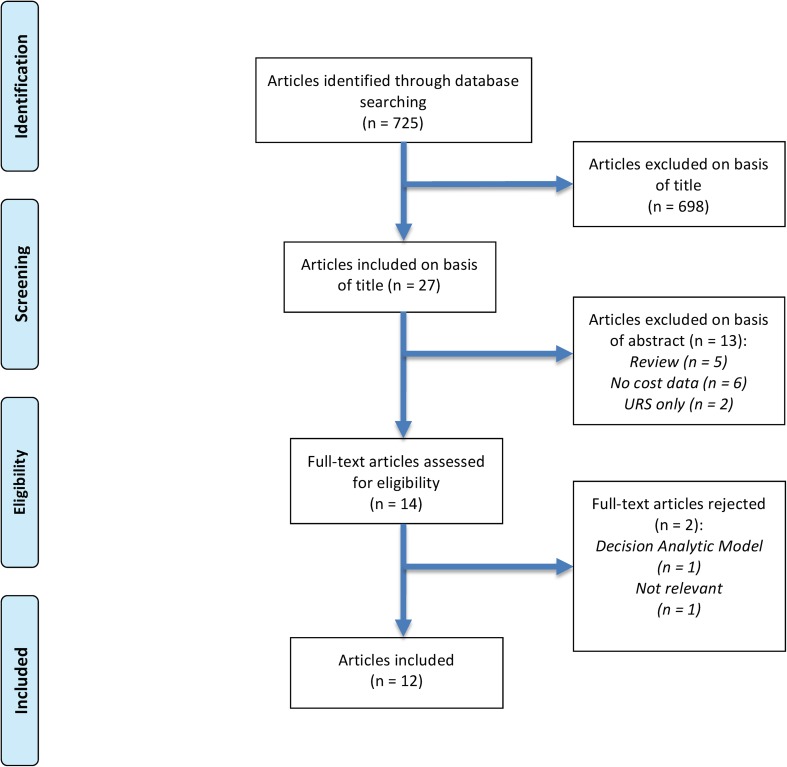
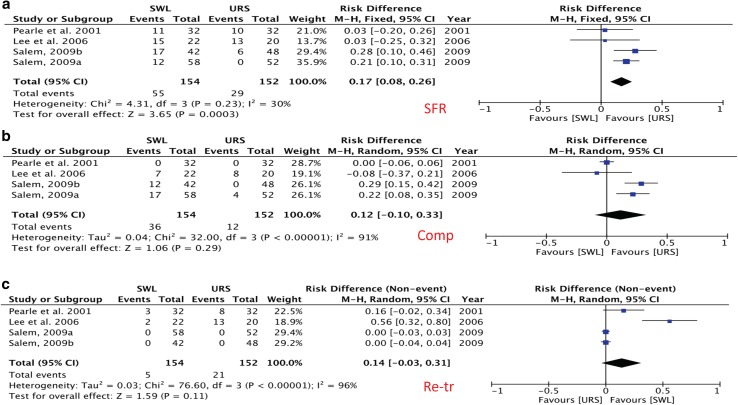
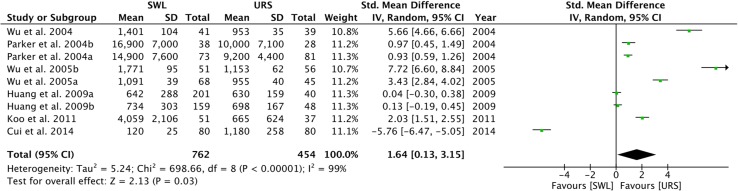
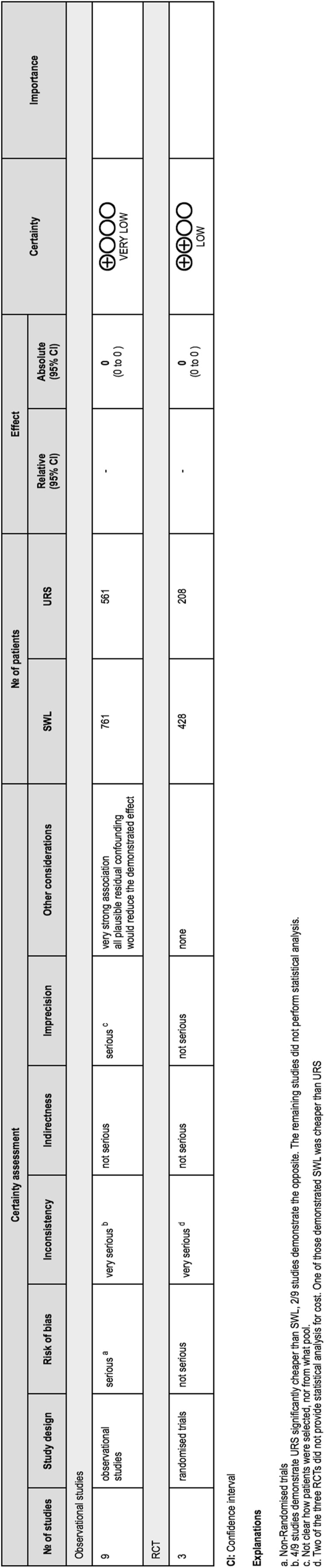
Results: A total of 12 studies involving 2012 patients (SWL-1243, URS-769) were included after initial identification and screening of 725 studies with further assessment of 27 papers. The mean stone size was 10 and 11 mm for SWL and URS, respectively, with stone location in the proximal ureter (n = 8 studies), distal ureter (n = 1), all locations in the ureter (n = 1) and in the kidney (n = 2). Stone free rates (84 vs. 60%) were favourable for URS compared to SWL (p < 0.001). Complication rates (23 vs. 30%) were non-significantly in favor of SWL (p = 0.11) whereas re-treatment rates (11 vs. 27%) were non-significantly in favor of URS (p = 0.29). Mean overall cost was significantly lower for URS ($2801) compared to SWL ($3627) (p = 0.03). The included studies had high risk of bias overall. On sub-analysis, URS was significantly cost-effective for both stones < 10 and ≥ 10 mm and for proximal ureteric stones.
Conclusion: There is limited evidence to suggest that URS is less expensive than SWL. However, due to lack of standardization, studies seem to be contradictory and further randomized studies are needed to address this issue.
Keywords: Cost; Effectiveness; Outcomes; Shock wave lithotripsy; Ureteroscopy.
Conflict of interest statement
Conflict of interest
The authors declare that there is no conflict of interest and no funding was received for this.
Research involving human participants ethical approval
As this is a systematic review, no ethical approval was required.
Informed consent
As this is a systematic review, no informed consent was required.
Figures
Comment in
-
Systematic reviews and meta-analysis in stone disease: is this what we need to get stronger evidence?World J Urol. 2018 Aug;36(8):1333-1334. doi: 10.1007/s00345-018-2393-5. Epub 2018 Jun 29. World J Urol. 2018. PMID: 29959520 No abstract available.
References
-
- Pietropaolo A, Proietti S, Geraghty R, et al. Trends of ‘urolithiasis: interventions, simulation, and laser technology’over the last 16 years (2000–2015) as published in the literature (PubMed): a systematic review from European section of Uro-technology (ESUT) World J Urol. 2017;35(11):1651–1658. doi: 10.1007/s00345-017-2055-z. - DOI - PMC - PubMed
-
- Izamin I, Aniza I, Rizal AM, et al. Comparing extracorporeal shock wave lithotripsy and ureteroscopy for treatment of proximal ureteric calculi: A cost-effectiveness study. Med J Malaysia. 2009;64(1):12–21. - PubMed
Publication types
MeSH terms
LinkOut - more resources
Full Text Sources
Other Literature Sources
