Review
. 2018 Jul 9;34(1):21-43.
doi: 10.1016/j.ccell.2018.03.022. Epub 2018 May 3.

NRF2 and the Hallmarks of Cancer

Affiliations
Review

NRF2 and the Hallmarks of Cancer

Montserrat Rojo de la Vega et al. Cancer Cell. .

Abstract

The transcription factor NRF2 is the master regulator of the cellular antioxidant response. Though recognized originally as a target of chemopreventive compounds that help prevent cancer and other maladies, accumulating evidence has established the NRF2 pathway as a driver of cancer progression, metastasis, and resistance to therapy. Recent studies have identified new functions for NRF2 in the regulation of metabolism and other essential cellular functions, establishing NRF2 as a truly pleiotropic transcription factor. In this review, we explore the roles of NRF2 in the hallmarks of cancer, indicating both tumor suppressive and tumor-promoting effects.

Keywords: KEAP1; NRF2; antioxidant response element (ARE); cancer initiation and progression; carcinogenesis; chemoresistance; metabolic reprogramming; metastasis; oxidative stress.


Conflict of interest statement

DECLARATION OF INTERESTS

The authors declare no competing interests.

Figures
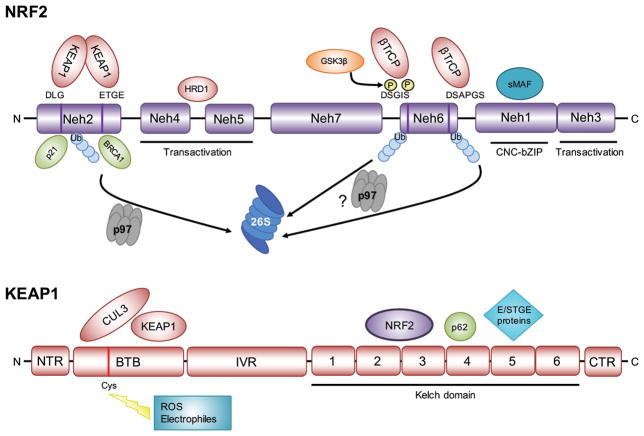
Figure 1
Figure 1. Protein domains of the transcription factor NRF2 and its negative regulator KEAP1
NRF2 is comprised of seven NRF2-ECH homology (Neh) domains. The amino acid motifs responsible for the negative regulation of NRF2 by KEAP1 (DLG and ETGE in Neh2) and β-TrCP (DSGIS and DSAPGS in Neh6) are highlighted. The serine (S) residues in the DSGIS motif are phosphorylated by GSK3β to promote recognition by β-TrCP. Neh3, 4, and 5 are important for transactivation. Neh1 is the cap’n’collar (CNC)-leucine zipper (bZIP) domain that interacts with small MAF proteins. Polyubiquitylated (Ub) lysine (K) residues contribute to the degradation of NRF2 by the 26S proteasome. KEAP1 is comprised of an amino terminal region (NTR), a broad complex, tramtrack, bric-à-brac (BTB) domain, an intervening region (IVR), and six Kelch domains that in conjunction with the carboxyl terminal region (CTR) form the region that interacts with NRF2, p62, and other E/STGE-containing proteins. The BTB domain is important for KEAP1 dimerization and interaction with CUL3, and contains a cysteine residue (C151) that senses reactive oxygen species (ROS) and electrophiles. Other cysteine residues located across the other KEAP1 domains are responsive to other stimuli (not shown).
Figure 2
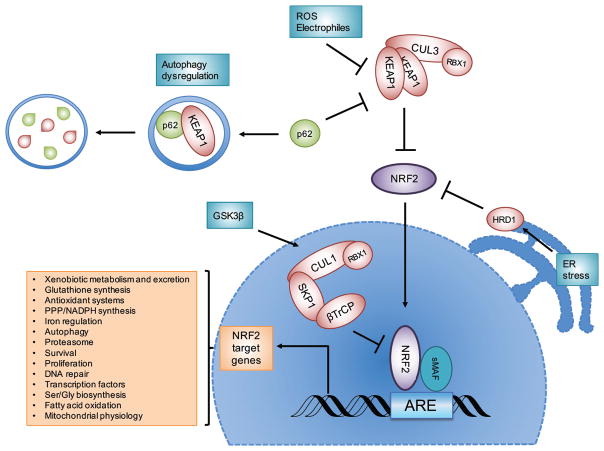
Figure 2. The NRF2 signaling pathway
NRF2 is negatively regulated by three E3 ubiquitin ligase complexes: the KEAP1-CUL3-RBX1 complex, the β-TrCP-SKP1-CUL1-RBX1 complex, and HRD1. When NRF2 protein levels increase following exposure to reactive oxygen species (ROS), electrophiles, or autophagy dysregulation, NRF2 translocates to the nucleus, dimerizes with sMAF proteins, and together they bind the antioxidant response element (ARE) to activate the transcription of its target genes. Examples of the general processes regulated by NRF2 target genes are indicated.
Figure 3
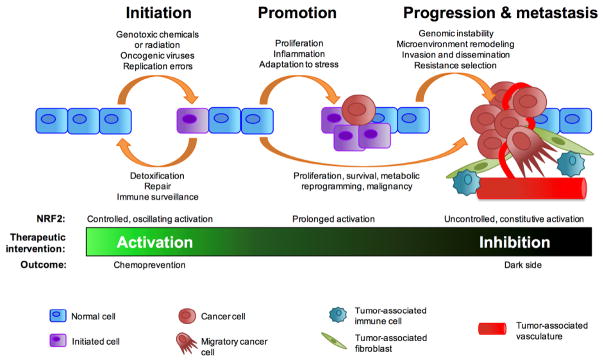
Figure 3. Dual roles of NRF2 in cancer
The modes of NRF2 regulation during the multistep development of cancer determine its functional outcome and influence the therapeutic intervention that could be used. Controlled activation of NRF2 in normal cells via the canonical mechanism prevents cancer initiation and is suitable for cancer chemoprevention strategies. Prolonged (non-canonical) or constitutive (loss of regulatory mechanisms) activation of NRF2 participates in cancer promotion, progression, and metastasis. This dark side can be antagonized by inhibition of NRF2.
Figure 4
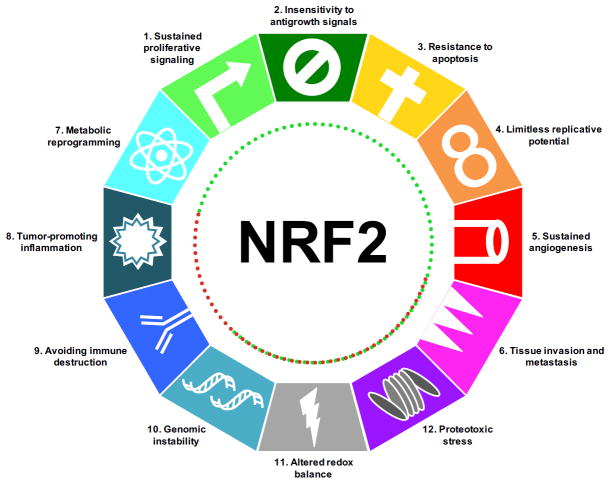
Figure 4. NRF2 in the hallmarks of cancer
NRF2 has direct and indirect roles that promote (green dotted lines) or block (red dotted lines) the emergence of the hallmarks of cancer.
Figure 5
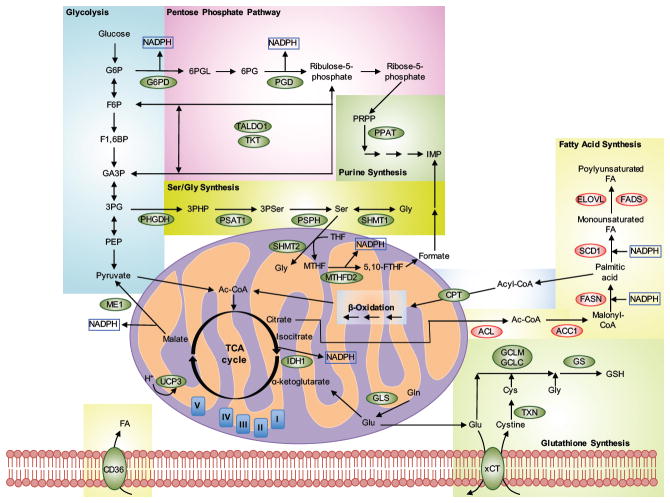
Figure 5. Metabolic pathways regulated by NRF2 target genes
NRF2 positively (green) or negatively (red) regulates the expression of enzymes involved in numerous interrelated metabolic pathways. Enzyme abbreviations: ACC1, acetyl-CoA carboxylase 1; ACL, ATP-citrate lyase; CPT, carnitine plamitoyltransferase 1 and 2; ELOVL, fatty acid elongase; FADS, fatty acid desaturase; FASN, fatty acid synthase; G6PD, glucose-6-phosphate dehydrogenase; GCLC, glutamate-cysteine ligase, catalytic subunit; GCLM, glutamate-cysteine ligase, modifier subunit; GLS, glutaminase; GS, glutathione synthetase; IDH1, isocitrate dehydrogenase 1; ME1, malic enzyme 1; MTFHD2, methylenetetrahydrofolate dehydrogenase 2; PGD, 6-phosphogluconate dehydrogenase; PHGDH, phosphoglycerate dehydrogenase; PPAT, phosphoribosyl pyrophosphate amidotransferase; PSAT1, phosphoserine aminotransferase; PSPH, phosphoserine phosphatase; SCD1, stearoyl CoA desaturase; SHMT, serine hydroxymethyltransferase 1 and 2; TALDO, transaldolase; TKT, transketolase; TXN, thioredoxin; UCP3, uncoupling protein 3; xCT, glutamate/cystine antiporter. Metabolite abbreviations. Glycolysis: G6P, glucose-6-phosphate; F6P, fructose-6-phosphate; F1,6BP, fructose-1,6-bisphosphate; GA3P, glyceraldehyde-3-phosphate; 3PG, 3-phosphoglycerate; PEP, phosphoenol pyruvate. Pentose Phosphate Pathway: 6PGL, 6-phosphoglucono-δ-lactone; 6PG, 6-phosphogluconate. Purine synthesis: PRPP, 5-phospho-D-ribosyl-1-pyrophosphate; IMP, inosine monophosphate. Ser/Gly Synthesis: 3PHP, 3-phosphohydroxypyruvate; 3PSer, 3-phosphoserine; THF, tetrahydrofolate; MTHF, methylenetetrahydrofolate; 5,10-FTHF, 5,10-methenyl-tetrahydrofolate. β-Oxidation: Acyl-CoA, acyl-coenzyme A; Ac-CoA, acetyl-coenzyme A. Fatty Acid Synthesis: FA, fatty acid. Glutathione Synthesis: GSH, glutathione, reduced.

References

    1. AGYEMAN AS, CHAERKADY R, SHAW PG, DAVIDSON NE, VISVANATHAN K, PANDEY A, KENSLER TW. Transcriptomic and proteomic profiling of KEAP1 disrupted and sulforaphane-treated human breast epithelial cells reveals common expression profiles. Breast Cancer Res Treat. 2012;132:175–87. - PMC - PubMed
    1. ALEXANDRE J, HU Y, LU W, PELICANO H, HUANG P. Novel action of paclitaxel against cancer cells: bystander effect mediated by reactive oxygen species. Cancer Res. 2007;67:3512–7. - PubMed
    1. ALNOUTI Y, KLAASSEN CD. Tissue distribution, ontogeny, and regulation of aldehyde dehydrogenase (Aldh) enzymes mRNA by prototypical microsomal enzyme inducers in mice. Toxicol Sci. 2008;101:51–64. - PubMed
    1. ALTMAN BJ, STINE ZE, DANG CV. From Krebs to clinic: glutamine metabolism to cancer therapy. Nat Rev Cancer. 2016;16:619–34. - PMC - PubMed
    1. ANCKAR J, SISTONEN L. Regulation of HSF1 function in the heat stress response: implications in aging and disease. Annu Rev Biochem. 2011;80:1089–115. - PubMed

Publication types

MeSH terms

Substances