Astrocytes, Microglia, and Parkinson's Disease
- PMID: 29731673
- PMCID: PMC5934545
- DOI: 10.5607/en.2018.27.2.77
Astrocytes, Microglia, and Parkinson's Disease
Abstract
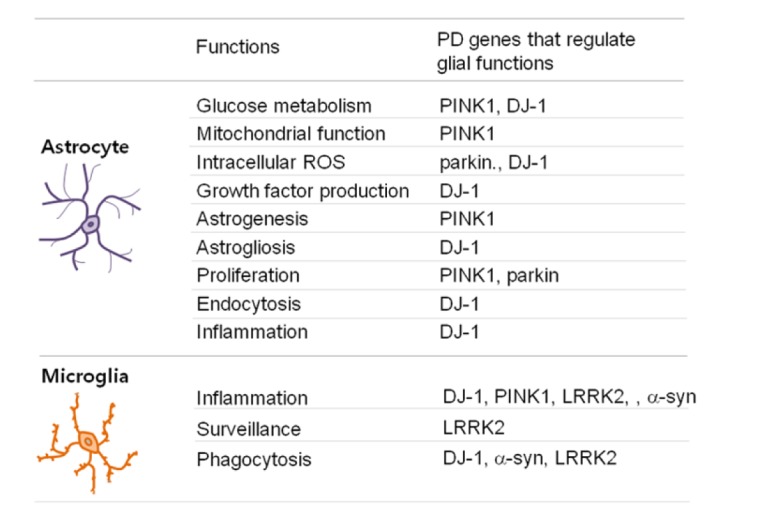
Astrocytes and microglia support well-being and well-function of the brain through diverse functions in both intact and injured brain. For example, astrocytes maintain homeostasis of microenvironment of the brain through up-taking ions and neurotransmitters, and provide growth factors and metabolites for neurons, etc. Microglia keep surveying surroundings, and remove abnormal synapses or respond to injury by isolating injury sites and expressing inflammatory cytokines. Therefore, their loss and/or functional alteration may be directly linked to brain diseases. Since Parkinson's disease (PD)-related genes are expressed in astrocytes and microglia, mutations of these genes may alter the functions of these cells, thereby contributing to disease onset and progression. Here, we review the roles of astrocytes and microglia in intact and injured brain, and discuss how PD genes regulate their functions.
Keywords: Astrocyte; Glia cell; Microglia; Parkinson's disease.
Figures
References
-
- Devine MJ, Plun-Favreau H, Wood NW. Parkinson's disease and cancer: two wars, one front. Nat Rev Cancer. 2011;11:812–823. - PubMed
-
- Koprich JB, Kalia LV, Brotchie JM. Animal models of alpha-synucleinopathy for Parkinson disease drug development. Nat Rev Neurosci. 2017;18:515–529. - PubMed
-
- Frahm S, Melis V, Horsley D, Rickard JE, Riedel G, Fadda P, Scherma M, Harrington CR, Wischik CM, Theuring F, Schwab K. Alpha-Synuclein transgenic mice, h-alpha-SynL62, display alpha-Syn aggregation and a dopaminergic phenotype reminiscent of Parkinson's disease. Behav Brain Res. 2018;339:153–168. - PubMed
Publication types
LinkOut - more resources
Full Text Sources
Other Literature Sources