. 2018 Feb 8;9(11):2873-2878.
doi: 10.1039/c8sc00181b. eCollection 2018 Mar 21.

Intramolecular hydride transfer onto arynes: redox-neutral and transition metal-free C(sp3)-H functionalization of amines

Affiliations

Intramolecular hydride transfer onto arynes: redox-neutral and transition metal-free C(sp3)-H functionalization of amines

Fahima I M Idiris et al. Chem Sci. .

Abstract

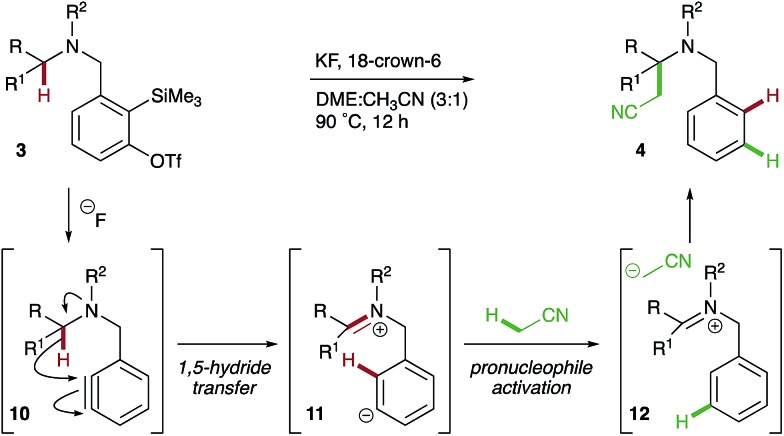
Transition metal-free intramolecular hydride transfer onto arynes is reported for the first time. This unique transformation is utilized in redox-neutral intermolecular α-functionalization reactions of different tertiary amines, generating C(sp3)-C(sp3/sp2/sp) bonds in a single synthetic operation. Deuterium labeling studies support initial cleavage of the α-C-H bond via intramolecular 1,5-hydride transfer onto the aryne, which leads to activation of a range of integrated pronucleophiles and ultimately affords a new approach to cross-dehydrogenative coupling reactions which utilize aryne intermediates.


Figures
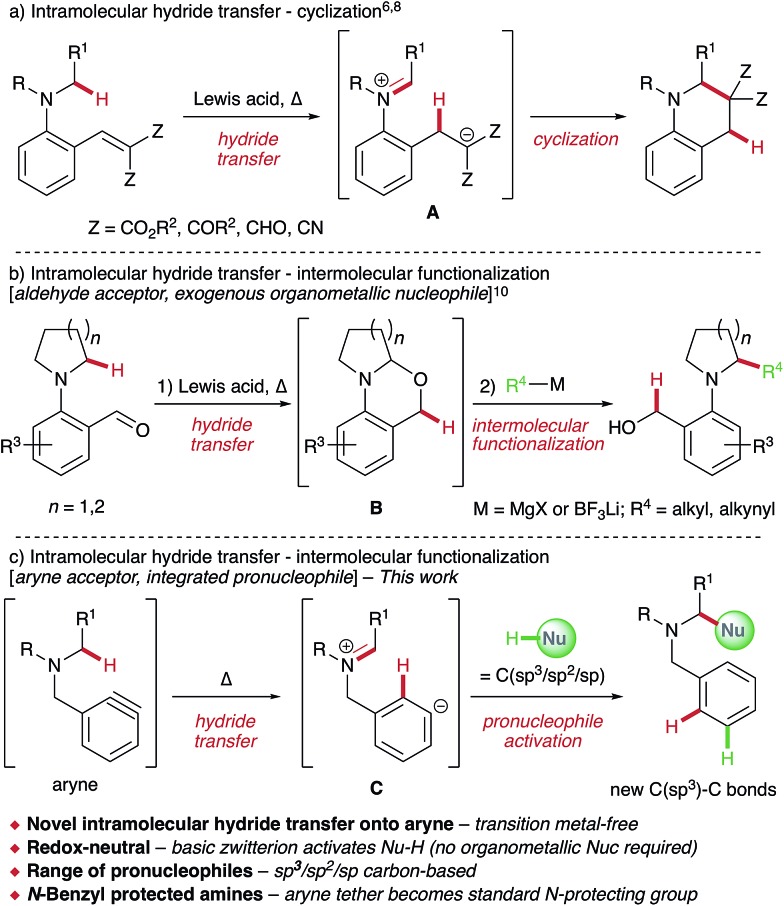
Scheme 1
Scheme 1. C(sp3)–H bond activation via intramolecular hydride transfer.
Scheme 2
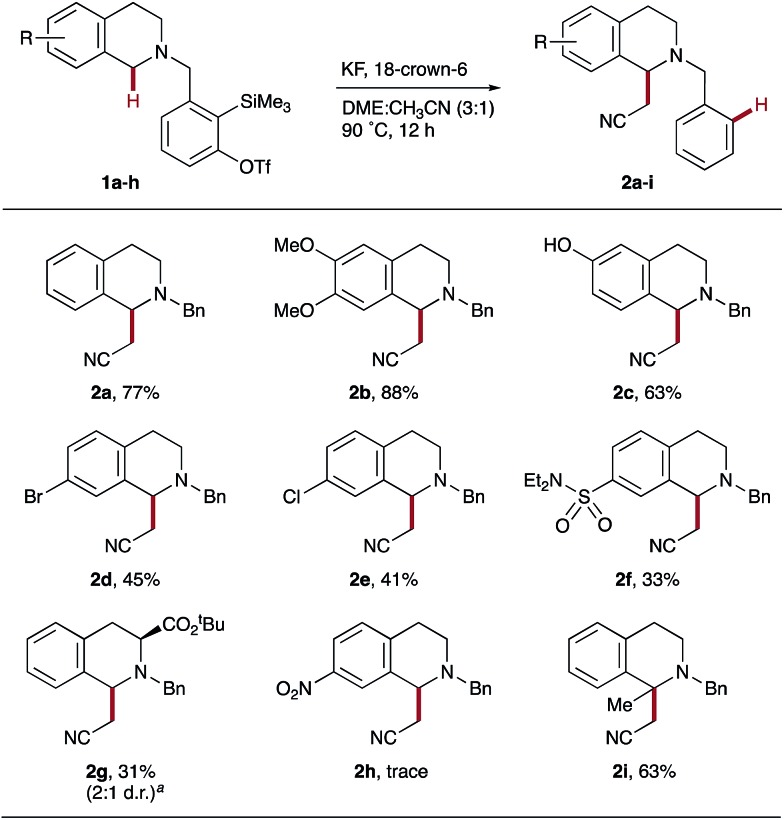
Scheme 2. Intramolecular hydride transfer onto aryne with THIQ derivatives. Reaction conditions: amine 1 (1.0 equiv.), KF (2.0 equiv.), 18-crown-6 (2.0 equiv.), DME : CH3CN (3 : 1 by volume, 0.01 M), 90 °C, 12 h. Yields of isolated products throughout. aRatio determined by 1H NMR spectroscopy.
Scheme 3
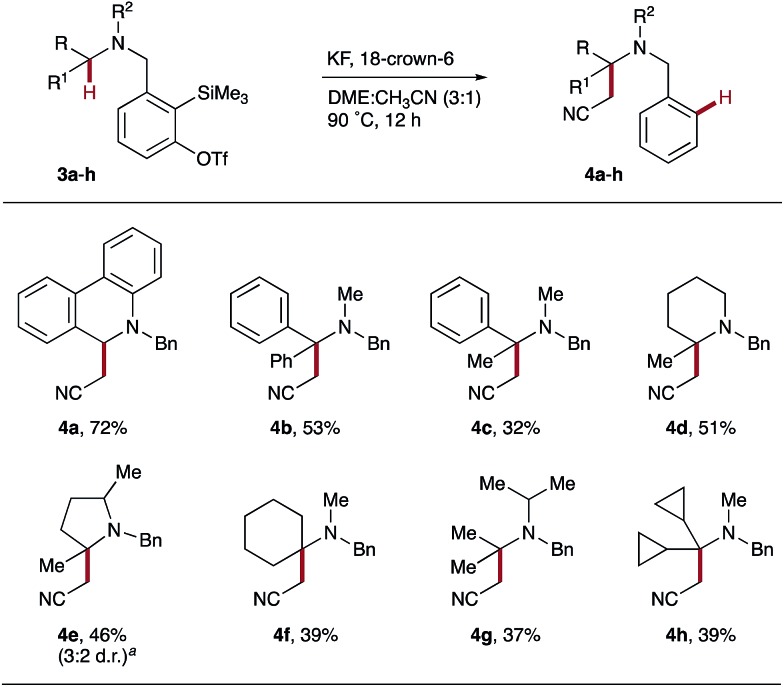
Scheme 3. Hydride transfer from linear and cyclic amine derivatives. Reaction conditions are as shown in Scheme 2. Yields of isolated products throughout. aRatio determined by 1H NMR spectroscopy.
Scheme 4
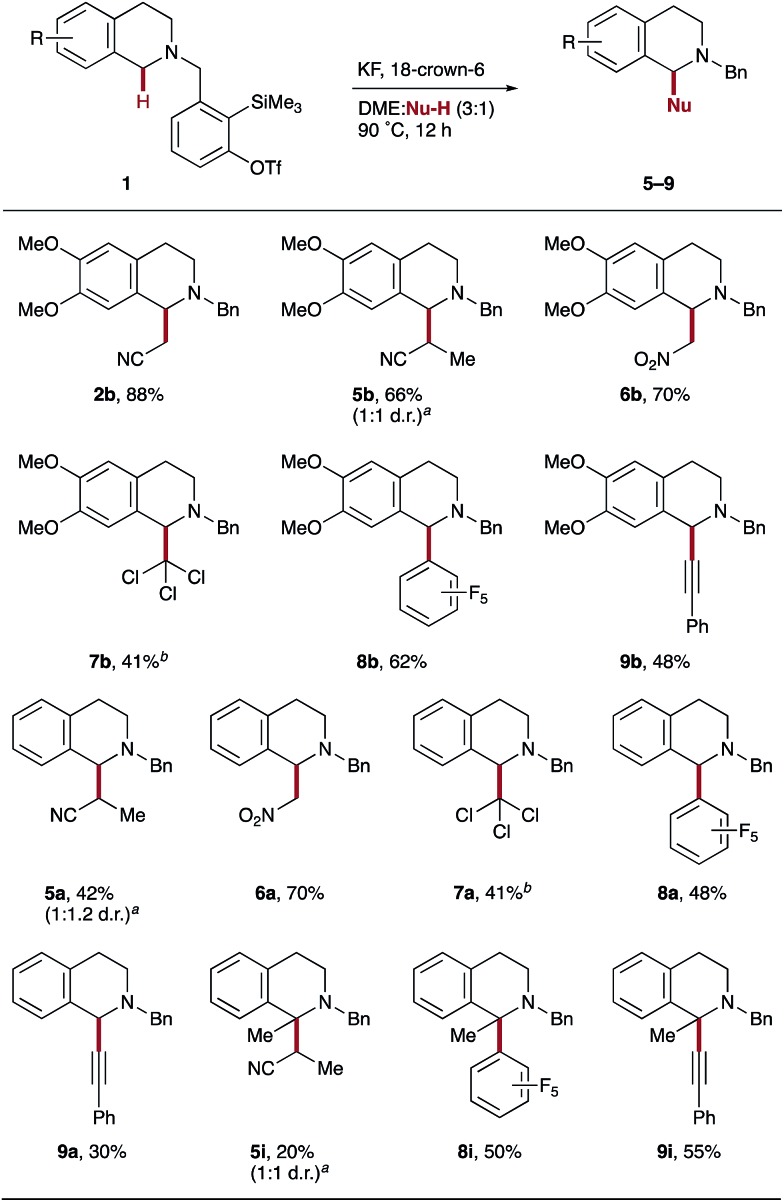
Scheme 4. Alternative pronucleophiles. Reaction conditions are as shown in Scheme 2. Yields of isolated products throughout. aRatio determined by 1H NMR spectroscopy. bDME : Nu-H (9 : 1 by volume, 0.01 M).
Scheme 5
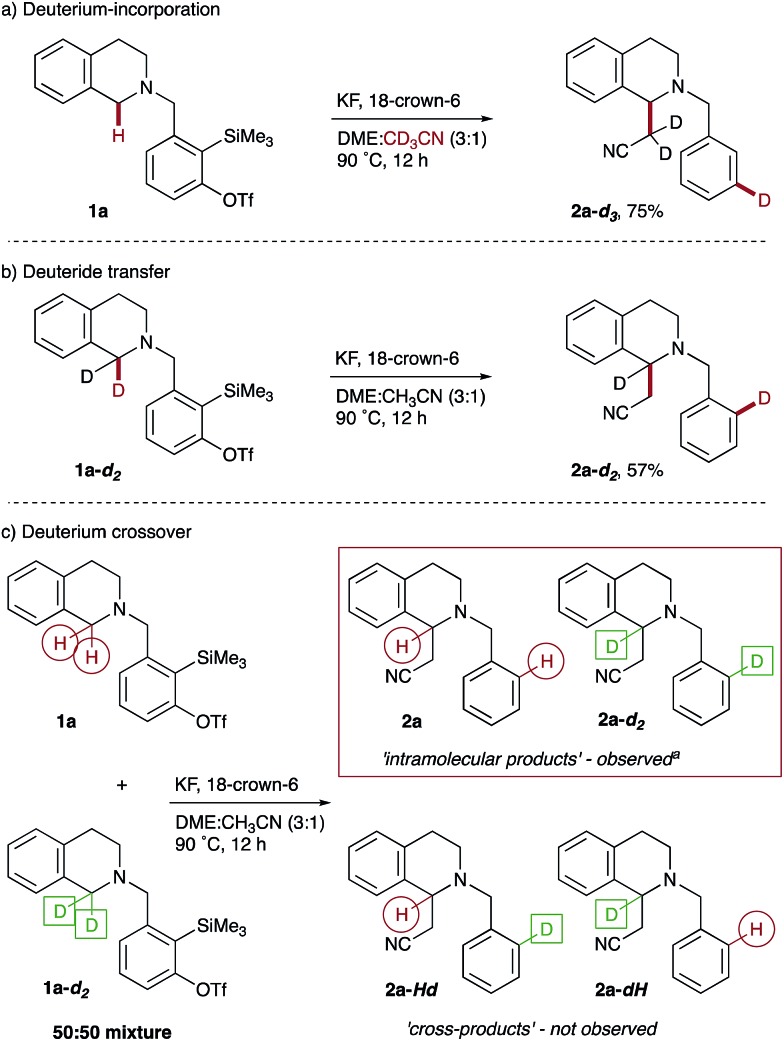
Scheme 5. Mechanistic experiments. Reaction conditions are as shown in Scheme 2. aProducts 2a and 2a-d2 isolated as an inseparable mixture of isotopologues (5 : 3.5, as determined by 1H NMR spectroscopy) in a combined 70% yield.
Scheme 6
Scheme 6. Proposed mechanism.

References

    1. Wencel-Delord J., Glorious F. Nat. Chem. 2013;5:369. - PubMed
    1. Selected reviews:

    2. Johansson C. C. C., Colacot T. J. Angew. Chem., Int. Ed. 2010;49:676. - PubMed
    3. Baudoin O. Chem. Soc. Rev. 2011;40:4902. - PubMed
    4. Li B.-J., Shi Z.-J. Chem. Soc. Rev. 2012;41:5588. - PubMed
    5. Geist E., Kirschning A., Schmidt T. Nat. Prod. Rep. 2014;31:441. - PubMed
    1. Chen W., Ma L., Paul A., Seidel D. Nat. Chem. 2018;10:165. - PMC - PubMed
    2. Campos K. R. Chem. Soc. Rev. 2007;36:1069. - PubMed
    3. Mitchell E. A., Peschiulli A., Lefevre N., Meerpoel L., Maes B. U. W. Chem.–Eur. J. 2012;18:10092. - PubMed
    1. Selected CDC reviews:

    2. Li C.-J. Acc. Chem. Res. 2009;42:335. - PubMed
    3. Zhang C., Tang C., Jiao N. Chem. Soc. Rev. 2012;41:3464. - PubMed
    4. Girard S. A., Knauber T., Li C.-J. Angew. Chem., Int. Ed. 2014;53:74. - PubMed
    5. Varun B. V., Dhineshkumar J., Bettadapur K. R., Siddaraju Y., Alagiri K., Prabhu K. R. Tetrahedron Lett. 2017;58:803.
    1. Selected metal-free CDC:

    2. Zhang Y., Li C.-J. J. Am. Chem. Soc. 2006;128:4242. - PubMed
    3. Richter H., Froehlich R., Daniliuc C. G., Mancheno O. G. Angew. Chem., Int. Ed. 2012;51:8656. - PubMed
    4. Schweitzer-Chaput B., Klussmann M. Eur. J. Org. Chem. 2013:666.