


What neuromodulation and lesion studies tell us about the function of the mirror neuron system and embodied cognition
- PMID: 29734039
- PMCID: PMC6173305
- DOI: 10.1016/j.copsyc.2018.04.001
What neuromodulation and lesion studies tell us about the function of the mirror neuron system and embodied cognition
Abstract
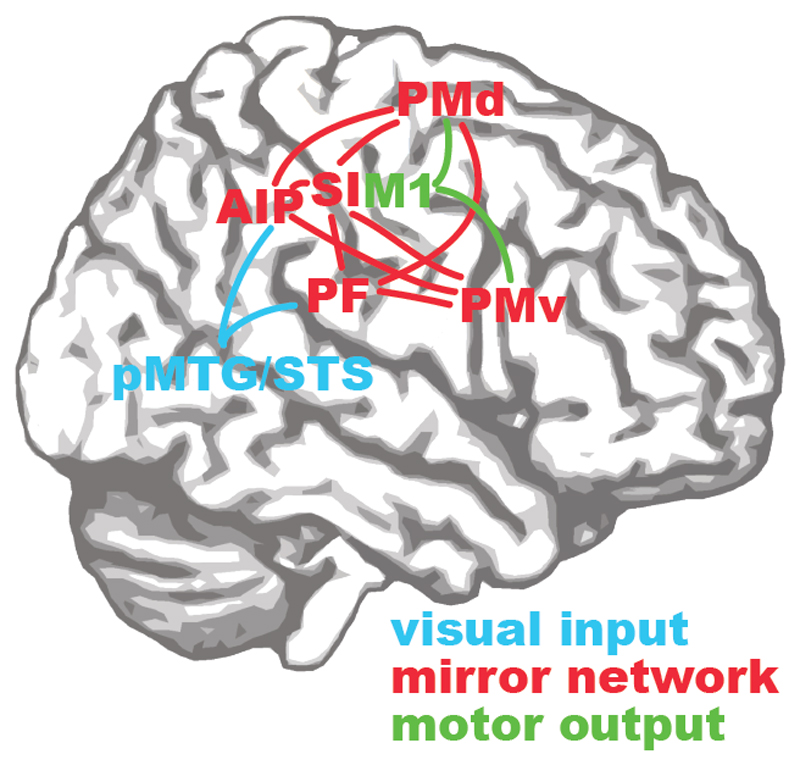
We review neuromodulation and lesion studies that address how activations in the mirror neuron system contribute to our perception of observed actions. Past reviews showed disruptions of this parieto-premotor network impair imitation and goal and kinematic processing. Recent studies bring five new themes. First, focal perturbations of a node of that circuit lead to changes across all nodes. Second, primary somatosensory cortex is an integral part of this network suggesting embodied representations are somatosensory-motor. Third, disturbing this network impairs the ability to predict the actions of others in the close (∼300ms) future. Fourth, disruptions impair our ability to coordinate our actions with others. Fifth, disrupting this network, the insula or cingulate also impairs emotion recognition.
Copyright © 2018 Elsevier Ltd. All rights reserved.
Figures
References
Important References
-
- Urgesi C, Candidi M, Avenanti A. Neuroanatomical substrates of action perception and understanding: an anatomic likelihood estimation meta-analysis of lesion-symptom mapping studies in brain injured patients. Front Hum Neurosci. 2014;8:1–17. doi: 10.3389/fnhum.2014.00344. [** A review summarizing neuromodulation studies up to 2014 showing deficits in action understanding following PM and IPL lesions] - DOI - PMC - PubMed
-
- Valchev N, Gazzola V, Avenanti A, Keysers C. Primary somatosensory contribution to action observation brain activity-combining fMRI and cTBS. Soc Cogn Affect Neurosci. 2016 doi: 10.1093/scan/nsw029. nsw029. [* A combined TMS fMRI study that shows that SI in closely integrated with PM and IPL during action observation, and that embodied representations are thus somatosensory-motor.] - DOI - PMC - PubMed
-
- de Wit MM, Buxbaum LJ. Critical Motor Involvement in Prediction of Human and Non-biological Motion Trajectories. J Int Neuropsychol Soc. 2017;23:171–184. doi: 10.1017/S1355617716001144. [** An elegant voxel-based lesion-sympton study that shows that lesions in a PM cluster and an SI/IPL cluster impair the ability to predict how actions should continue after occlusion.] - DOI - PMC - PubMed
-
- Avenanti A, Paracampo R, Annella L, Tidoni E, Aglioti SM. Boosting and decreasing action prediction abilities through excitatory and inhibitory tDCS of inferior frontal cortex. Cereb Cortex. 2017 [** An elegant tDCS study that shows that fascilitating and inhibiting PM results in improved and disrupted action prediction, respectively.] - PubMed
-
- Hadley LV, Novembre G, Keller PE, Pickering MJ. Causal Role of Motor Simulation in Turn-Taking Behavior. J Neurosci. 2015;35:16516–16520. doi: 10.1523/JNEUROSCI.1850-15.2015. [* A very original study showing that disrupting PM disrupts our ability to coordinate our actions with others] - DOI - PMC - PubMed
Publication types
MeSH terms
Grants and funding
LinkOut - more resources
Full Text Sources
Other Literature Sources
Miscellaneous
