Review
. 2018 Nov;48 Suppl 2(Suppl Suppl 2):e12949.
doi: 10.1111/eci.12949. Epub 2018 May 23.

CXCR4, the master regulator of neutrophil trafficking in homeostasis and disease

Affiliations
Review

CXCR4, the master regulator of neutrophil trafficking in homeostasis and disease

Katia De Filippo et al. Eur J Clin Invest. 2018 Nov.

Abstract

Background: Chemokines play a critical role in orchestrating the distribution and trafficking of neutrophils in homeostasis and disease.

Results: The CXCR4/CXCL12 chemokine axis has been identified as a central regulator of these processes.

Conclusion: In this review, we focus on the role of CXCR4/CXCL12 chemokine axis in regulating neutrophil release from the bone marrow and the trafficking of senescent neutrophils back to the bone marrow for clearance under homeostasis and disease. We also discuss the role of CXCR4 in fine-tuning neutrophil responses in the context of inflammation.

Keywords: CXCR4; clearance; mobilization; neutrophils; retention.


Figures

Figure 1
Figure 1
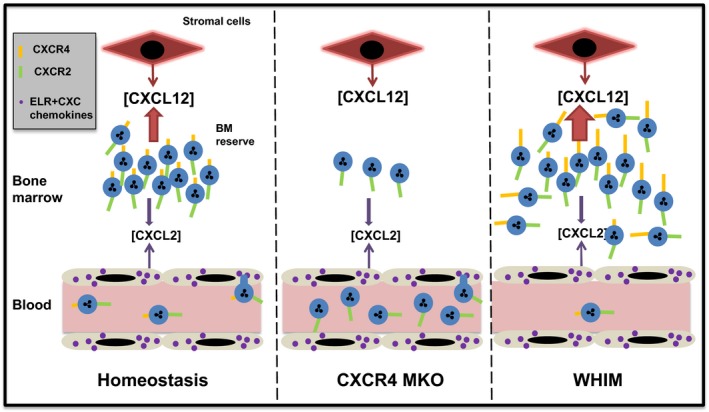
The CXCL12/CXCR4 neutrophil retention axis. There is a substantial storage pool of mature neutrophils in the bone marrow termed the bone marrow reserve. Under homeostasis, neutrophils are retained in the bone marrow due to the constitutive production of CXCL12 by stromal cells and expression of CXCR4 by neutrophils. Genetic deletion of CXCR4 in myeloid cells (CXCR4MKO) results in depletion of the bone marrow reserve with a rise in circulating neutrophil numbers. In WHIM syndrome, a genetic mutation of CXCR4 increases the activity of the receptor, thereby enhancing neutrophil retention in the bone marrow and reducing numbers in the blood
Figure 2
Figure 2
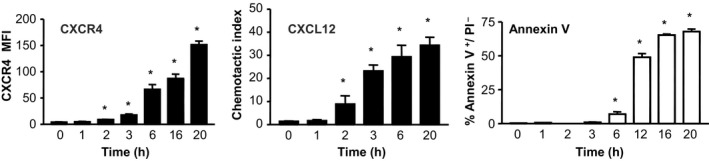
Upregulation of CXCR4 on human blood neutrophils in CXCL12‐free medium occurs rapidly, preceding apoptosis. Human neutrophils isolated from the blood of healthy volunteers were placed in culture in CXCL12‐free medium at 37°C and 5%CO 2. Levels of CXCR4 annexin V and PI were determined by flow cytometry, and migration to CXCL12 was assessed in a transwell chemotaxis assay (unpublished data courtesy of Coralie Martin and Andrew Scourfield). *P < .05
Figure 3
Figure 3
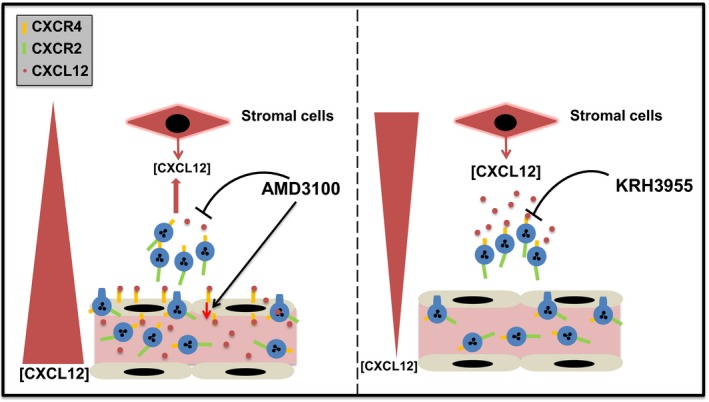
Neutrophil mobilisation by CXCR4 antagonists. Two CXCR4 antagonists AMD3100 and KRH3955, both stimulate neutrophil mobilisation into the blood, but by distinct mechanisms of action in vivo. AMD3100 interacts with the transmembrane domain of CXCR4 and stimulates the translocation of CXCL12 from the bone marrow stroma across the sinusoidal endothelium, increasing CXCL12 levels in the blood with a concomitant reduction in CXCL12 levels in the bone marrow. Neutrophils migrate in response to increased levels of CXCL12 in the blood. In contrast KRH3955 binds to the extracellular domain of CXCR4 and blocks binding of CXCL12 to the receptor, thereby directly disrupting the CXCL12/CXCR2 neutrophil retention axis in the bone marrow
Figure 4
Figure 4
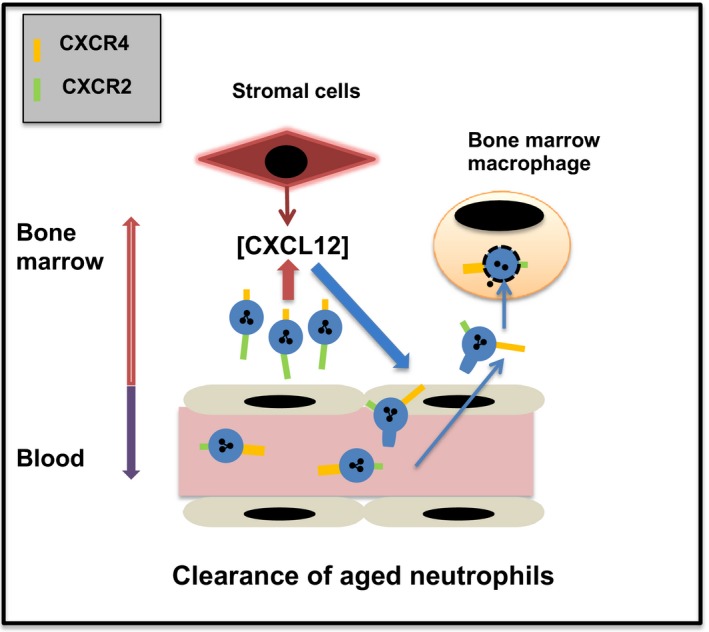
CXCR4‐dependent neutrophil clearance in the bone marrow upregulation of CXCR4 on neutrophils as they age increases their trafficking back to the bone marrow, where they are phagocytosed by bone marrow macrophages
Figure 5
Figure 5
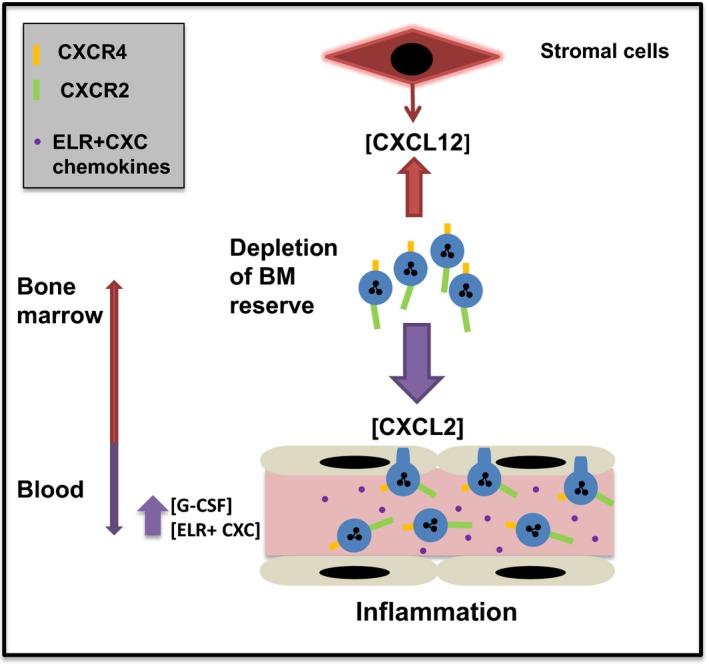
In response to inflammation, an increase in circulating GCSF and ELR+ CXC chemokines drives neutrophil egress from the bone marrow reserve into the blood resulting in a rapid rise in circulating numbers of neutrophils

References

    1. Bleul CC, Fuhlbrigge RC, Casasnovas JM, Aiuti A, Springer TA. A highly efficacious lymphocyte chemoattractant, stromal cell‐derived factor 1 (SDF‐1). J Exp Med. 1996;184:1101‐1109. - PMC - PubMed
    1. Oberlin E, Amara A, Bachelerie F, et al. The CXC chemokine SDF‐1 is the ligand for LESTR/fusin and prevents infection by T‐cell‐line‐adapted HIV‐1. Nature. 1996;382:833‐835. - PubMed
    1. Ma Q, Jones D, Borghesani PR, et al. Impaired B‐lymphopoiesis, myelopoiesis, and derailed cerebellar neuron migration in CXCR4‐ and SDF‐1‐deficient mice. Proc Natl Acad Sci USA. 1998;95:9448‐9453. - PMC - PubMed
    1. Boldajipour B, Doitsidou M, Tarbashevich K, et al. Cxcl12 evolution–subfunctionalization of a ligand through altered interaction with the chemokine receptor. Development. 2011;138:2909‐2914. - PubMed
    1. Feng Y, Broder CC, Kennedy PE, Berger EA. HIV‐1 entry cofactor: functional cDNA cloning of a seven‐transmembrane, G protein‐coupled receptor. Science. 1996;272:872‐877. - PubMed

MeSH terms

Supplementary concepts