


Current Challenges in Plant Eco-Metabolomics
- PMID: 29734799
- PMCID: PMC5983679
- DOI: 10.3390/ijms19051385
Current Challenges in Plant Eco-Metabolomics
Abstract
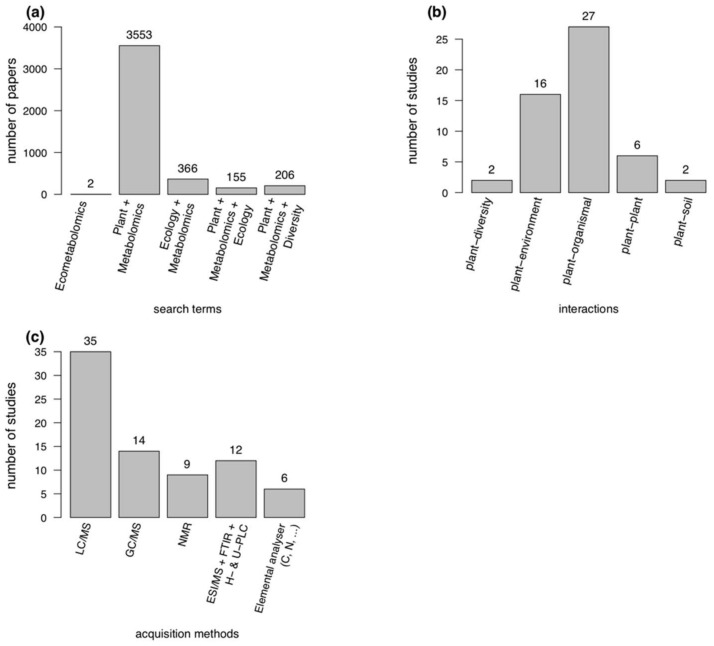
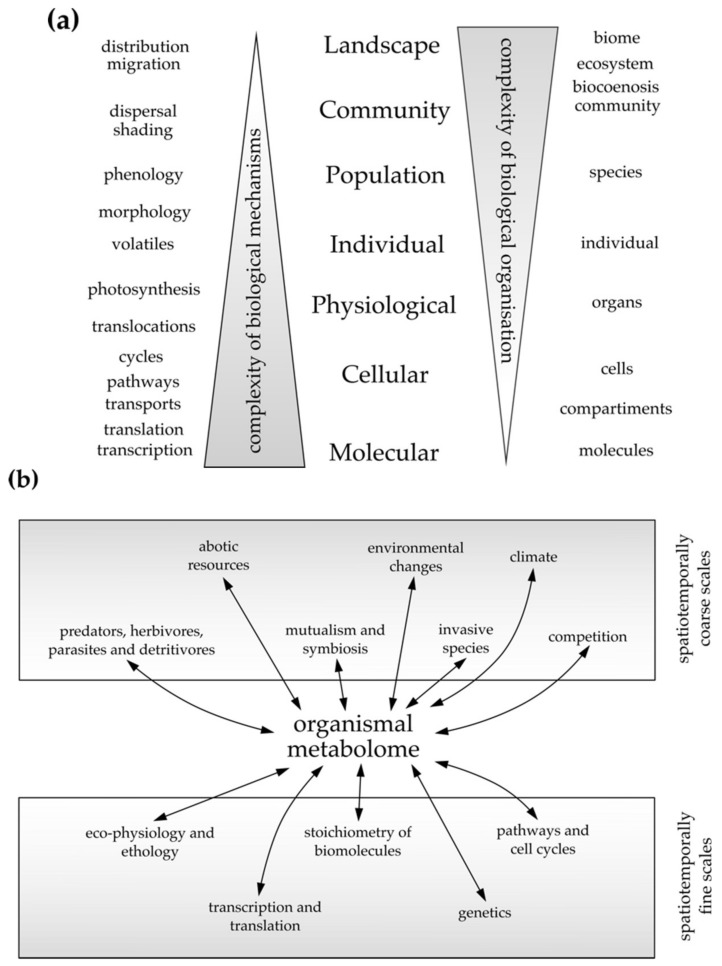
The relatively new research discipline of Eco-Metabolomics is the application of metabolomics techniques to ecology with the aim to characterise biochemical interactions of organisms across different spatial and temporal scales. Metabolomics is an untargeted biochemical approach to measure many thousands of metabolites in different species, including plants and animals. Changes in metabolite concentrations can provide mechanistic evidence for biochemical processes that are relevant at ecological scales. These include physiological, phenotypic and morphological responses of plants and communities to environmental changes and also interactions with other organisms. Traditionally, research in biochemistry and ecology comes from two different directions and is performed at distinct spatiotemporal scales. Biochemical studies most often focus on intrinsic processes in individuals at physiological and cellular scales. Generally, they take a bottom-up approach scaling up cellular processes from spatiotemporally fine to coarser scales. Ecological studies usually focus on extrinsic processes acting upon organisms at population and community scales and typically study top-down and bottom-up processes in combination. Eco-Metabolomics is a transdisciplinary research discipline that links biochemistry and ecology and connects the distinct spatiotemporal scales. In this review, we focus on approaches to study chemical and biochemical interactions of plants at various ecological levels, mainly plant⁻organismal interactions, and discuss related examples from other domains. We present recent developments and highlight advancements in Eco-Metabolomics over the last decade from various angles. We further address the five key challenges: (1) complex experimental designs and large variation of metabolite profiles; (2) feature extraction; (3) metabolite identification; (4) statistical analyses; and (5) bioinformatics software tools and workflows. The presented solutions to these challenges will advance connecting the distinct spatiotemporal scales and bridging biochemistry and ecology.
Keywords: biochemistry; bioinformatics; ecology; ecometabolomics; metabolites.
Conflict of interest statement
The authors declare no conflict of interest.
Figures
References
-
- Weiß B.M., Marcillo A., Manser M., Holland R., Birkemeyer C., Widdig A. A non-invasive method for sampling the body odour of mammals. Methods Ecol. Evol. 2018;9:420–429. doi: 10.1111/2041-210X.12888. - DOI
Publication types
MeSH terms
LinkOut - more resources
Full Text Sources
Other Literature Sources
