Review
. 2018 Apr 27:6:15.
doi: 10.1038/s41413-018-0016-9. eCollection 2018.

Rheumatoid arthritis: pathological mechanisms and modern pharmacologic therapies

Affiliations
Review

Rheumatoid arthritis: pathological mechanisms and modern pharmacologic therapies

Qiang Guo et al. Bone Res. .

Abstract

Rheumatoid arthritis (RA) is a chronic systemic autoimmune disease that primarily affects the lining of the synovial joints and is associated with progressive disability, premature death, and socioeconomic burdens. A better understanding of how the pathological mechanisms drive the deterioration of RA progress in individuals is urgently required in order to develop therapies that will effectively treat patients at each stage of the disease progress. Here we dissect the etiology and pathology at specific stages: (i) triggering, (ii) maturation, (iii) targeting, and (iv) fulminant stage, concomitant with hyperplastic synovium, cartilage damage, bone erosion, and systemic consequences. Modern pharmacologic therapies (including conventional, biological, and novel potential small molecule disease-modifying anti-rheumatic drugs) remain the mainstay of RA treatment and there has been significant progress toward achieving disease remission without joint deformity. Despite this, a significant proportion of RA patients do not effectively respond to the current therapies and thus new drugs are urgently required. This review discusses recent advances of our understanding of RA pathogenesis, disease modifying drugs, and provides perspectives on next generation therapeutics for RA.


Conflict of interest statement

The authors declare that they have no conflict of interest.

Figures

Fig. 1
Fig. 1
RA can be triggered in the potential trigger sites (lung, oral, gut, et al.) by the interaction between the genes and environmental factors, which is characterized by the onset of self-protein citrullination resulting in the production of autoantibodies against citrullinated peptides. Lung exposure to noxious agents, infectious agents (Porphyromonas gingivalis, Aggregatibacter actinomycetemcomitans, and Epstein-Barr virus), gut microbiome, and dietary factors may induce the self-protein citrullination and maturation of ACPA. Citrullination is catalyzed by the calcium-dependent enzyme PAD, changing a positively charged arginine to a polar but neutral citrulline as the result of a post-translational modification. In RA, PAD can be secreted by the granulocyte and macrophage. ACPA occurs as a result of an abnormal antibody response to a range of citrullinated proteins, including fibrin, vimentin, fibronectin, Epstein-Barr Nuclear Antigen 1, α-enolase, type II collagen, and histones, all of which are distributed throughout the whole body. Many citrullination neoantigens would activate MHC class II-dependent T cells that in turn would help B cells produce more ACPA. The stage is also called loss of tolerance. RA rheumatoid arthritis, PAD peptidyl-arginine-deiminase, ACPA anti-citrullinated  protein antibodies, RF rheumatoid factor.
Fig. 2
Fig. 2
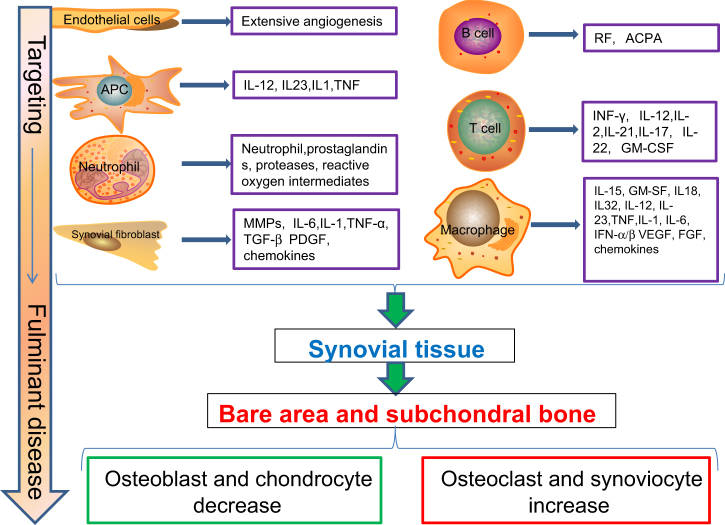
Many cells and their cytokines play critical roles in the development of RA. The synovial compartment is infiltrated by leukocytes and the synovial fluid is inundated with pro-inflammatory mediators that are produced to induce an inflammatory cascade, which is characterized by interactions of fibroblast-like synoviocytes with the cells of the innate immune system, including monocytes, macrophages, mast cells, dendritic cells, and so on, as well as cells of adaptive immune system such as T cells and B cells. Endothelial cells contribute to the extensive angiogenesis. The fulminant stage contains hyperplastic synovium, cartilage damage, bone erosion, and systemic consequence. Bone resorption virtually creates bone erosions, which are usually found at spots where the synovial membrane inserts into the periosteum, which is known as a bare area according to certain anatomical features. The destruction of the subchondral bone can eventually result in the degeneration of the articular cartilage as the result of a decrease in osteoblasts and an increase in osteoclasts and synoviocytes. IL interleukin, TNF tumor necrosis factor, MMP matrix metalloproteinase, TGF transforming growth factor, PDGF platelet-derived growth factor, IFN interferon, GM-CSF granulocyte–macrophage colony-stimulating factor, VEGF vascular endothelial growth factor, FGF fibroblast growth factor.
Fig. 3
Fig. 3
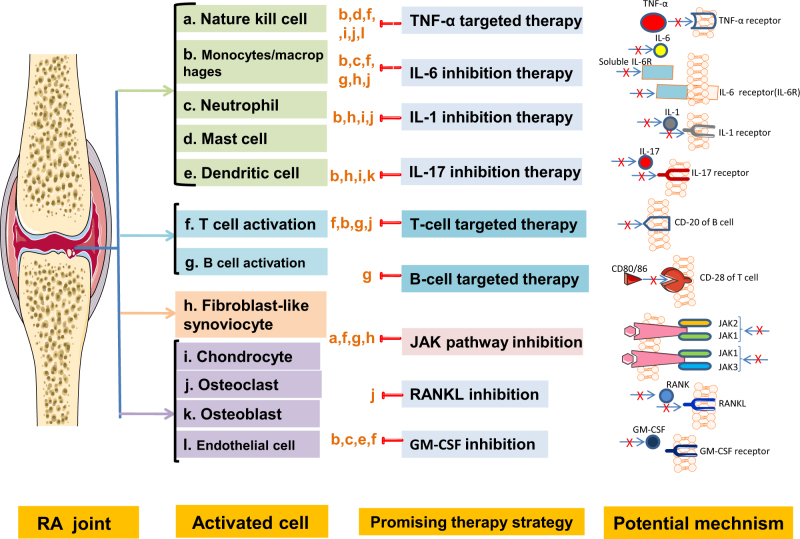
Cells and key receptors/pathways targeted by current therapy strategies. RANKL receptor activator of nuclear factor-ΚB ligand, JAK Janus kinase/signal transducers.

References

    1. Silman AJ, Pearson JE. Epidemiology and genetics of rheumatoid arthritis. Arthritis Res. 2002;4(Suppl. 3):S265–S272. - PMC - PubMed
    1. van der Linden MP, et al. Long-term impact of delay in assessment of patients with early arthritis. Arthritis Rheum. 2010;62:3537–3546. - PubMed
    1. Moura CS, et al. Early medication use in new-onset rheumatoid arthritis may delay joint replacement: results of a large population-based study. Arthritis Res. Ther. 2015;17:197. - PMC - PubMed
    1. Cho, S. K. et al. Factors associated with time to diagnosis from symptom onset in patients with early rheumatoid arthritis. Korean J. Intern. Med.113, (2017). - PMC - PubMed
    1. Raza K, et al. Delays in assessment of patients with rheumatoid arthritis: variations across Europe. Ann. Rheum. Dis. 2011;70:1822–1825. - PubMed