


Temporal Trends in Gestational Diabetes Prevalence, Treatment, and Outcomes at Aarhus University Hospital, Skejby, between 2004 and 2016
- PMID: 29736403
- PMCID: PMC5875052
- DOI: 10.1155/2018/5937059
Temporal Trends in Gestational Diabetes Prevalence, Treatment, and Outcomes at Aarhus University Hospital, Skejby, between 2004 and 2016
Abstract
Background: The prevalence of gestational diabetes (GDM) is increasing worldwide. The most important risk of GDM in pregnancy is excessive fetal growth, increasing the risk of complications during delivery as well as long-term complications like obesity and diabetes in both the mother and the offspring.
Method: All women with GDM who delivered a singleton between 2004 and 2016 were included. The treatment of GDM patients sought to achieve normal blood glucose levels, primarily by diet and exercise. If the glycemic targets were not reached, insulin therapy was initiated. Birth weight and birth weight Z-score was calculated corrected for gender and gestational age at delivery.
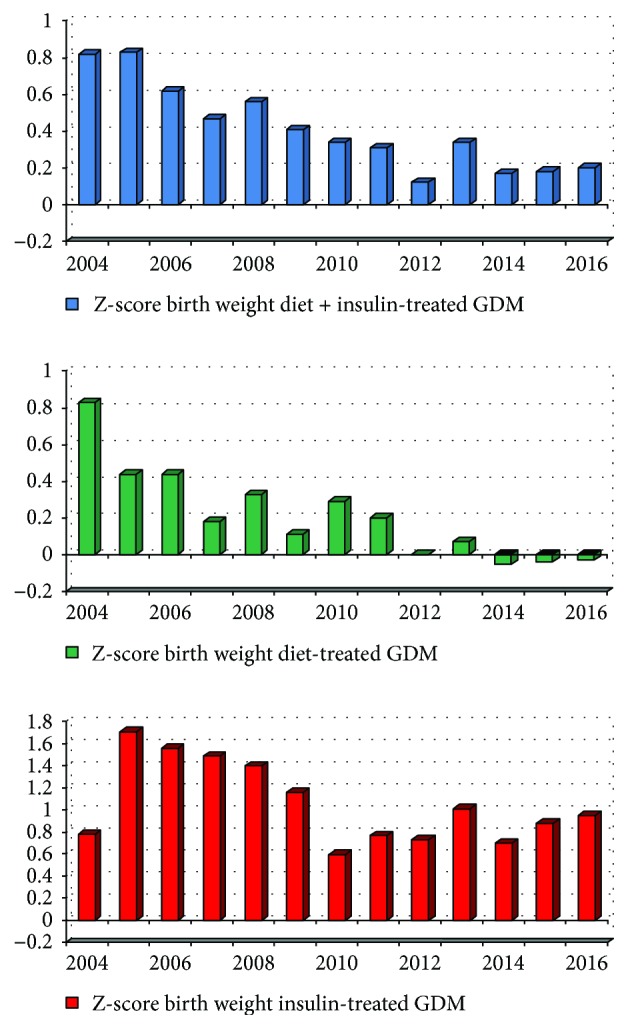
Results: The study included 1910 women. The number of GDM women increased significantly each year over the course of the study, as did the proportion requiring insulin therapy. Birth weight and birth weight Z-score fell significantly over the years largely due to a decrease in large for gestational age frequency from 29% to around 19%.
Conclusion: During the last 13 years, the number of women diagnosed with GDM has increased. Furthermore, the proportion of GDM women receiving insulin treatment has increased. The birth weight in diet-treated women has been virtually normal for the last 5 years of the reported period.
References
-
- Benhalima K., Mathieu C., Van Assche A., et al. Survey by the European Board and College of Obstetrics and Gynaecology on screening for gestational diabetes in Europe. European Journal of Obstetrics & Gynecology, and Reproductive Biology. 2016;201:197–202. doi: 10.1016/j.ejogrb.2016.04.003. - DOI - PubMed
-
- International Association of Diabetes and Pregnancy Study Groups Consensus Panel, Metzger B. E., Gabbe S. G., et al. International association of diabetes and pregnancy study groups recommendations on the diagnosis and classification of hyperglycemia in pregnancy. Diabetes Care. 2010;33(3):676–682. doi: 10.2337/dc09-1848. - DOI - PMC - PubMed
MeSH terms
Substances
LinkOut - more resources
Full Text Sources
Other Literature Sources
Medical
