


Use of TT-PCL versus TT-TG
- PMID: 29736872
- PMCID: PMC5970116
- DOI: 10.1007/s12178-018-9481-4
Use of TT-PCL versus TT-TG
Abstract
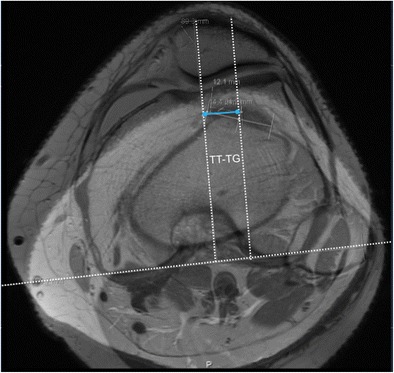
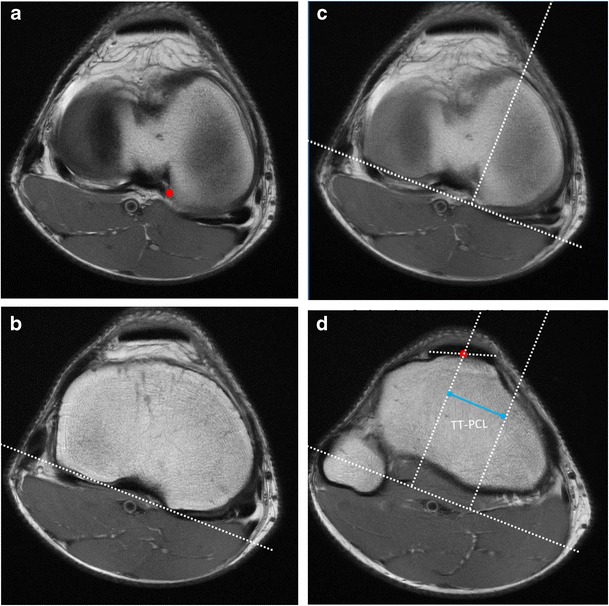
Purpose of review: The tibial tubercle-to-trochlear groove (TT-TG) distance and tibial tubercle-to-posterior cruciate ligament (TT-PCL) distance have both been proposed for use in the evaluation of patients with patellofemoral instability.
Recent findings: While the TT-TG value may be confounded by several factors, including age, gender, body mass index, and varying degrees of knee flexion on cross-sectional imaging, recent literature supports its utility for differentiation of patients with and without patellofemoral instability, and stratification of patients with and without coronal malalignment. The TT-PCL describes pure lateralization of the tibial tubercle, and may be used in conjunction with the TT-TG to better understand the path taken by the extensor mechanism of the knee joint. The TT-TG measurement is superior to the TT-PCL measurement for differentiating patients with patellofemoral instability from their stable counterparts, though TT-PCL may be useful in conjunction with TT-TG for better understanding the path of the extensor mechanism across the knee joint.
Keywords: Instability; Patellofemoral; TT-PCL; TT-TG; Tibial tubercle osteotomy.
Conflict of interest statement
Conflict of Interest
Beth E. Shubin Stein is a consultant for Arthrex. Other authors have no conflicts of interest.
Human and Animal Rights and Informed Consent
This article does not contain any studies with human or animal subjects performed by any of the authors.
Figures
References
-
- France L, Nester C. Effect of errors in the identification of anatomical landmarks on the accuracy of Q angle values. 2001;16:710–713. - PubMed
-
- • Camp CL, Stuart MJ, Krych AJ, Levy BA, Bond JR, Collins MS, et al. CT and MRI measurements of tibial tubercle-trochlear groove distances are not equivalent in patients with patellar instability. Am J Sports Med. 2013 [cited 2014 Oct 29];41(8):1835–40. Available from: http://ajs.sagepub.com/cgi/content/short/41/8/1835. While both MRI and CT measurements of TT-TG distances were found to have high interrater reliability, the values were not equivalent, and the authors concluded that MRI might underestimate TT-TG compared to CT. - PubMed
-
- Yao L, Gai N, Boutin RD. Axial scan orientation and the tibial tubercle-trochlear groove distance: error analysis and correction. AJR Am J Roentgenol. 2014 Jun [cited 2014 Jun 12];202(6):1291–6. Available from: http://www.ncbi.nlm.nih.gov/pubmed/24848827. - PubMed
Publication types
LinkOut - more resources
Full Text Sources
Other Literature Sources
Research Materials
Miscellaneous
