


Impact of early changes in serum biomarkers following androgen deprivation therapy on clinical outcomes in metastatic hormone-sensitive prostate cancer
- PMID: 29739368
- PMCID: PMC5941329
- DOI: 10.1186/s12894-018-0353-4
Impact of early changes in serum biomarkers following androgen deprivation therapy on clinical outcomes in metastatic hormone-sensitive prostate cancer
Abstract
Background: Less evidence is known about the role of early changes in serum biomarker after androgen deprivation therapy (ADT) in patients with metastatic hormone-sensitive prostate cancer (mHSPC). Here we evaluated the impact of pre-treatment prognostic factors and early changes in serum biomarkers on prostate specific antigen (PSA) progression-free and overall survival rates in mHSPC.
Methods: We retrospectively reviewed the medical records of 60 mHSPC patients (median age 72 years) treated with ADT whose laboratory data at baseline and following 12 weeks were available.
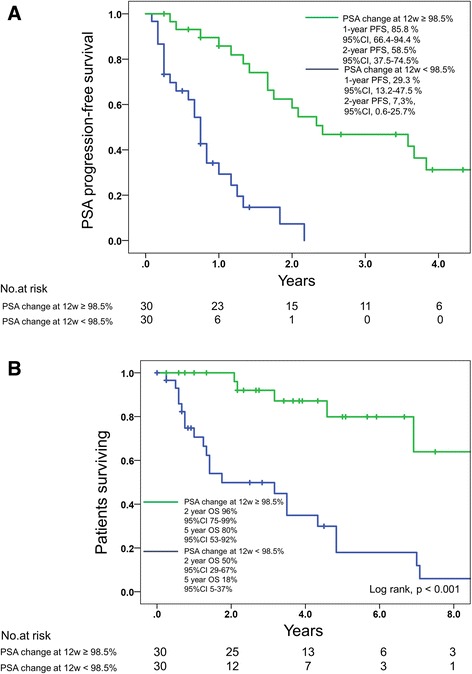
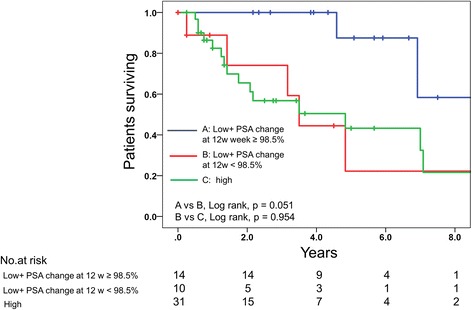
Results: Forty-four patients (73%) had PSA progression and 27 patients (45.0%) died during a median follow-up of 34 months. The multivariable Cox hazard model demonstrated that a log-transformed baseline PSA level (p = 0.003) and an extent of bone disease (EOD) score of ≥3 (p = 0.004) were statistically associated with an increased risk for PSA progression whereas one unit increase in a log-transformed PSA change (baseline-12 weeks) was associated with a decreased risk for PSA progression (p = 0.004). For overall survival, a high level of alkaline phosphatase (ALP) at 12 weeks was associated with increased risk (p = 0.030) whereas a one-unit increase in the log-transformed PSA change was associated with decreased risk (p = 0.001).
Conclusions: An increased level of PSA at baseline, or an EOD score of ≥3 may be a good predictor of PSA progression, and a high level of ALP at 12 weeks may be a risk predictor of death. A larger decline in PSA at 12 weeks from the baseline was associated with both PSA progression-free and overall survival time. Early changes in serum biomarkers may be useful in predicting poor outcomes in patients with mHSPC who are initially treated with ADT.
Conflict of interest statement
Competing interests
The authors declare that they have no competing interests.
Publisher’s Note
Springer Nature remains neutral with regard to jurisdictional claims in published maps and institutional affiliations.
Figures
References
-
- Vale CL, Burdett S, Rydzewska LH, Albiges L, Clarke NW, Fisher D, Fizazi K, Gravis G, James ND, Mason MD, et al. Addition of docetaxel or bisphosphonates to standard of care in men with localised or metastatic, hormone-sensitive prostate cancer: a systematic review and meta-analyses of aggregate data. The Lancet Oncology. 2016;17:243–256. doi: 10.1016/S1470-2045(15)00489-1. - DOI - PMC - PubMed
-
- Lee JL, Kim JE, Ahn JH, Lee DH, Lee J, Kim CS, Hong JH, Hong B, Song C, Ahn H. Efficacy and safety of docetaxel plus prednisolone chemotherapy for metastatic hormone-refractory prostate adenocarcinoma: single institutional study in Korea. Cancer Res Treat : official journal of Korean Cancer Association. 2010;42:12–17. doi: 10.4143/crt.2010.42.1.12. - DOI - PMC - PubMed
MeSH terms
Substances
LinkOut - more resources
Full Text Sources
Other Literature Sources
Medical
Research Materials
Miscellaneous
