


Environmental and social determinants of population vulnerability to Zika virus emergence at the local scale
- PMID: 29739467
- PMCID: PMC5941591
- DOI: 10.1186/s13071-018-2867-8
Environmental and social determinants of population vulnerability to Zika virus emergence at the local scale
Abstract
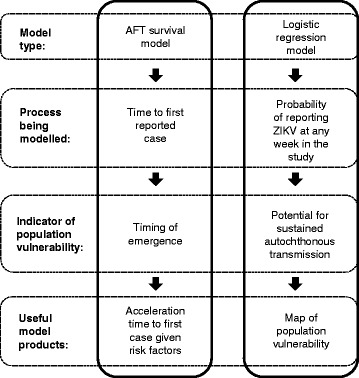
Background: Zika virus (ZIKV) spread rapidly in the Americas in 2015. Targeting effective public health interventions for inhabitants of, and travellers to and from, affected countries depends on understanding the risk of ZIKV emergence (and re-emergence) at the local scale. We explore the extent to which environmental, social and neighbourhood disease intensity variables influenced emergence dynamics. Our objective was to characterise population vulnerability given the potential for sustained autochthonous ZIKV transmission and the timing of emergence. Logistic regression models estimated the probability of reporting at least one case of ZIKV in a given municipality over the course of the study period as an indicator for sustained transmission; while accelerated failure time (AFT) survival models estimated the time to a first reported case of ZIKV in week t for a given municipality as an indicator for timing of emergence.
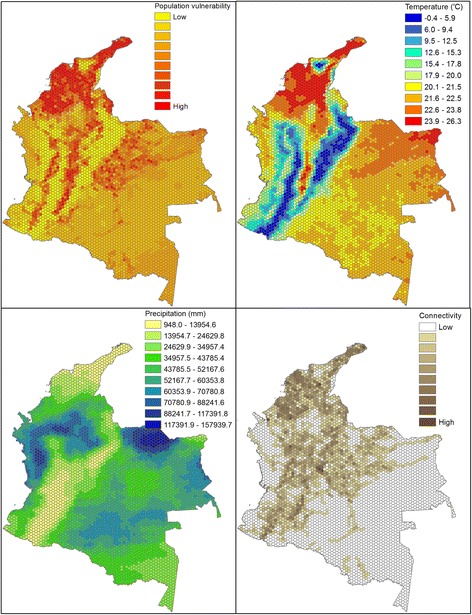
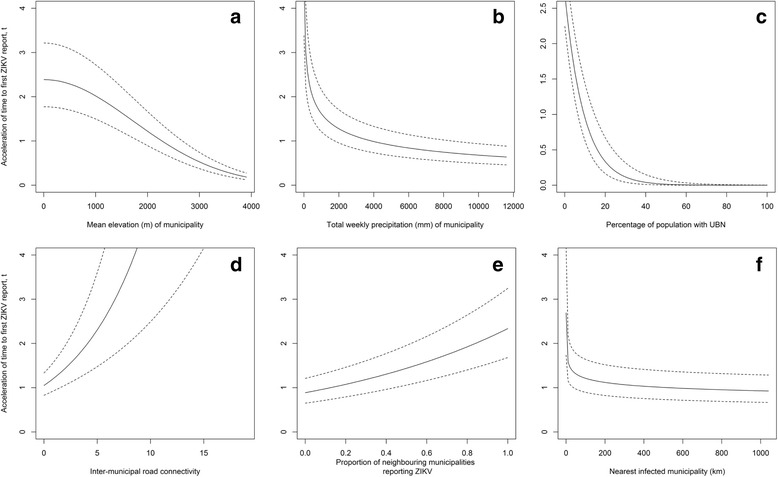
Results: Sustained autochthonous ZIKV transmission was best described at the temporal scale of the study period (almost one year), such that high levels of study period precipitation and low mean study period temperature reduced the probability. Timing of ZIKV emergence was best described at the weekly scale for precipitation in that high precipitation in the current week delayed reporting. Both modelling approaches detected an effect of high poverty on reducing/slowing case detection, especially when inter-municipal road connectivity was low. We also found that proximity to municipalities reporting ZIKV had an effect to reduce timing of emergence when located, on average, less than 100 km away.
Conclusions: The different modelling approaches help distinguish between large temporal scale factors driving vector habitat suitability and short temporal scale factors affecting the speed of spread. We find evidence for inter-municipal movements of infected people as a local-scale driver of spatial spread. The negative association with poverty suggests reduced case reporting in poorer areas. Overall, relatively simplistic models may be able to predict the vulnerability of populations to autochthonous ZIKV transmission at the local scale.
Keywords: Accelerated failure time survival model; Colombia; Environmental determinants; Logistic regression model; Public health surveillance; Risk analysis; Social bias; Zika.
Conflict of interest statement
Ethics approval and consent to participate
Formal ethical review was not sought because, in line with current guidelines [61], the study relied solely on secondary use of anonymous information, and there was no data linkage, recording or dissemination of results that could generate identifiable information.
Competing interests
The authors declare that they have no competing interests.
Publisher’s Note
Springer Nature remains neutral with regard to jurisdictional claims in published maps and institutional affiliations.
Figures
References
Publication types
MeSH terms
LinkOut - more resources
Full Text Sources
Other Literature Sources
Medical
