


Limit, lean or listen? A typology of low-value care that gives direction in de-implementation
- PMID: 29741672
- PMCID: PMC6307334
- DOI: 10.1093/intqhc/mzy100
Limit, lean or listen? A typology of low-value care that gives direction in de-implementation
Abstract
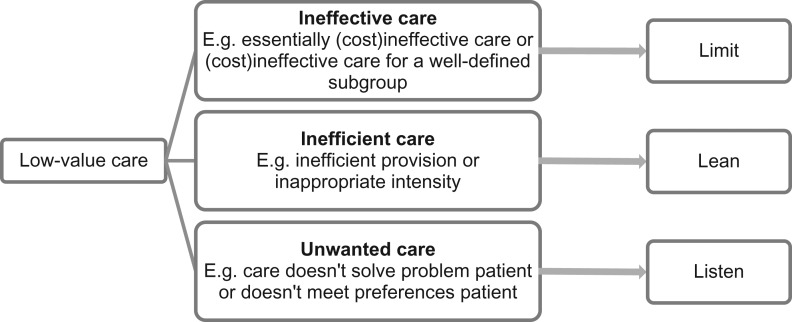
Background: Overuse of unnecessary care is widespread around the world. This so-called low-value care provides no benefit for the patient, wastes resources and can cause harm. The concept of low-value care is broad and there are different reasons for care to be of low-value. Hence, different strategies might be necessary to reduce it and awareness of this may help in designing a de-implementation strategy. Based on a literature scan and discussions with experts, we identified three types of low-value care.
Results: The type ineffective care is proven ineffective, such as antibiotics for a viral infection. Inefficient care is in essence effective, but is of low-value through inefficient provision or inappropriate intensity, such as chronic benzodiazepine use. Unwanted care is in essence appropriate for the clinical condition it targets, but is low-value since it does not fit the patients' preferences, such as a treatment aimed to cure a patient that prefers palliative care. In this paper, we argue that these three types differ in their most promising strategy for de-implementation and that our typology gives direction in choosing whether to limit, lean or listen.
Conclusion: We developed a typology that provides insight in the different reasons for care to be of low-value. We believe that this typology is helpful in designing a tailor-made strategy for reducing low-value care.
Figures
References
MeSH terms
LinkOut - more resources
Full Text Sources
Other Literature Sources
