


Gabapentin for the Treatment of Vulvodynia: A Randomized Controlled Trial
- PMID: 29742655
- PMCID: PMC6020139
- DOI: 10.1097/AOG.0000000000002617
Gabapentin for the Treatment of Vulvodynia: A Randomized Controlled Trial
Abstract
Objective: To evaluate whether extended-release gabapentin is more effective than placebo among women with vulvodynia.
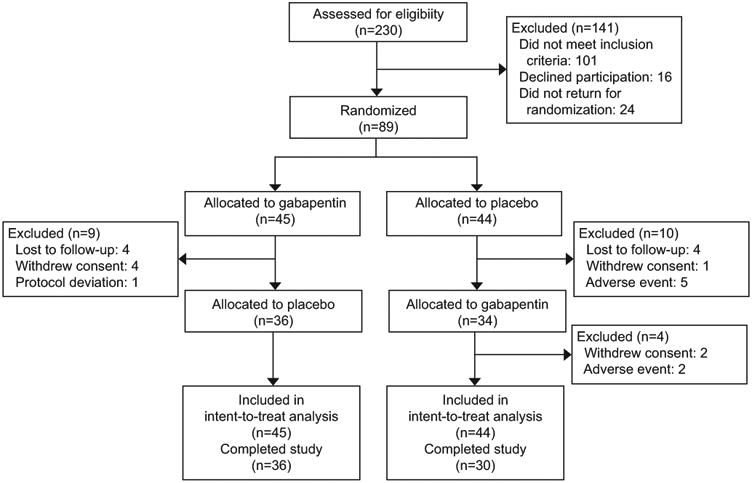
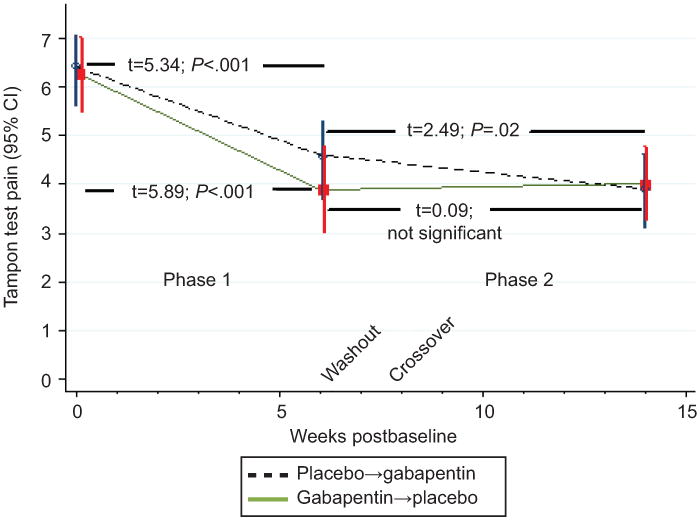
Methods: In a multicenter double-blind, placebo-controlled randomized crossover trial, gabapentin (1,200-3,000 mg/d) was compared with a placebo. The primary outcome was mean pain intensity (0, no pain at all to 10, worst pain ever) on the tampon test (a standardized tampon insertion and removal test used as a surrogate marker for dyspareunia) during the last 7 days of the maintenance phase. Secondary outcomes included sexual intercourse pain and daily pain. A sample size of 53 provided 90% power to detect a 1-point reduction on the tampon test (.05 level, two-sided) between the two treatment phases.
Results: From August 2012 to January 2016, 230 women were screened at three academic institutions and 89 (mean age 37 years; 65% black) were randomized: 45 to gabapentin first and then placebo and 44 to placebo first and then gabapentin. Tampon test pain with gabapentin was not different compared with the placebo (adjusted mean 4.0, 95% CI 3.0-4.9 vs 4.3, 95% CI 3.4-5.2, difference -0.3, 95% CI -0.7 to 0.0; P=.07). Gabapentin also did not improve pain over placebo for sexual intercourse pain (adjusted mean 3.9, 95% CI 2.4-5.3 vs 4.0, 95% CI 2.5-5.4, difference -0.1, 95% CI -0.9 to 0.6; P=.76) and daily pain (adjusted mean 2.7, 95% CI 1.8-3.6 vs 2.9, 95% CI 2.0-3.8, difference -0.2, 95% CI -0.5 to -0.2; P=.36). Subset analyses found that longer pain duration and oral contraceptive nonuse were associated with minimal improvement in tampon test pain with gabapentin.
Conclusion: In this cohort, extended-release gabapentin, as compared with a placebo, did not reduce tampon test pain. These data do not support the recommendation of gabapentin alone as treatment for vulvodynia.
Clinical trial registration: ClinicalTrials.gov, NCT01301001.
Figures
Comment in
-
Excerpts from the World Medical Literature.J Obstet Gynaecol Can. 2018 Nov;40(11):1387-1389. doi: 10.1016/j.jogc.2018.08.020. J Obstet Gynaecol Can. 2018. PMID: 30473115 No abstract available.
References
-
- Harlow BL, Stewart EG. A population-based assessment of chronic unexplained vulvar pain: have we underestimated the prevalence of vulvodynia? J Am Med Women's Assoc. 2003;58:82–8. - PubMed
-
- Bornstein J. Efficacy study of topical application of nifedipine cream to treat vulvar vestibulitis. J Lower Gen Tract Dis. 2009;13:S1–S28. 33.
-
- Petersen CD, Giraldi A, Lundvall L, Kristensen E. Botulinum toxin type A-a novel treatment for provoked vestibulodynia? Results from a randomized, placebo controlled, double blinded study. J Sex Med. 2009;6:2523–37. - PubMed
Publication types
MeSH terms
Substances
Associated data
Grants and funding
LinkOut - more resources
Full Text Sources
Other Literature Sources
Medical
