


Sickness absence as a predictor of disability retirement in different occupational classes: a register-based study of a working-age cohort in Finland in 2007-2014
- PMID: 29743328
- PMCID: PMC5942421
- DOI: 10.1136/bmjopen-2017-020491
Sickness absence as a predictor of disability retirement in different occupational classes: a register-based study of a working-age cohort in Finland in 2007-2014
Abstract
Objectives: The objective of the study was to examine diagnosis-specific sickness absences of different lengths as predictors of disability retirement in different occupational classes.
Design: Register-based prospective cohort study up to 8 years of follow-up.
Participants: A 70% random sample of the non-retired Finnish population aged 25-62 at the end of 2006 was included (n=1 727 644) and linked to data on sickness absences in 2005 and data on disability retirement in 2007-2014.
Main outcome measures: Cox proportional hazards regression was utilised to analyse the association of sickness absence with the risk of all-cause disability retirement during an 8-year follow-up.
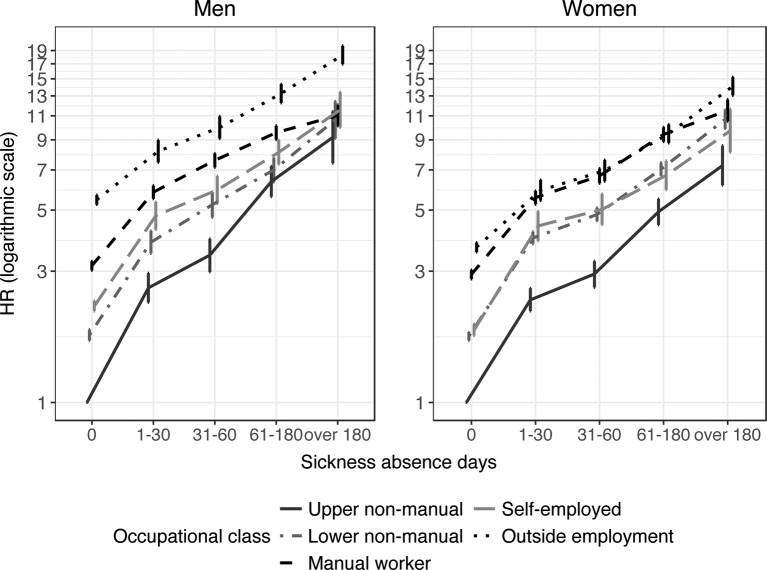
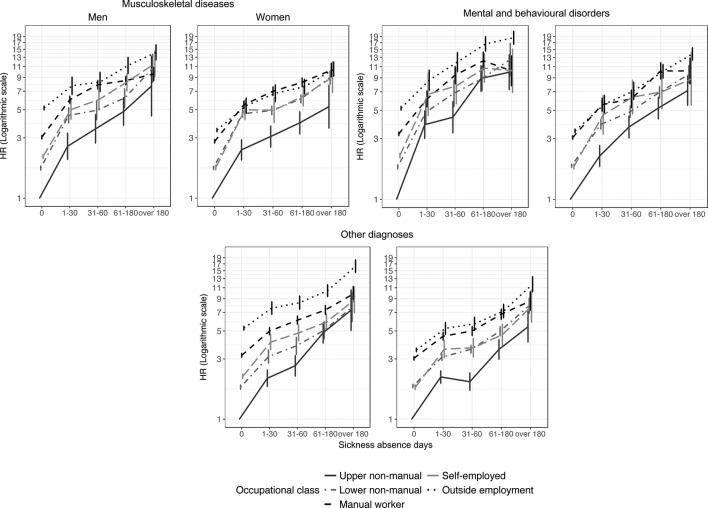
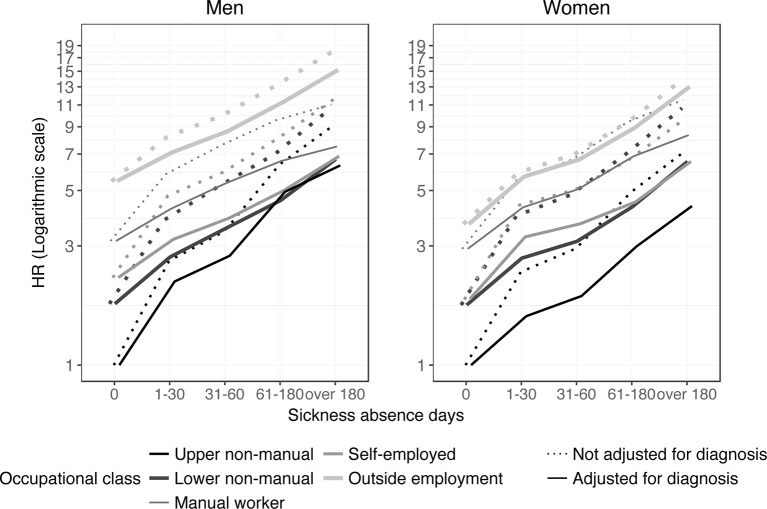
Results: The risk of disability retirement increased with increasing lengths of sickness absence in all occupational classes. A long sickness absence was a particularly strong predictor of disability retirement in upper non-manual employees as among those with over 180 sickness absence days the HR was 9.19 (95% CI 7.40 to 11.40), but in manual employees the HR was 3.51 (95% CI 3.23 to 3.81) in men. Among women, the corresponding HRs were 7.26 (95% CI 6.16 to 8.57) and 3.94 (95% CI 3.60 to 4.30), respectively. Adjusting for the diagnosis of sickness absence partly attenuated the association between the length of sickness absence and the risk of disability retirement in all employed groups.
Conclusions: A long sickness absence is a strong predictor of disability retirement in all occupational classes. Preventing the accumulation of sickness absence days and designing more efficient policies for different occupational classes may be crucial to reduce the number of transitions to early retirement due to disability.
Keywords: public health; social medicine.
© Article author(s) (or their employer(s) unless otherwise stated in the text of the article) 2018. All rights reserved. No commercial use is permitted unless otherwise expressly granted.
Conflict of interest statement
Competing interests: None declared.
Figures
References
-
- OECD. Sickness, disability and work: breaking the barriers; a synthesis of findings across OECD countries. Paris: OECD, 2010:165 Sickness, disability and work: breaking the barriers.
Publication types
MeSH terms
LinkOut - more resources
Full Text Sources
Other Literature Sources
Medical
