. 2018 May 9;7(1):84.
doi: 10.1038/s41426-018-0077-2.

Enterovirus 71 infection of human airway organoids reveals VP1-145 as a viral infectivity determinant

Affiliations

Enterovirus 71 infection of human airway organoids reveals VP1-145 as a viral infectivity determinant

Sabine M G van der Sanden et al. Emerg Microbes Infect. .

Abstract

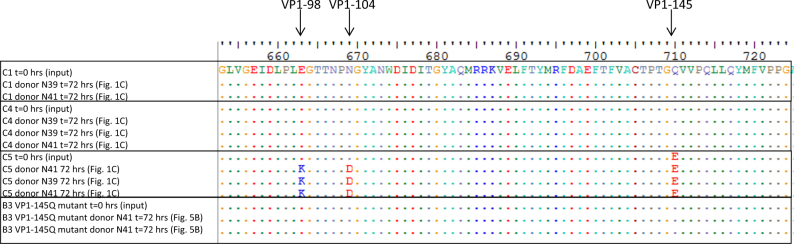
Human enteroviruses frequently cause severe diseases in children. Human enteroviruses are transmitted via the fecal-oral route and respiratory droplets, and primary replication occurs in the gastro-intestinal and respiratory tracts; however, how enteroviruses infect these sites is largely unknown. Human intestinal organoids have recently proven to be valuable tools for studying enterovirus-host interactions in the intestinal tract. In this study, we demonstrated the susceptibility of a newly developed human airway organoid model for enterovirus 71 (EV71) infection. We showed for the first time in a human physiological model that EV71 replication kinetics are strain-dependent. A glutamine at position 145 of the VP1 capsid protein was identified as a key determinant of infectivity, and residues VP1-98K and VP1-104D were identified as potential infectivity markers. The results from this study provide new insights into EV71 infectivity in the human airway epithelia and demonstrate the value of organoid technology for virus research.


Conflict of interest statement

N.S. and H.C. are inventors on patents/patent applications related to organoid technology. The other authors declare that they have no conflict of interest.

Figures
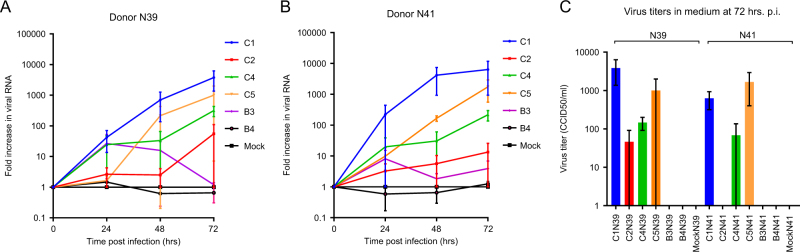
Fig. 1
Fig. 1. Replication kinetics of enterovirus 71 (EV71) in human airway organoids.
a, b Fold increases in viral RNA of EV71 subgenotype strains C1 (C1 91-480), C2 (2485), C4 (75-Yamagata), C5 (209-VN), B3 (SK-EV006), and B4 (C7-Osaka) in donors N39 and N41, determined by RT-PCR on lysed organoids. Data present the mean fold increase in two infection experiments + standard error of the mean (SEM). c Viral titers detected in the medium covering the gel-embedded organoids at 72 h postinfection (p.i.). Titers are expressed as the mean 50% cell culture infective dose (CCID50)/ml in two infection experiments + SEM
Fig. 2
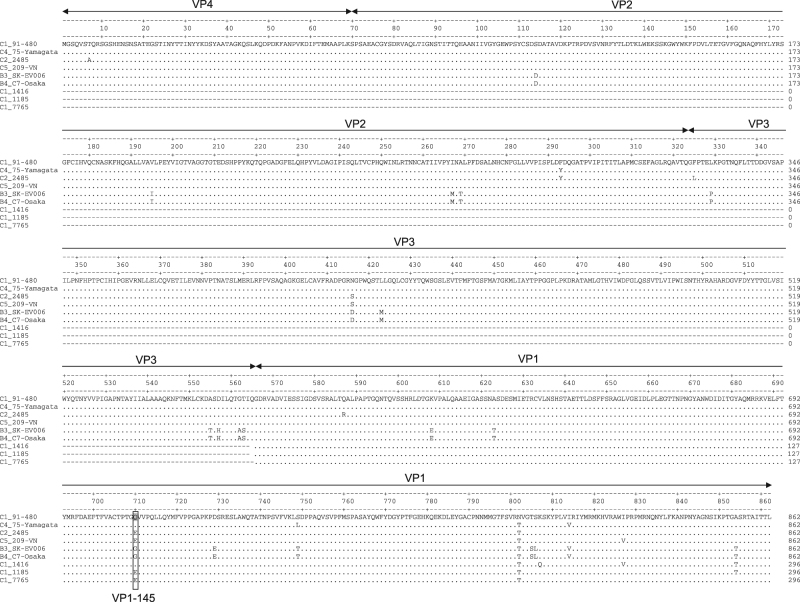
Fig. 2. Amino acid sequence comparison of the EV71 strain capsid regions included in the current study.
Residue 145 of the VP1 capsid region is marked by a box
Fig. 3
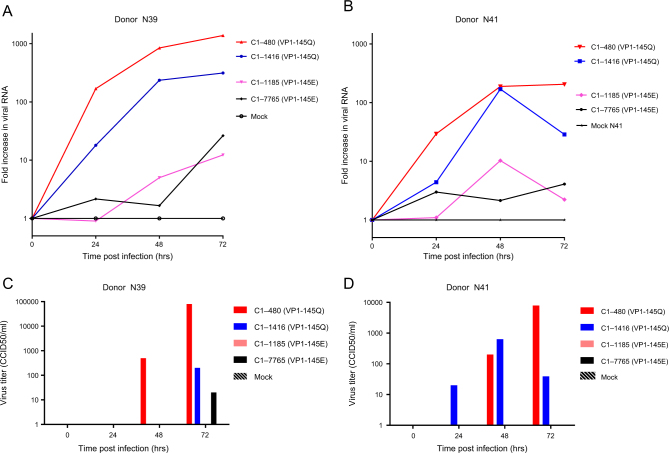
Fig. 3. Replication kinetics of EV71 subgenotype C1 strains with a glutamine (Q) or glutamic acid (E) at VP1 residue 145 in human airway organoids.
a, b Fold increases in viral RNA of EV71 strains in donors N39 and N41, respectively. Values presented were calculated from RT-PCR assays of lysed organoids. c, d Viral titers detected in the medium covering embedded organoids of donors N39 and N41, respectively, at 0 to 72 h postinfection. Titers are expressed as the 50% cell culture infective dose (CCID50)/ml
Fig. 4
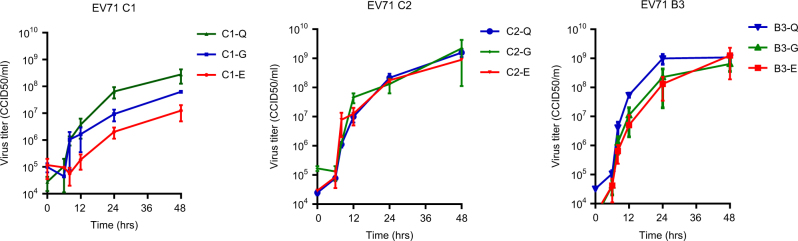
Fig. 4. Growth characteristics of EV71 C1, C2, and B3 strains with a glutamic acid (E), glycine (G), or glutamine (Q) at VP1-145, generated by site-directed mutagenesis, in rhabdomyosarcoma (RD) cells.
Data represent the mean 50% cell culture infective dose (CCID50)/ml in two infection experiments + SEM
Fig. 5
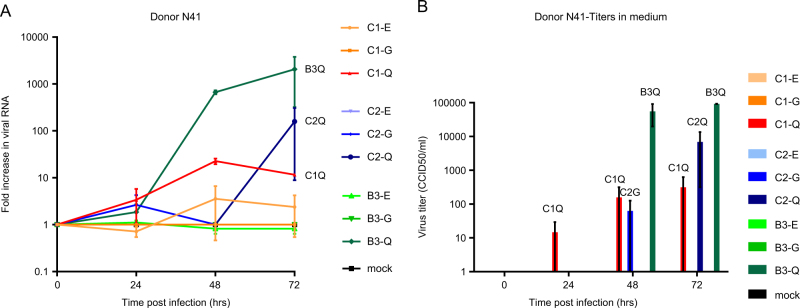
Fig. 5. Replication kinetics of EV71 strains with a glutamic acid (E), glycine (G), or glutamine (Q) at VP1-145, generated by site-directed mutagenesis, in human airway organoids.
a Fold increases in viral RNA of C1, C2, and B3 strains with VP1-145E, -G, or -Q in donor N41, determined by RT-PCR assay on lysed organoids. Data present the mean fold increase in two infection experiments + SEM. b Viral titers detected in the medium covering embedded organoids at 0–72 h postinfection. Titers are expressed as the mean 50% cell culture infective dose (CCID50)/ml in two infection experiments+SEM
Fig. 6
Fig. 6
Comparison of EV71 VP1 amino acid sequences that were retained from the organoid culture medium 72 h postinfection

References

    1. Zaoutis T, Klein JD. Enterovirus infections. Pediatr. Rev. 1998;19:183–191. doi: 10.1542/pir.19-6-183. - DOI - PubMed
    1. Dunn J. J. Enteroviruses and parechoviruses. Microbiol. Spectr. https://microbiolspec.DMIH2-0006-2015 (2016). - PubMed
    1. Solomon T, et al. Virology, epidemiology, pathogenesis, and control of enterovirus 71. Lancet Infect. Dis. 2010;10:778–790. doi: 10.1016/S1473-3099(10)70194-8. - DOI - PubMed
    1. Xing W, et al. Hand, foot, and mouth disease in China, 2008-12: an epidemiological study. Lancet Infect. Dis. 2014;14:308–318. doi: 10.1016/S1473-3099(13)70342-6. - DOI - PMC - PubMed
    1. Chong P, Liu CC, Chow YH, Chou AH, Klein M. Review of enterovirus 71 vaccines. Clin. Infect. Dis. 2015;60:797–803. doi: 10.1093/cid/ciu852. - DOI - PubMed

Substances