. 2018 May 9;8(1):7361.
doi: 10.1038/s41598-018-25474-w.

Acquisition and dissemination of cephalosporin-resistant E. coli in migratory birds sampled at an Alaska landfill as inferred through genomic analysis

Affiliations

Acquisition and dissemination of cephalosporin-resistant E. coli in migratory birds sampled at an Alaska landfill as inferred through genomic analysis

Christina A Ahlstrom et al. Sci Rep. .

Abstract

Antimicrobial resistance (AMR) in bacterial pathogens threatens global health, though the spread of AMR bacteria and AMR genes between humans, animals, and the environment is still largely unknown. Here, we investigated the role of wild birds in the epidemiology of AMR Escherichia coli. Using next-generation sequencing, we characterized cephalosporin-resistant E. coli cultured from sympatric gulls and bald eagles inhabiting a landfill habitat in Alaska to identify genetic determinants conferring AMR, explore potential transmission pathways of AMR bacteria and genes at this site, and investigate how their genetic diversity compares to isolates reported in other taxa. We found genetically diverse E. coli isolates with sequence types previously associated with human infections and resistance genes of clinical importance, including blaCTX-M and blaCMY. Identical resistance profiles were observed in genetically unrelated E. coli isolates from both gulls and bald eagles. Conversely, isolates with indistinguishable core-genomes were found to have different resistance profiles. Our findings support complex epidemiological interactions including bacterial strain sharing between gulls and bald eagles and horizontal gene transfer among E. coli harboured by birds. Results suggest that landfills may serve as a source for AMR acquisition and/or maintenance, including bacterial sequence types and AMR genes relevant to human health.


Conflict of interest statement

The authors declare no competing interests.

Figures
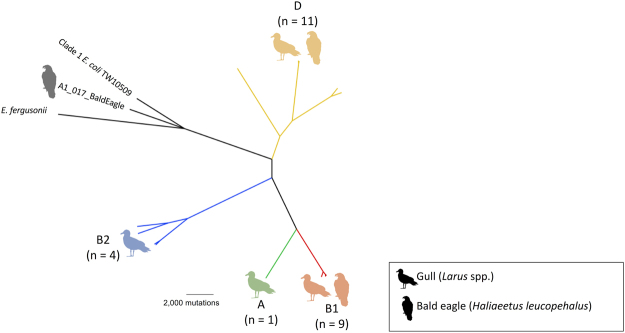
Figure 1
Figure 1
Unrooted clonal core genome phylogeny of 26 cephalosporin-resistant E. coli isolates originating from gulls and bald eagles in Alaska, E. fergusonii (NC_011740.1) and a Clade 1 E. coli sequence (TW10509; NZ_GL872204.1). Phylotypes A (green), B1 (red), B2 (blue) and D (yellow) are indicated at the tips with an image of a gull, bald eagle, or both, according to the species from which the isolates were obtained. The number of cephalosporin-resistant E. coli isolates belonging to each phylotype is indicated in parentheses. Silhouette images of gulls (credit: Rebecca Groom, https://creativecommons.org/licenses/by/3.0/legalcode) and bald eagles were sourced from PhyloPic (www.phylopic.org).
Figure 2
Figure 2
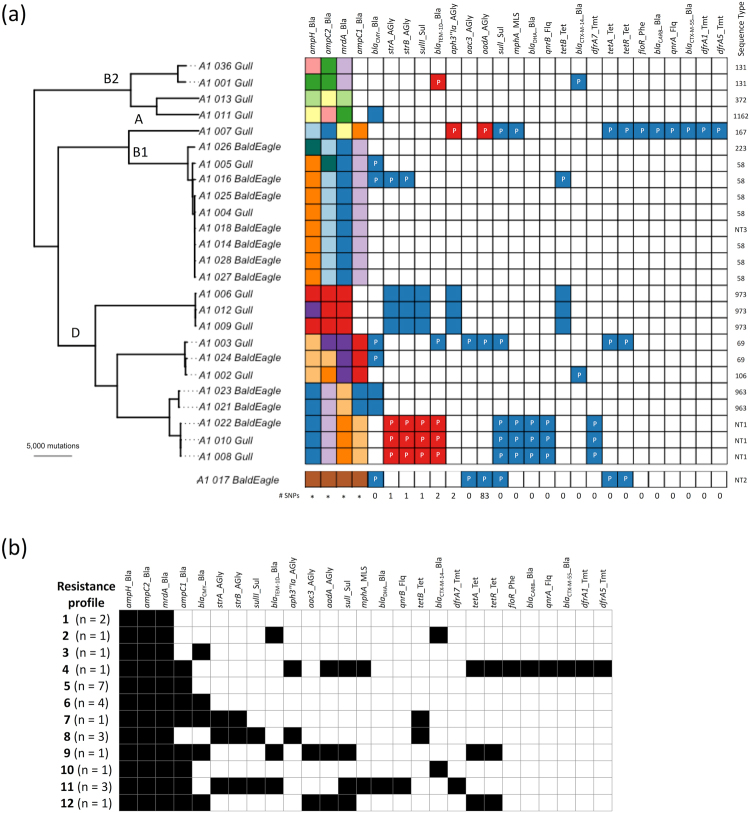
(a) Midpoint rooted clonal core genome phylogeny of 25 cephalosporin-resistant E. coli isolates originating from gulls and bald eagles in Alaska. Phylotypes (A, B1, B2, D) are indicated on branches. Presence of each of 27 identified AMR genes is shown as a matrix, with gene names indicated at the top of the matrix underscored by the antibiotics class (AGly: aminoglycosides, Bla: beta-lactamases, Flq: fluoroquinolones, MLS: macrolide-lincosamide-streptogramin, Phe: phenicols, Sul: sulfonamides, Tet: tetracyclines and Tmt: trimethoprim). Coloured squares indicate presence and white indicates that the gene was not found. Each colour indicates a different allele for each gene. The number of SNPs differentiating AMR genes with two alleles is shown below the matrix, while the phylogenetic diversity of genes with more than two alleles (indicated by *) can be seen in Fig. 3. AMR genes found on plasmids identified by PlasmidSPAdes are indicated with the letter “P”. The final column of the matrix indicates in silico identified E. coli sequence types. The divergent A1_017_BaldEagle isolate is included at the bottom of the matrix, as it was omitted from the midpoint rooted clonal core genome phylogeny. (b) Unique resistance profiles identified through in silico AMR gene detection in cephalosporin-resistant E. coli isolates. A presence/absence matrix of 27 identified AMR genes is shown, with black shading indicating presence, and no shading indicating that the gene was not found. The number of isolates found with each resistance profile is indicated in parentheses.
Figure 3
Figure 3
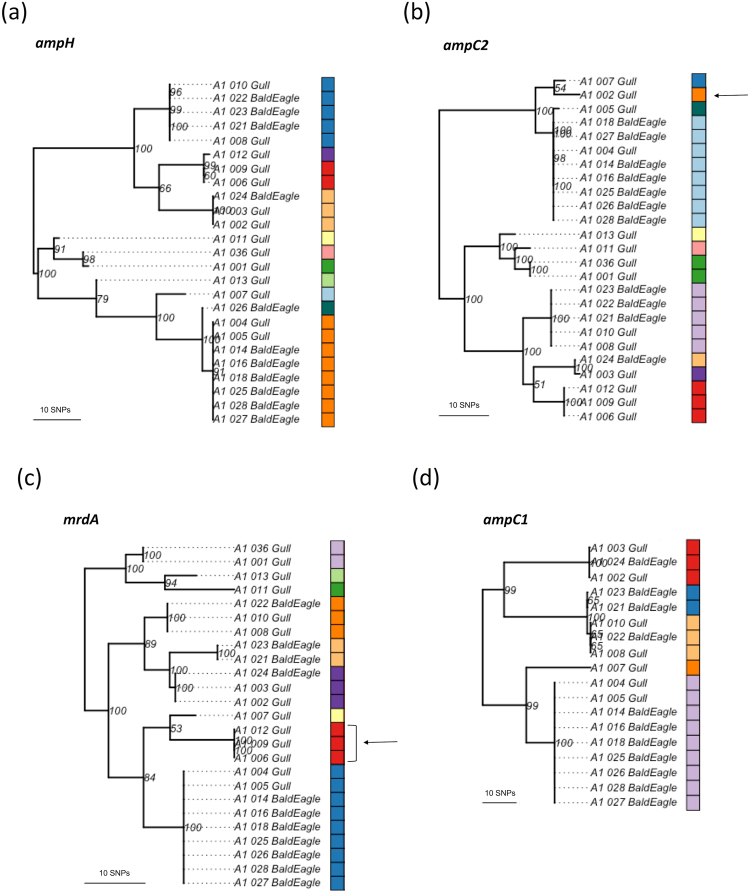
Midpoint rooted maximum likelihood phylogenies of cephalosporin-resistant E. coli isolates originating from gulls and bald eagles in Alaska based on individual chromosomally-encoded AMR genes – (a) ampH, (b) ampC2, (c) mrdA, and (d) ampC1. Each colour indicates a different allele for each gene sequence. Arrows indicate incongruence with the core genome phylogeny. Branch support values are indicated and based on 100 bootstrap pseudoreplicates.

References

    1. WHO. Antimicrobial resistance: global report on surveillance 2014. http://www.who.int/drugresistance/documents/surveillancereport/en/ (2014).
    1. GHSA. Global Health Security Agenda: GHSA Antimicrobial Resistance Action Package (GHSA Action Package Prevent-1). https://www.ghsagenda.org/packages/p1-antimicrobial-resistance (2015).
    1. McDanel J, et al. Incidence of extended-spectrum β-lactamase (ESBL)-producing Escherichia coli and Klebsiella infections in the United States: A systematic literature review. Infect. Control Hosp. Epidemiol. 2017;38:1209–1215. doi: 10.1017/ice.2017.156. - DOI - PubMed
    1. Dhillon RHP, Clark J. ESBLs: A clear and present danger? Crit. Care Res. Pract. 2012;2012:625170. - PMC - PubMed
    1. Ashbolt NJ, et al. Human Health Risk Assessment (HHRA) for environmental development and transfer of antibiotic resistance. Environ. Health Perspect. 2013;121:993–1001. - PMC - PubMed

Publication types