


Impact of "Stroke Code"-Rapid Response Team: An Attempt to Improve Intravenous Thrombolysis Rate and to Shorten Door-to-Needle Time in Acute Ischemic Stroke
- PMID: 29743763
- PMCID: PMC5930528
- DOI: 10.4103/ijccm.IJCCM_504_17
Impact of "Stroke Code"-Rapid Response Team: An Attempt to Improve Intravenous Thrombolysis Rate and to Shorten Door-to-Needle Time in Acute Ischemic Stroke
Abstract
Objective: "Stroke code" (SC) implementation in hospitals can improve the rate of thrombolysis and the timeline in care of stroke patient.
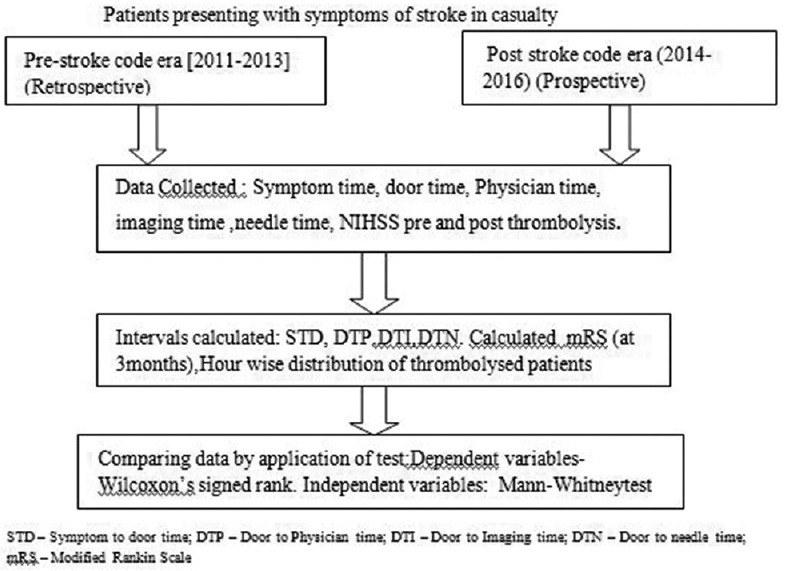
Materials and methods: A prospective data of patients treated for acute ischemic stroke (AIS) after implementation of "SC" (post-SC era) were analyzed (2015-2016) and compared with the retrospective data of patients treated in the "pre-SC era." Parameters such as symptom-to-door, door-to-physician, door-to-imaging, door-to-needle (DTN), and symptom-to-needle time were calculated. The severity of stroke was calculated using the National Institutes of Health Stroke Score (NIHSS) before and after treatment.
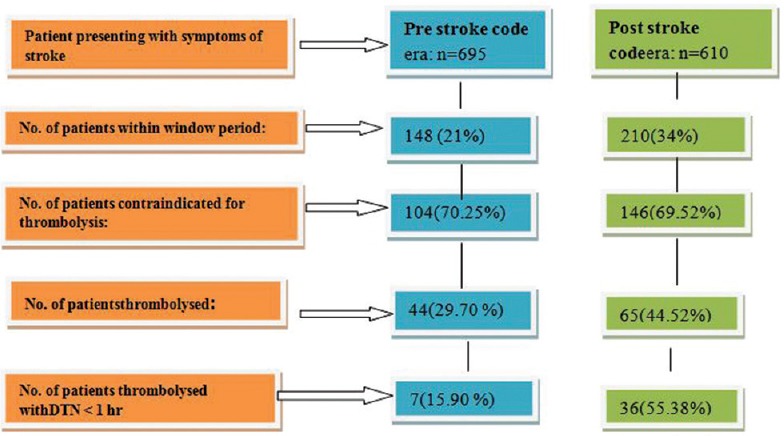
Results: Patients presented with stroke symptoms in pre- and post-SC era (695 vs. 610) and, out of these, patients who came in window period constituted 148 (21%) and 210 (34%), respectively. Patients thrombolyzed in pre- and post-SC era were 44 (29.7%) and 65 (44.52%), respectively. Average DTN time was 104.95 min in pre-SC era and reduced to 67.28 min (P < 0.001) post-SC implementation. Percentage of patients thrombolyzed within DTN time ≤60 min in pre-SC era and SC era was 15.90% and 55.38%, respectively.
Conclusion: Implementation of SC helped us to increase thrombolysis rate in AIS and decrease DTN time.
Keywords: Acute ischemic stroke; door to needle time; stroke code.
Conflict of interest statement
There are no conflicts of interest.
Figures
References
-
- Paramasivam S. Current trends in the management of acute ischemic stroke. Neurol India. 2015;63:665–72. - PubMed
-
- Kalkonde YV, Deshmukh MD, Sahane V, Puthran J, Kakarmath S, Agavane V, et al. Stroke is the leading cause of death in rural Gadchiroli, India: A Prospective community-based study. Stroke. 2015;46:1764–8. - PubMed
-
- Murthy JM. Thrombolysis for stroke in India: Miles to go. Neurol India. 2007;55:3–5. - PubMed
-
- Truelsen T, Begg S, Mathers C. The Global Burden of Cerebrovascular Disease. [Last accessed on 2017 Aug]. Available from: http://www.WHO statistics:cerebrovascular disease stroke pdf .
LinkOut - more resources
Full Text Sources
Other Literature Sources