


Follicle Size on Day of Trigger Most Likely to Yield a Mature Oocyte
- PMID: 29743877
- PMCID: PMC5930292
- DOI: 10.3389/fendo.2018.00193
Follicle Size on Day of Trigger Most Likely to Yield a Mature Oocyte
Abstract
Objective: To identify follicle sizes on the day of trigger most likely to yield a mature oocyte following hCG, GnRH agonist (GnRHa), or kisspeptin during IVF treatment.
Design: Retrospective analysis to determine the size of follicles on day of trigger contributing most to the number of mature oocytes retrieved using generalized linear regression and random forest models applied to data from IVF cycles (2014-2017) in which either hCG, GnRHa, or kisspeptin trigger was used.
Setting: HCG and GnRHa data were collected at My Duc Hospital, Ho Chi Minh City, Vietnam, and kisspeptin data were collected at Hammersmith Hospital, London, UK.
Patients: Four hundred and forty nine women aged 18-38 years with antral follicle counts 4-87 were triggered with hCG (n = 161), GnRHa (n = 165), or kisspeptin (n = 173).
Main outcome measure: Follicle sizes on the day of trigger most likely to yield a mature oocyte.
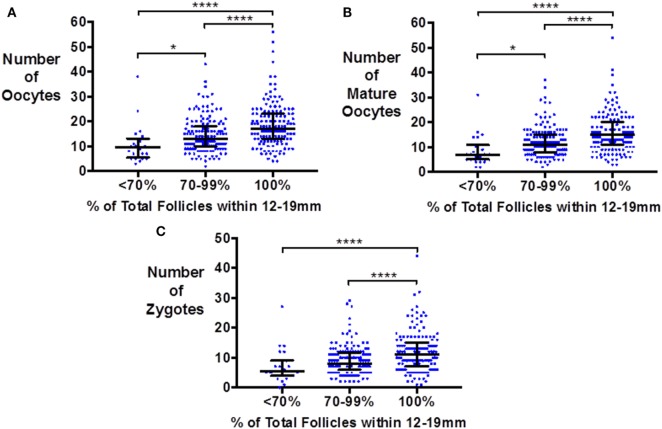
Results: Follicles 12-19 mm on the day of trigger contributed the most to the number of oocytes and mature oocytes retrieved. Comparing the tertile of patients with the highest proportion of follicles on the day of trigger 12-19 mm, with the tertile of patients with the lowest proportion within this size range, revealed increases of 4.7 mature oocytes for hCG (P < 0.0001) and 4.9 mature oocytes for GnRHa triggering (P < 0.01). Using simulated follicle size profiles of patients with 20 follicles on the day of trigger, our model predicts that the number of oocytes retrieved would increase from a mean 9.8 (95% prediction limit 9.3-10.3) to 14.8 (95% prediction limit 13.3-16.3) oocytes due to the difference in follicle size profile alone.
Conclusion: Follicles 12-19 mm on the morning of trigger administration were most likely to yield a mature oocyte following hCG, GnRHa, or kisspeptin.
Keywords: IVF treatment; follicle size; kisspeptin; mature oocyte; trigger.
Figures
References
-
- Revelli A, Martiny G, Delle Piane L, Benedetto C, Rinaudo P, Tur-Kaspa I. A critical review of bi-dimensional and three-dimensional ultrasound techniques to monitor follicle growth: do they help improving IVF outcome? Reprod Biol Endocrinol (2014) 12:107. 10.1186/1477-7827-12-107 - DOI - PMC - PubMed
-
- Ectors FJ, Vanderzwalmen P, Van Hoeck J, Nijs M, Verhaegen G, Delvigne A, et al. Relationship of human follicular diameter with oocyte fertilization and development after in-vitro fertilization or intracytoplasmic sperm injection. Hum Reprod (1997) 12(9):2002–5. 10.1093/humrep/12.9.2002 - DOI - PubMed
Grants and funding
LinkOut - more resources
Full Text Sources
Other Literature Sources
Medical
