


Treatment patterns and survival among older adults in the United States with advanced soft-tissue sarcomas
- PMID: 29744029
- PMCID: PMC5932822
- DOI: 10.1186/s13569-018-0094-x
Treatment patterns and survival among older adults in the United States with advanced soft-tissue sarcomas
Abstract
Background: To describe patient and tumor characteristics, treatments, and survival among older adults in the United States with advanced soft-tissue sarcoma (STS), across and by categories of specifically defined histologic subtypes.
Methods: We conducted a retrospective cohort analysis using the SEER. The study population comprised patients ≥ 65 years old with advanced STS (excluding osteosarcoma, Kaposi sarcoma, and gastrointestinal stromal tumors) diagnosed from January 1, 2001 to December 31, 2011.
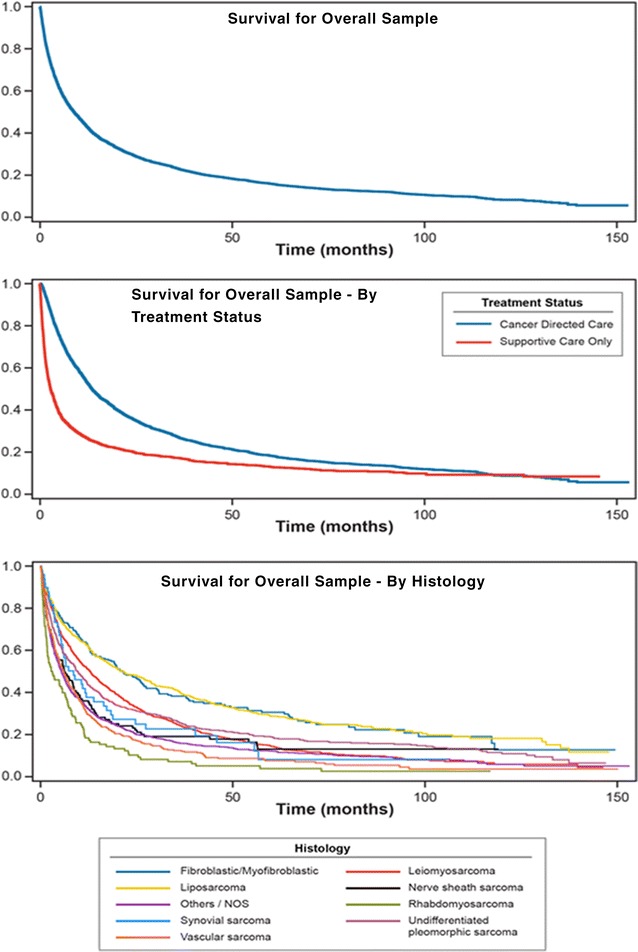
Results: Of 4274 study patients, 2103 (49.2%) were male. Mean age was 77.8 years, and 1539 (36.0%) had distant disease at initial diagnosis. The most common histologic categories were leiomyosarcoma (922[21.6%]), undifferentiated pleomorphic sarcoma (652[15.3%]), and liposarcoma (554[13.0%]). Overall, 1227 (28.7%) patients received first-line systemic therapy. Among these patients, 325 (26.5%) received docetaxel plus gemcitabine and 231 (18.8%) received doxorubicin alone. Only 476 patients received second-line therapy (11.1%), most commonly doxorubicin alone (n = 101). Median overall survival (95% confidence interval) from advanced STS diagnosis was 8.9 (8.3, 9.7) months.
Conclusions: Although previous studies of younger populations reported anthracycline-based therapy predominated in first line, our study of older advanced STS patients found that docetaxel plus gemcitabine was most commonly used. Despite variation by histologic category, prognosis remains poor for older adult patients with advanced STS.
Keywords: Chemotherapy; Observational study; Soft-tissue sarcoma.
Figures
References
-
- National Cancer Institute (NCI). Age-adjusted SEER incidence rates. https://seer.cancer.gov/faststats/selections.php?series=age. Accessed 10 Jan 2018.
-
- National Cancer Institute (NCI). Adult soft tissue sarcoma treatment (PDQ); 2017. https://www.cancer.gov/types/soft-tissue-sarcoma/patient/adult-soft-tiss.... Accessed 30 March 2017.
LinkOut - more resources
Full Text Sources
Other Literature Sources
Molecular Biology Databases
