Review
. 2018 Apr 13:7:458.
doi: 10.12688/f1000research.13247.1. eCollection 2018.

Generating and repairing genetically programmed DNA breaks during immunoglobulin class switch recombination

Affiliations
Review

Generating and repairing genetically programmed DNA breaks during immunoglobulin class switch recombination

Laura Nicolas et al. F1000Res. .

Abstract

Adaptive immune responses require the generation of a diverse repertoire of immunoglobulins (Igs) that can recognize and neutralize a seemingly infinite number of antigens. V(D)J recombination creates the primary Ig repertoire, which subsequently is modified by somatic hypermutation (SHM) and class switch recombination (CSR). SHM promotes Ig affinity maturation whereas CSR alters the effector function of the Ig. Both SHM and CSR require activation-induced cytidine deaminase (AID) to produce dU:dG mismatches in the Ig locus that are transformed into untemplated mutations in variable coding segments during SHM or DNA double-strand breaks (DSBs) in switch regions during CSR. Within the Ig locus, DNA repair pathways are diverted from their canonical role in maintaining genomic integrity to permit AID-directed mutation and deletion of gene coding segments. Recently identified proteins, genes, and regulatory networks have provided new insights into the temporally and spatially coordinated molecular interactions that control the formation and repair of DSBs within the Ig locus. Unravelling the genetic program that allows B cells to selectively alter the Ig coding regions while protecting non-Ig genes from DNA damage advances our understanding of the molecular processes that maintain genomic integrity as well as humoral immunity.

Keywords: AID; CSR; DNA repair; immunoglobulin.


Conflict of interest statement

No competing interests were disclosed.No competing interests were disclosed.No competing interests were disclosed.

Figures
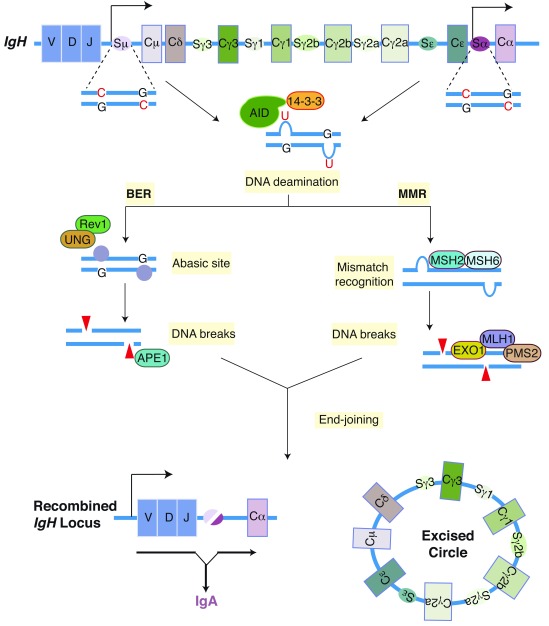
Figure 1.
Figure 1.. Mature B lymphocytes undergo class switch recombination (CSR) to alter the expression of the immunoglobulin heavy chain constant region (C H).
The figure depicts CSR between Sμ and Sα in the immunoglobulin heavy chain ( IgH) locus. Activation-induced cytidine deaminase (AID) converts cytidines into uridines in S-region DNA. The dU:dG mismatch is converted into DNA double-strand breaks by either the base excision repair (BER) or the mismatch repair (MMR) pathway. In the BER pathway, uracil DNA glycosylase (UNG) removes the uracil base from the DNA to generate an abasic site, which is recognized and cleaved by the apurinic/apyrimidinic endonuclease 1 (APE1). During MMR, the dU:dG mismatch is recognized by mutS homologue 2 and mutS homologue 6 (MSH2 and MSH6), which recruit the complex of exonuclease 1 (EXO1), mutL homologue 1 (MLH1), and post-mitotic segregation 2 (PMS2) to excise a short patch of DNA that includes the dU:dG mismatch. The DNA breaks are ligated by classical or alternative non-homologous end-joining pathways to generate a recombined Igh locus and an excision circle. Rev1 and 14-3-3 are scaffolding proteins, which are necessary for the assembly of the protein complexes participating in CSR.
Figure 2.
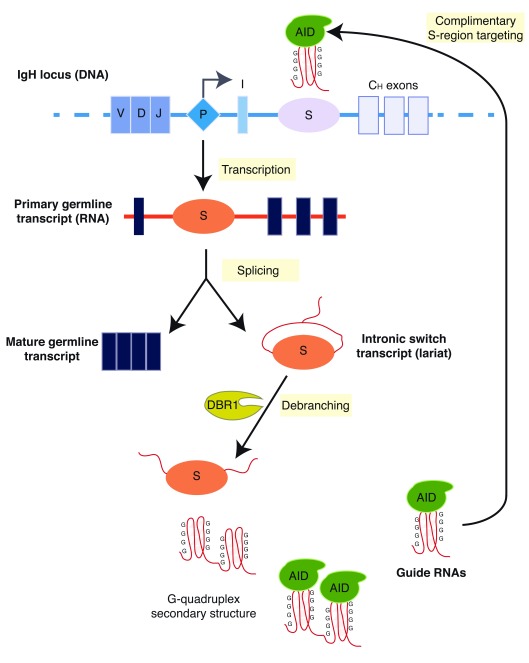
Figure 2.. Proposed model for RNA-dependent targeting of AID during class switch recombination.
Upon B-cell activation, germline transcription is initiated from a cytokine-inducible promoter (P) and primary germline transcripts are generated from the I-S-C H sequences, which encode the I-exon, switch (S) region, and constant coding exons (C H). These transcripts are spliced to form a mature non-coding, germline transcript and an intronic S lariat. The latter is further processed by the debranching enzyme DBR1 to form a linear S-region transcript. Linear S transcripts fold into G-quadruplex RNA, which is bound by AID. The complex of S-RNA and AID is guided to transcribed S-region DNA as a result of the complimentary between the S-RNA and the transcribed S region. AID, activation-induced cytidine daminase; DBR1, debranching RNA lariats 1.
Figure 3.
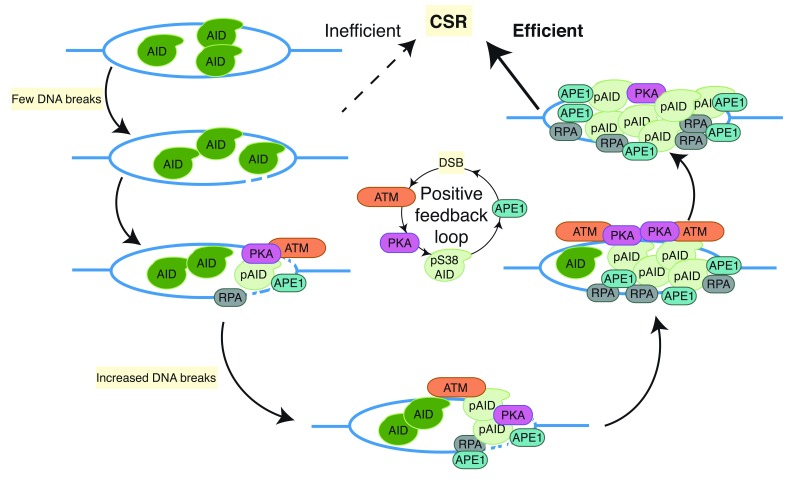
Figure 3.. A hypothetical positive feedback loop generates a high density of DNA double-strand breaks to promote wild-type CSR.
AID-mediated deamination of S regions generates DNA breaks that induce PKA-dependent AID phosphorylation at serine-38 (pS38-AID) and subsequent binding of APE1 and RPA to pS38-AID. Recruitment of APE1 to S regions generates additional DNA breaks, inducing additional AID phosphorylation through an unidentified ATM-dependent mechanism of activating PKA. AID, activation-induced cytidine daminase; APE1, apurinic/apyrimidinic endonuclease 1; ATM, ataxia telangiectasia mutated; CSR, class switch recombination; PKA, protein kinase A; RPA, replication protein A.
Figure 4.
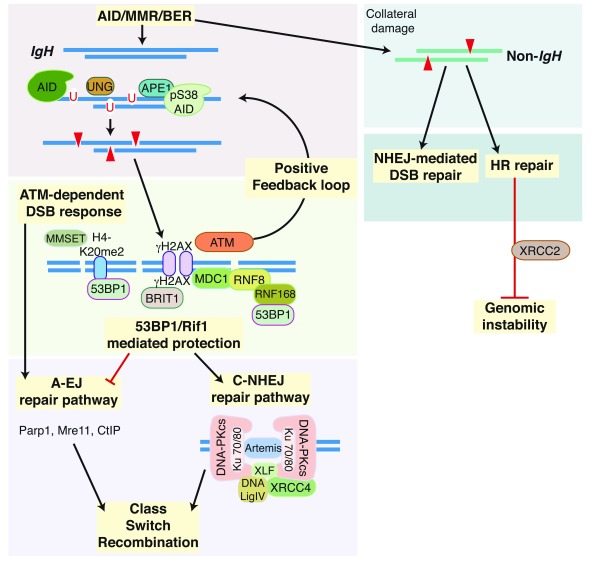
Figure 4.. Resolution of DSBs generated by MMR or BER following AID-dependent deamination of S regions is accomplished by multiple pathways.
ATM directly or indirectly phosphorylates proteins (for example, H2AX, MDC1, 53BP1, and AID) and stabilizes protein complexes that aid in the formation and resolution of DSBs during class switch recombination. A-EJ, alternative end-joining; AID, activation-induced cytidine daminase; BER, base excision repair; cNHEJ, classical non-homologous end-joining; DSB, double-strand break; HR, homologous recombination; MMR, mismatch repair.

References

    1. Jung D, Alt FW: Unraveling V(D)J recombination; insights into gene regulation. Cell. 2004;116(2):299–311. 10.1016/S0092-8674(04)00039-X - DOI - PubMed
    1. Schatz DG, Ji Y: Recombination centres and the orchestration of V(D)J recombination. Nat Rev Immunol. 2011;11(4):251–63. 10.1038/nri2941 - DOI - PubMed
    1. Methot SP, Di Noia JM: Molecular Mechanisms of Somatic Hypermutation and Class Switch Recombination. Adv Immunol. 2017;133:37–87. 10.1016/bs.ai.2016.11.002 - DOI - PubMed
    1. Hwang JK, Alt FW, Yeap LS: Related Mechanisms of Antibody Somatic Hypermutation and Class Switch Recombination. Microbiol Spectr. 2015;3(1):MDNA3-0037-2014. 10.1128/microbiolspec.MDNA3-0037-2014 - DOI - PMC - PubMed
    1. Choi JH, Wang KW, Zhang D, et al. : IgD class switching is initiated by microbiota and limited to mucosa-associated lymphoid tissue in mice. Proc Natl Acad Sci U S A. 2017;114(7):E1196–E1204. 10.1073/pnas.1621258114 - DOI - PMC - PubMed
    2. F1000 Recommendation

LinkOut - more resources