Review
. 2018 Aug;19(4):331-352.
doi: 10.1007/s10162-018-0669-5. Epub 2018 May 9.

Supra-Threshold Hearing and Fluctuation Profiles: Implications for Sensorineural and Hidden Hearing Loss

Affiliations
Review

Supra-Threshold Hearing and Fluctuation Profiles: Implications for Sensorineural and Hidden Hearing Loss

Laurel H Carney. J Assoc Res Otolaryngol. 2018 Aug.

Abstract

An important topic in contemporary auditory science is supra-threshold hearing. Difficulty hearing at conversational speech levels in background noise has long been recognized as a problem of sensorineural hearing loss, including that associated with aging (presbyacusis). Such difficulty in listeners with normal thresholds has received more attention recently, especially associated with descriptions of synaptopathy, the loss of auditory nerve (AN) fibers as a result of noise exposure or aging. Synaptopathy has been reported to cause a disproportionate loss of low- and medium-spontaneous rate (L/MSR) AN fibers. Several studies of synaptopathy have assumed that the wide dynamic ranges of L/MSR AN fiber rates are critical for coding supra-threshold sounds. First, this review will present data from the literature that argues against a direct role for average discharge rates of L/MSR AN fibers in coding sounds at moderate to high sound levels. Second, the encoding of sounds at supra-threshold levels is examined. A key assumption in many studies is that saturation of AN fiber discharge rates limits neural encoding, even though the majority of AN fibers, high-spontaneous rate (HSR) fibers, have saturated average rates at conversational sound levels. It is argued here that the cross-frequency profile of low-frequency neural fluctuation amplitudes, not average rates, encodes complex sounds. As described below, this fluctuation-profile coding mechanism benefits from both saturation of inner hair cell (IHC) transduction and average rate saturation associated with the IHC-AN synapse. Third, the role of the auditory efferent system, which receives inputs from L/MSR fibers, is revisited in the context of fluctuation-profile coding. The auditory efferent system is hypothesized to maintain and enhance neural fluctuation profiles. Lastly, central mechanisms sensitive to neural fluctuations are reviewed. Low-frequency fluctuations in AN responses are accentuated by cochlear nucleus neurons which, either directly or via other brainstem nuclei, relay fluctuation profiles to the inferior colliculus (IC). IC neurons are sensitive to the frequency and amplitude of low-frequency fluctuations and convert fluctuation profiles from the periphery into a phase-locked rate profile that is robust across a wide range of sound levels and in background noise. The descending projection from the midbrain (IC) to the efferent system completes a functional loop that, combined with inputs from the L/MSR pathway, is hypothesized to maintain "sharp" supra-threshold hearing, reminiscent of visual mechanisms that regulate optical accommodation. Examples from speech coding and detection in noise are reviewed. Implications for the effects of synaptopathy on control mechanisms hypothesized to influence supra-threshold hearing are discussed. This framework for understanding neural coding and control mechanisms for supra-threshold hearing suggests strategies for the design of novel hearing aid signal-processing and electrical stimulation patterns for cochlear implants.

Keywords: auditory; computational models; neural coding; speech.


Figures

Fig. 1
Fig. 1
Properties of AN average discharge rate vs. sound level functions. a Schematic rate-level functions for low- (cyan), medium- (blue), and high- (red) spontaneous rate AN fibers. (from Bharadwaj et al. ; permission requested). b Synchronization to the envelope of SAM tones vs. sound level for LSR (blue) and HSR (red) AN fibers (from Bharadwaj et al. , after Joris and Yin ; reprinted with permission). c Rate-level functions for three AN fibers with different spontaneous rates, all with CF near 1 kHz (from Liberman ; reprinted with permission). Arrow: Saturated discharge rate of low-CF LSR AN fiber. d Schematic illustration of the dependence of the shapes of AN rate-level functions with different thresholds on basilar membrane compression (from Yates et al. ; reprinted with permission). The threshold levels (gray lines) of the three different types of AN fibers fall at different points along the compressive curve describing the basilar membrane input-output function, thus compression affects the rate-level functions in varying degrees: the dynamic range of HSR fibers are largely confined to levels below compression, whereas LSR fibers are affected by compression throughout the dynamic range of their rate-level functions. e Dynamic range adaptation (DRA) in a HSR AN fiber. The black symbols and line represent a typical rate-level function based on responses to tones at CF that were evenly distributed across the full range of SPLs. Other symbols and lines were based on responses to different level contexts, or sets of tones at CF in which 80 % of the tones were in the SPL range highlighted by the matching color bar, and the remaining 20 % covered the remainder of the level range. Note that the response rates to the lowest SPLs also depend on overall context. (from Wen et al. ; reprinted with permission). f Variation in spontaneous rate over time. This HSR AN fiber’s spontaneous rate varies between ~ 35 and 85 sp/s. Solid: average rate estimated using 0.5 s windows, over a period of 15 s. Dashed: average rate estimated using 5 s windows, over a period of 150 s. (from Teich et al. ; reprinted with permission)
Fig. 2
Fig. 2
From vowel spectrum to AN fluctuation profile. The spectrum of the vowel /æ/ is in the foreground. Model HSR AN PSTHs are for several CFs spanning two spectral peaks in the vowel, the two formant frequencies F1 (700 Hz) and F2 (1800 Hz). The slow fluctuations in the AN PSTHs are highlighted in red. AN fluctuation amplitudes are plotted as a profile across CFs in the background (blue). Note that HSR AN average discharge rates in response to the 65 dB SPL vowel are saturated across all channels, but the profile of fluctuation amplitudes code the spectral peaks. Dips in the fluctuation amplitude profile are aligned with spectral peaks
Fig. 3
Fig. 3
From peripheral fluctuation profile to midbrain rate profile. Top: The spectrum of the vowel /æ/ (from “had,” black line) is dominated by harmonics of the fundamental (F0 = 115 Hz) and has an overall shape that is determined by resonances of the vocal tract (Fant 1960). The spectral envelope (dashed line) highlights spectral peaks at the formant frequency locations. Responses of model AN fibers with CF = 500 Hz (below F1), 700 Hz (near F1), 1200 Hz (between F1 and F2), and 1800 Hz (near F2). Responses of AN fibers tuned near formant peaks have small low-frequency fluctuations because they are dominated by a single harmonic (synchrony capture). Fibers tuned away from spectral peaks have responses that fluctuate strongly at F0, in addition to phase-locking to harmonics near CF. Bottom: responses of a simple IC model consisting of a bandpass filter centered at 100 Hz with a bandwidth of 100 Hz (i.e., Q = 1). Model IC neurons have large differences in rate due to the differences in fluctuation amplitudes in each channel. The fluctuation amplitude profile across AN frequency channels is thus converted into a rate profile across IC neurons with bandpass modulation transfer functions (MTFs). IC neurons phase-lock to low-frequency fluctuations (review: Rees and Langner 2005). Vowel waveform is from the Hillenbrand et al. (1995) database
Fig. 4
Fig. 4
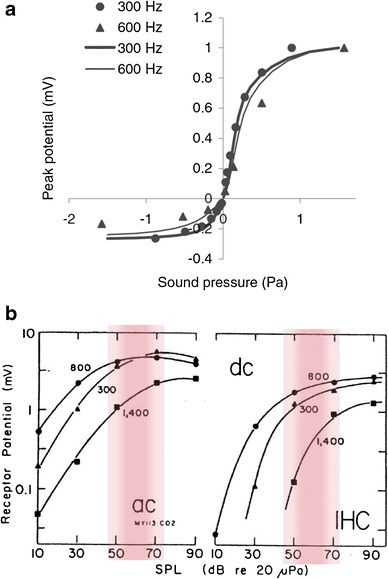
IHC response properties. a Normalized input/output nonlinearity, with 300-Hz data from Russell and Sellick (1983) and 600-Hz data from Russell et al. (1986). Lines are responses of an IHC model that includes the transduction nonlinearity and K+-channels (from Lopez-Poveda and Eustaquio-Martín ; reprinted with permission). b AC and DC response components of in vivo IHC responses to several tone frequencies. The red bands indicate the SPL range of conversational speech; this range of levels is near the bend in the response curves, above which the IHC responses become considerably saturated (modified from Dallos 1985)
Fig. 5
Fig. 5
Illustration of fluctuation profiles and a vowel coding hypothesis, for IC neurons with both bandpass and band-suppressed modulation transfer functions (MTFs). a Vowel spectrum. b Responses of model AN fibers tuned near formants have small pitch-related rate fluctuations. c Model fibers tuned between formants have strong rate fluctuations at F0 (see examples of actual AN recordings in Delgutte and Kiang 1984a). d Band-pass MTF from rabbit IC with a BMF near a typical male F0. e Band-reject MTF with a notch near a typical F0. f Band-pass midbrain neurons have reduced rates in frequency channels with weak fluctuations (green arrow) and increased rates in channels with strong fluctuations (see c, orange arrow); therefore, dips in the rate profile of bandpass neurons encode F1 and F2. g Rate profile for a population of band-reject neurons has peaks at F1 and F2; band-reject neurons respond more strongly to stimuli that yield reduced neural fluctuations (see b, green arrow). (from Carney et al. ; reprinted with permission)
Fig. 6
Fig. 6
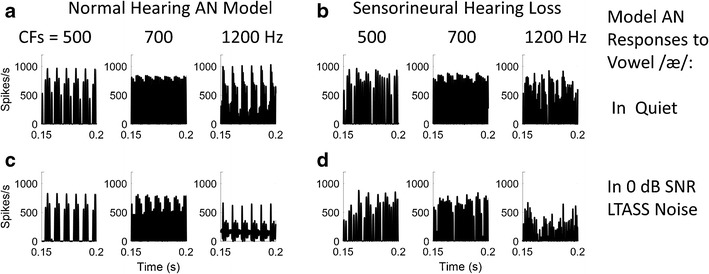
Fluctuation profiles associated with F1 in the vowel /æ/, illustrated with AN model responses for CFs below (500 Hz), near (700 Hz), and above (1200 Hz) the first formant frequency. HSR fibers; 65 dB SPL. a Responses of model with normal hearing, for vowel in quiet. b Responses of AN model with moderate sensorineural hearing loss (SNHL; COHC and CIHC = 0.2 in Zilany et al. , AN model). c Normal hearing and d SNHL model responses to vowel with additive 0 dB signal-to-noise ratio (SNR) LTASS noise. Both addition of noise and SNHL reduce the changes in fluctuation amplitudes across these frequency channels that span F1. Vowel waveform is from the Hillenbrand et al. (1995) database
Fig. 7
Fig. 7
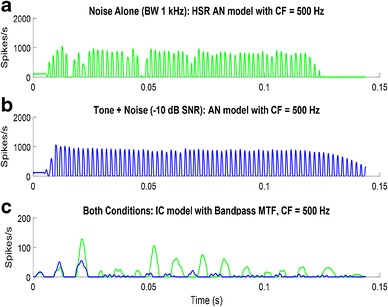
Responses of AN Model for a 500-Hz CF HSR fiber to a noise-alone stimulus (1 kHz bandwidth low-pass Gaussian noise) at 70 dB SPL and b tone-plus-noise, the same noise as in a, with a 500-Hz, 60 dB SPL tone added. c Responses of a simple model IC cell (bandpass filter with BMF = 100 Hz) to both stimuli. Green: response to the noise-alone. Blue: response to tone-plus-noise. The addition of the tone flattens the envelope and decreases the response of a model IC cell that is driven by amplitude fluctuations
Fig. 8
Fig. 8
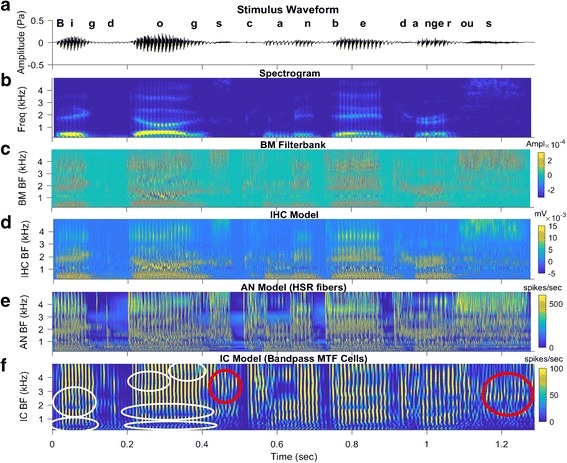
Several stages of AN and IC model outputs in response to a sentence from the Hearing In Noise Test (HINT, Nilsson et al. 1994), “Big dogs can be dangerous.” Overall sound level = 65 dB SPL. a Stimulus time waveform. b Spectrogram. ce Responses of stages in the Zilany et al. (2014) AN model, for a population of 50 HSR fibers with CFs from 150 to 5000 Hz. c Basilar membrane filter bank response. d IHC voltage. e AN synapse output (related to probability of firing). f Simple IC model based on a modulation filter (Mao et al. 2013), for IC cells with bandpass modulation transfer functions tuned to 100 Hz with Q = 1 (i.e., bandwidth = 100 Hz). Bright vertical striations are IC responses that are phase-locked to F0 periods during voiced portions of the sentence. Horizontal blue streaks indicate dips in the cross-frequency fluctuation profiles that are associated with formants during voiced sounds (several are indicated by white circles). Vertical blue streaks are pauses between words. Note that the model IC responses during fricatives (red circles) are in response to strong AN fluctuations at frequencies where the spectrum is sloping, not at spectral peaks (cf. response to final /s/ in panels bd with panel f). (Figure created using UR_Ear_v2.1 tool)
Fig. 9
Fig. 9
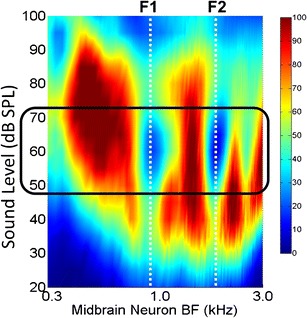
The differences in fluctuation amplitude across frequency channels are greatest at conversational speech levels (box.) This image shows amplitudes of low-frequency fluctuations across the population (BF) over a wide range of sound levels (dB SPL). The responses are for simple model IC cells that have band-enhanced modulation tuning, with best modulation frequency of 100 Hz (color bar, average rate in spikes/s). The inputs to the model IC cells were provided by the Zilany et al. (2014) AN model for HSR AN fibers. The stimulus waveform was the vowel /æ/ in “had” from the Hillenbrand et al. (1995) database. (from Carney et al. ; reprinted with permission)
Fig. 10
Fig. 10
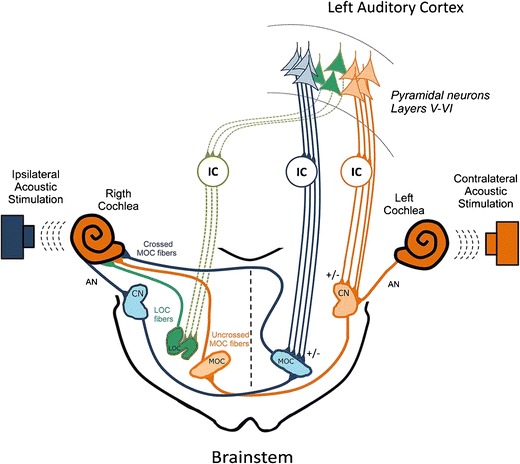
Schematic of auditory efferent pathways, illustrating descending connections from the IC and auditory cortex onto the regions of the brainstem where MOC and LOC cell bodies are clustered (from Terreros and Delano ; reprinted with permission). Uncrossed projections descending from the auditory cortex are indicated by solid lines and crossed projections by dotted lines. Descending projections from the IC terminate in both MOC and LOC regions, as well as in the cochlear nucleus (CN). MOC and LOC neurons project into the cochlea; MOC fibers terminate on the OHCs of both cochleae and influence the cochlear amplifier. LOC fibers project to the ipsilateral cochlea where they terminate directly on AN fibers, near the IHC-AN synapse
Fig. 11
Fig. 11
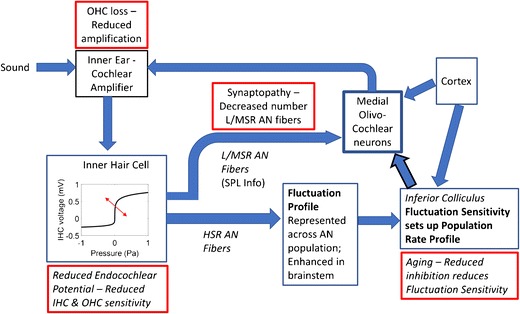
Schematic illustration of hypothesized fluctuation-profile-driven gain control system. Effects of various impairments are indicated in red boxes. Bold arrow highlights path of fluctuation-profile feedback signal from IC to MOC. All projections would be tonotopically organized (not shown). Details of crossed and uncrossed MOC projections are not shown (see Fig. 10)

References

    1. Almishaal A, Jennings SG. Effects of a precursor on amplitude modulation detection are consistent with efferent feedback. J Acoust Soc Am. 2016;139:2155–2155.
    1. Arnott RH, Wallace MN, Shackleton TM, Palmer AR. Onset neurones in the anteroventral cochlear nucleus project to the dorsal cochlear nucleus. J Assoc Res Otolaryngol. 2004;5:153–170. - PMC - PubMed
    1. Babalian AL, Ryugo DK, Vischer MW, Rouiller EM. Inhibitory synaptic interactions between cochlear nuclei: evidence from an in vitro whole brain study. Neuroreport. 1999;10:1913–1917. - PubMed
    1. Beattie RC, Raffin MJ. Reliability of threshold, slope, and PB max for monosyllabic words. J Speech Hear Disord. 1985;50:166–178. - PubMed
    1. Beattie RC, Edgerton BJ, Svihovec DV. A comparison of the Auditec of St. Louis cassette recordings of NU-6 and CID W-22 on a normal-hearing population. J Speech Hear Disord. 1977;42:60–64. - PubMed

Publication types

MeSH terms