


Effect of the WeCareAdvisor™ on family caregiver outcomes in dementia: a pilot randomized controlled trial
- PMID: 29747583
- PMCID: PMC5946471
- DOI: 10.1186/s12877-018-0801-8
Effect of the WeCareAdvisor™ on family caregiver outcomes in dementia: a pilot randomized controlled trial
Abstract
Background: Behavioral and psychological symptoms of dementia (BPSD) are universal and associated with multiple negative outcomes. This pilot randomized controlled trial (RCT) evaluated the effect of using the WeCareAdvisor, an innovative web-based tool developed to enable family caregivers to assess, manage, and track BPSD.
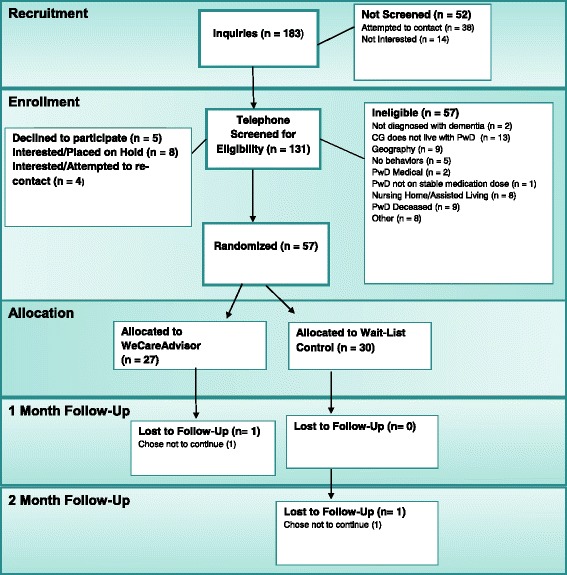
Methods: This RCT enrolled 57 dementia family caregivers from community and clinical settings in Ann Arbor, Michigan and Baltimore, Maryland. Participants were randomly assigned to immediate use of the WeCareAdvisor tool (WCA, n = 27) or a Waitlist control group (n = 30) that received the tool after a one-month waiting period. Outcomes for the caregiver and the person they were caring for were assessed at baseline (T0) and one-month followup for both the WCA (T1) and Waitlist control (T2) groups.
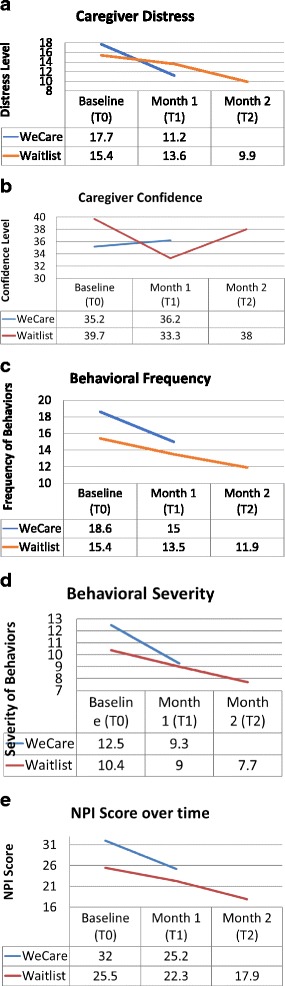
Results: Caregiver mean age was 65.9 ± 14.0 years old. About half (49%) were spouses. Baseline characteristics were comparable between groups except for mean caregiver confidence which was higher in the control group (WCA 35.0 ± 10.0 vs. Waitlist control 39.7 ± 6.9, p = 0.04). There were no significant differences between the WCA and control groups in characteristics of the person with dementia. After their one-month of tool use (T1), WCA caregivers showed significant within group improvement in caregiver distress (- 6.08 ± 6.31 points, t = - 4.82, p < 0.0001) and behavioral frequency (- 3.60 ± 5.05, t = - 3.56, p = 0.002), severity (- 3.24 ± 3.87, t = - 4.19, p = 0.0003) and total behavioral score (- 6.80 ± 10.73, t = - 3.17, p = 004). In the same timeframe, Waitlist control caregivers showed a significant decrease in confidence (- 6.40 ± 10.30, t = - 3.40, p = 0.002). The WCA group showed greater improvement in distress compared to the Waitlist group (T0-T1; t = - 2.49, p = 0.02), which remained significant after adjusting for site and baseline distress. There were no significant between-group differences in caregiver confidence or other secondary outcomes. After their one month of tool use (T2), the Waitlist group also showed significant improvement in caregiver distress (- 3.72 ± 7.53, t = - 2.66, p = 0.013), stress (- 0.41 ± 1.02, t = - 2.19, p = 0.037), confidence (4.38 ± 5.17, t = 4.56, p < 0.0001), burden (- 2.76 ± 7.26, t = - 2.05, p = 0.05), negative communication (- 1.48 ± 2.96, t = - 2.70, p = 0.012) and behavioral frequency (- 1.86 ± 4.58, t = - 2.19, p = 0.037); distress remained significant after adjustment.
Conclusions: In this pilot RCT, WCA use resulted in a significant decrease in caregiver distress. Future research will identify whether longer use of WCA can impact other caregiver and behavioral outcomes.
Trial registration: Clinicaltrials.gov identifier NCT02420535 (Date of registry: 4/20/2015, prior to the start of the clinical trial).
Keywords: Neuropsychiatric symptoms of dementia; Non-pharmacologic strategies, informal caregivers.
Conflict of interest statement
Ethics approval and consent to participate
All three phases or the project were approved in 2012 by Institutional Review Boards of University of Michigan and Johns Hopkins University. Written consent was obtained from all caregiver-subjects, and from all PLWD-subjects who could provide informed consent. If the PLWD was unable to provide informed consent, then proxy consent from the family caregiver (and assent from the person with dementia) was obtained.
Consent for publication
Not applicable.
Competing interests
The authors declare they have no competing interests with the exception of CGL:
C.G.L. receives grant support (research or CME) from NIMH, NIA, Associated Jewish Federation of Baltimore, Weinberg Foundation, Forest, Glaxo-Smith-Kline, Eisai, Pfizer, Astra-Zeneca, Lilly, Ortho-McNeil, Bristol-Myers, Novartis, National Football League, Elan,
Functional Neuromodulation. He is also Consultant/Advisor to Astra-Zeneca, Glaxo-Smith Kline, Eisai, Novartis, Forest, Supernus, Adlyfe, Takeda, Wyeth, Lundbeck, Merz, Lilly, Pfizer, Genentech, Elan, NFL Players Association, NFL Benefits Office, Avanir, Zinfandel, BMS,
Abvie, Janssen, Orion, Otsuka, Astellas. He also receives Honorarium or travel support from Pfizer, Forest, Glaxo-Smith Kline, Health Monitor.
Publisher’s Note
Springer Nature remains neutral with regard to jurisdictional claims in published maps and institutional affiliations.
Figures
References
Publication types
MeSH terms
Associated data
Grants and funding
LinkOut - more resources
Full Text Sources
Other Literature Sources
Medical
