


Clinical chronobiology: a timely consideration in critical care medicine
- PMID: 29747699
- PMCID: PMC5946479
- DOI: 10.1186/s13054-018-2041-x
Clinical chronobiology: a timely consideration in critical care medicine
Abstract
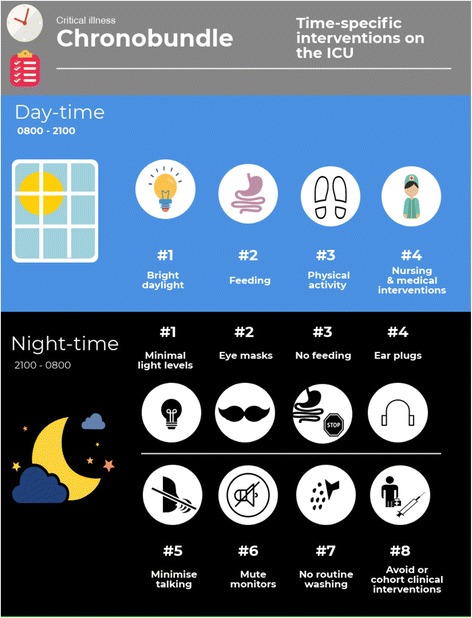
A fundamental aspect of human physiology is its cyclical nature over a 24-h period, a feature conserved across most life on Earth. Organisms compartmentalise processes with respect to time in order to promote survival, in a manner that mirrors the rotation of the planet and accompanying diurnal cycles of light and darkness. The influence of circadian rhythms can no longer be overlooked in clinical settings; this review provides intensivists with an up-to-date understanding of the burgeoning field of chronobiology, and suggests ways to incorporate these concepts into daily practice to improve patient outcomes. We outline the function of molecular clocks in remote tissues, which adjust cellular and global physiological function according to the time of day, and the potential clinical advantages to keeping in time with them. We highlight the consequences of "chronopathology", when this harmony is lost, and the risk factors for this condition in critically ill patients. We introduce the concept of "chronofitness" as a new target in the treatment of critical illness: preserving the internal synchronisation of clocks in different tissues, as well as external synchronisation with the environment. We describe methods for monitoring circadian rhythms in a clinical setting, and how this technology may be used for identifying optimal time windows for interventions, or to alert the physician to a critical deterioration of circadian rhythmicity. We suggest a chronobiological approach to critical illness, involving multicomponent strategies to promote chronofitness (chronobundles), and further investment in the development of personalised, time-based treatment for critically ill patients.
Keywords: Chronobiology; Chronotherapy; Circadian rhythm; Critical illness; Intensive care units.
Conflict of interest statement
Competing interests
The authors declare that they have no competing interests.
Publisher’s Note
Springer Nature remains neutral with regard to jurisdictional claims in published maps and institutional affiliations.
Figures
References
-
- Gotts JE, Matthay MA. Sepsis: pathophysiology and clinical management. BMJ. 2016;353:i1585. - PubMed
-
- Holst LB, Haase N, Wetterslev J, et al. Lower versus higher hemoglobin threshold for transfusion in septic shock. N Engl J Med. 2014;371:1381–1391. - PubMed
-
- Ko CH, Takahashi JS. Molecular components of the mammalian circadian clock. Hum Mol Genet. 2006;15 Spec No 2:R271–R277. - PubMed
Publication types
MeSH terms
LinkOut - more resources
Full Text Sources
Other Literature Sources
