. 2018 May 10;8(1):7477.
doi: 10.1038/s41598-018-25544-z.

Genomic features of renal cell carcinoma with venous tumor thrombus

Affiliations

Genomic features of renal cell carcinoma with venous tumor thrombus

Gregor Warsow et al. Sci Rep. .

Abstract

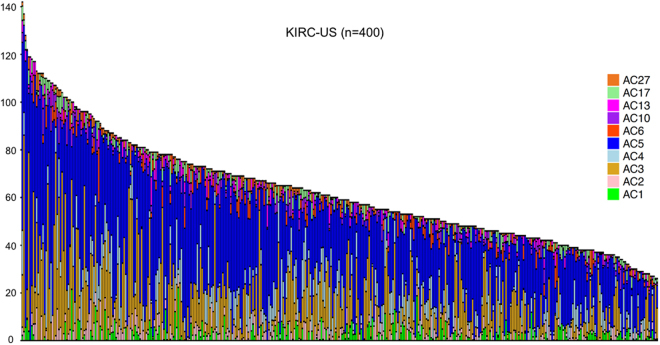
A venous tumor thrombus (VTT) is a potentially lethal complication of renal cell carcinoma (RCC) but virtually nothing is known about the underlying natural history. Based on our observation that venous thrombi contain significant numbers of viable tumor cells, we applied multiregion whole exome sequencing to a total of 37 primary tumor and VTT samples including normal tissue specimens from five consecutive patients. Our findings demonstrate mutational heterogeneity between primary tumor and VTT with 106 of 483 genes (22%) harboring functional SNVs and/or indels altered in either primary tumor or thrombus. Reconstruction of the clonal phylogeny showed clustering of tumor samples and VTT samples, respectively, in the majority of tumors. However, no new subclones were detected suggesting that pre-existing subclones of the primary tumor drive VTT formation. Importantly, we found several lines of evidence for "BRCAness" in a subset of tumors. These included mutations in genes that confer "BRCAness", a mutational signature and an increase of small indels. Re-analysis of SNV calls from the TCGA KIRC-US cohort confirmed a high frequency of the "BRCAness" mutational signature AC3 in clear cell RCC. Our findings warrant further pre-clinical experiments and may lead to novel personalized therapies for RCC patients.


Conflict of interest statement

The authors declare no competing interests.

Figures
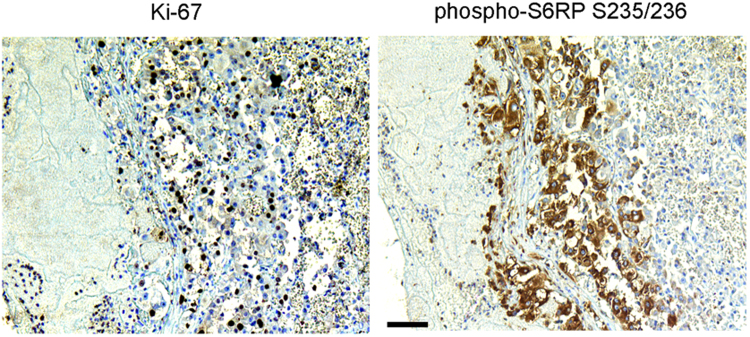
Figure 1
Figure 1
Tumor thrombi contain vital tumor cells. Representative immunohistochemical staining of a venous tumor thrombus for Ki-67 and phospho-S6RP S235/236. The tumor was unrelated to the five RCC-VTT cases analyzed. Scale bar = 100 μm.
Figure 2
Figure 2
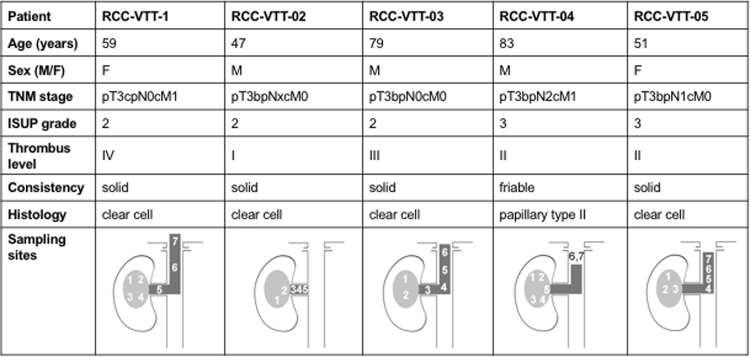
Patient characteristics and sampling sites. VTT levels are indicated according to Novick.
Figure 3
Figure 3
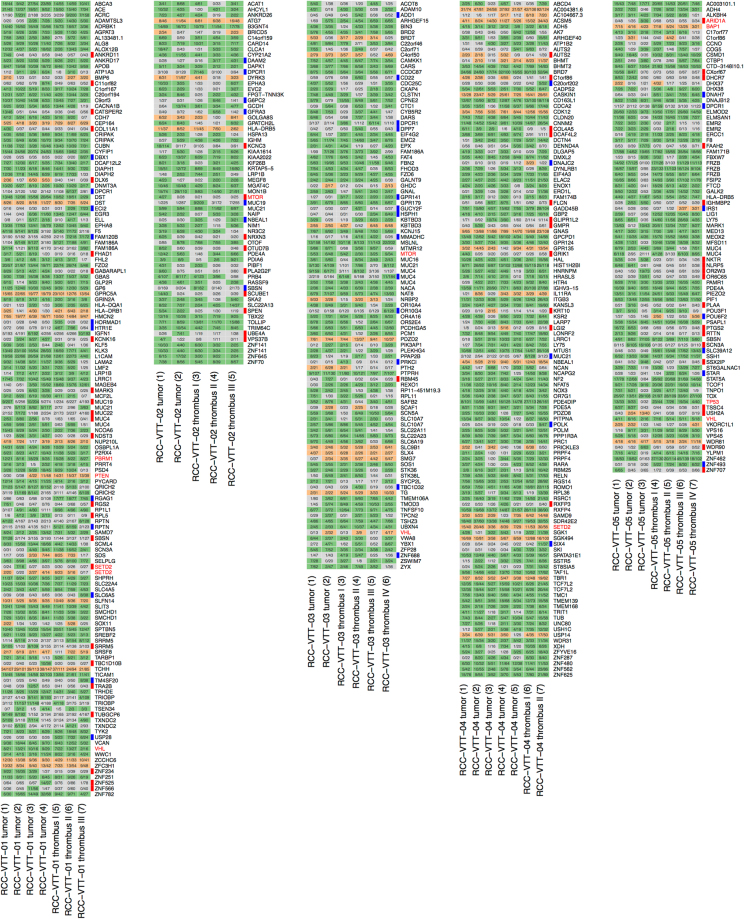
Mutational landscape of RCC with venous tumor thrombus. Functional SNVs (green) and indels (orange) in 483 genes are shown (grey indicates absence of a mutation). Numbers in cells describe the number of reads carrying the alternative allele and the respective sequencing coverage at this position. Bars on the right side of each plot indicate primary tumor-specific (red) or VTT-specific (blue) SNVs and indels. Driver mutations are highlighted in red.
Figure 4
Figure 4
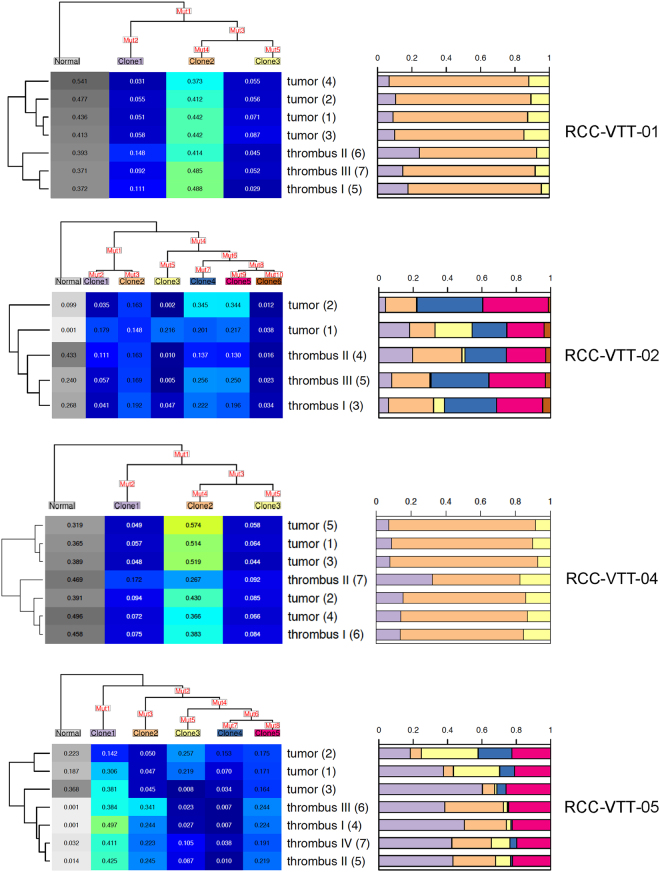
Clonal evolution in RCC with VTT. The clonal heterogeneity for all samples was determined using Canopy. Clonal evolution is depicted as a tree, the leaves of which correspond to the subclones denoted by “Clone1” up to “Clone6”. The number of leaves corresponds to the optimal number of subclones. The set of all mutations (SNVs and CNAs) among all samples of the patient is distributed along the tree in a (heuristically) optimal way (“Mut1”–“Mut10”). Each clone carries all the mutations, which can be collected when following the path from the respective leaf to the root of the tree. The matrix below the mutation tree shows the subclonal composition of each sample (values per line add up to 1). The leaf named “Normal” represents normal tissue contamination and has been neglected in further analyses. The contributions of each other subclone to a sample are illustrated in a stacked bar plot to the right of the matrix, the colors of which correspond to the colors of the leaf labels of the mutation tree. To the left of the matrix, the relationship between the samples with respect to subclonal composition (without “Normal”) is illustrated by a dendrogram.
Figure 5
Figure 5
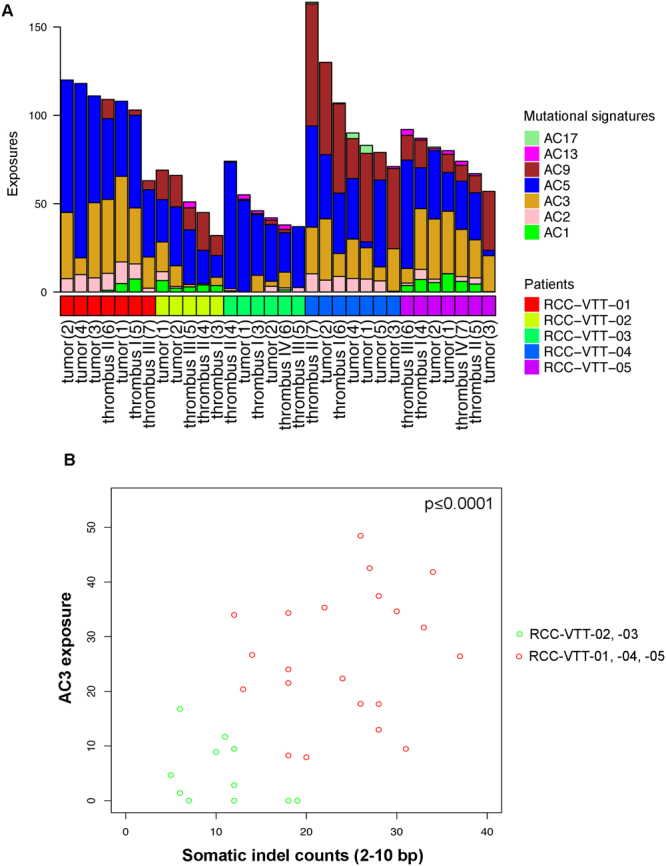
Mutational signatures in RCC with VTT. (A) Mutational signature analysis of the five patients. The shown signatures represent the following mutational processes: AC1 = spontaneous deamination; AC2 = APOBEC action; AC3 = homologous recombination repair defect; AC5 = unknown/metabolic stress; AC9 = Pol eta/somatic hypermutation; AC13 = APOBEC; AC17 = unknown. Note the presence of AC3 indicating defective homologous recombination repair in three of the five patients (RCC-VTT-01, -04, -05). (B) Scatterplot of exposures to signature AC3 and indel counts (2–10 bp) per sample. Wilcoxon rank-sum test between the two colour-coded groups, p ≤ 0.0001.
Figure 6
Figure 6
Mutational signatures in the TCGA KIRC-US cohort. Re-analysis of the TCGA KIRC-US cohort using 400 samples of the clear cell RCC TCGA cohort (KIRC-US; patients filtered by a minimum of 25 somatic SNVs per sample; https://portal.gdc.cancer.gov/projects/TCGA-KIRC). Note the high frequency of mutational signature AC3 and AC5. Each bar represents one patient. The y axis depicts the number of mutations. Additional signatures represent the following mutational processes: AC4 = smoking; AC6 = defective DNA mismatch repair; AC10 = altered POLE activity; AC27 = unknown.

References

    1. Gerlinger M, et al. Intratumor heterogeneity and branched evolution revealed by multiregion sequencing. N. Engl. J. Med. 2012;366:883–892. doi: 10.1056/NEJMoa1113205. - DOI - PMC - PubMed
    1. Gerlinger M, et al. Genomic architecture and evolution of clear cell renal cell carcinomas defined by multiregion sequencing. Nat. Genet. 2014;46:225–233. doi: 10.1038/ng.2891. - DOI - PMC - PubMed
    1. Pouliot, F., Shuch, B., Larochelle, J. C., Pantuck, A. & Belldegrun, A. S. Contemporary management of renal tumors with venous tumor thrombus. J. Urol. 184, 833–41; quiz 1235 (2010). - PubMed
    1. Martínez-Salamanca JI, et al. Lessons learned from the International Renal Cell Carcinoma-Venous Thrombus Consortium (IRCC-VTC) Curr Urol Rep. 2014;15:404. doi: 10.1007/s11934-014-0404-7. - DOI - PubMed
    1. Psutka SP, Leibovich BC. Management of inferior vena cava tumor thrombus in locally advanced renal cell carcinoma. Ther Adv Urol. 2015;7:216–229. doi: 10.1177/1756287215576443. - DOI - PMC - PubMed

Publication types

MeSH terms