. 2018 May 10;8(1):7471.
doi: 10.1038/s41598-018-25935-2.

Lantibiotic production is a burden for the producing staphylococci

Affiliations

Lantibiotic production is a burden for the producing staphylococci

Patrick Ebner et al. Sci Rep. .

Abstract

Lantibiotics are antimicrobial peptides that contain non-proteinogenic amino acids lanthionine and 3-methyllanthionine and are produced by Gram-positive bacteria. Here we addressed the pros and cons of lantibiotic production for its producing strains. Two staphylococcal strains, S. gallinarum Tü3928 and S. epidermidis Tü3298 producing gallidermin and epidermin respectively were selected. In each of these parental strains, the structural genes gdmA and epiA were deleted; all the other biosynthetic genes including the immunity genes were left intact. Comparative analysis of the lantibiotic-producing strains with their non-producing mutants revealed that lantibiotic production is a burden for the cells. The production affected growth, caused release of ATP, lipids and increased the excretion of cytoplasmic proteins (ECP). The epidermin and gallidermin immunity genes were insufficient to protect the cells from their own product. Co-cultivation studies showed that the ΔgdmA mutant has an advantage over the parental strain; the latter was outcompeted. On the one hand, the production of staphylococcal lantibiotics is beneficial by suppressing competitors, but on the other hand they impose a burden on the producing-strains when they accumulate in higher amounts. Our observations explain why antibiotic-producing strains occur as a minority on our skin and other ecological niches, but retain corresponding antibiotic resistance.


Conflict of interest statement

The authors declare no competing interests.

Figures
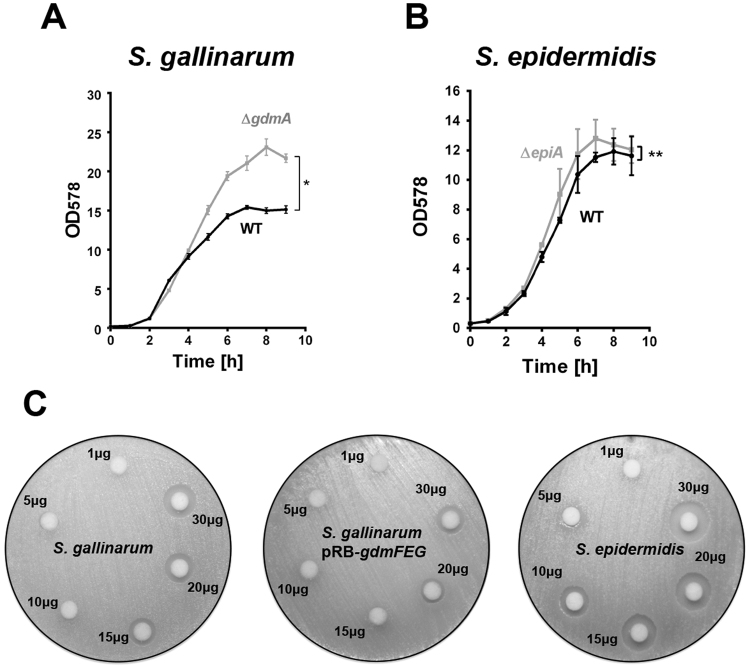
Figure 1
Figure 1
Growth of wild type strains with their lantibiotic-deficient mutants and Gdm-susceptibility comparison of the S. gallinarum and S. epidermidis. (A) S. gallinarum and its gdmA deletion mutant. (B) S. epidermidis and its epiA deletion mutant. Representative data from two independent experiments are shown. For all graphs, each data point represents the mean value ± SD *p < 0.05, **p < 0.01 by unpaired t-test comparing the parent strain with its corresponding epiA/gdmA mutants. (C) Agar-diffusion test with S. gallinarum (left), S. gallinarum pRB-gdmFEG (middle) and S. epidermidis (right) as reporter strain using increasing concentrations (1, 5, 10, 15, 20, 30 μg) of Gdm.
Figure 2
Figure 2
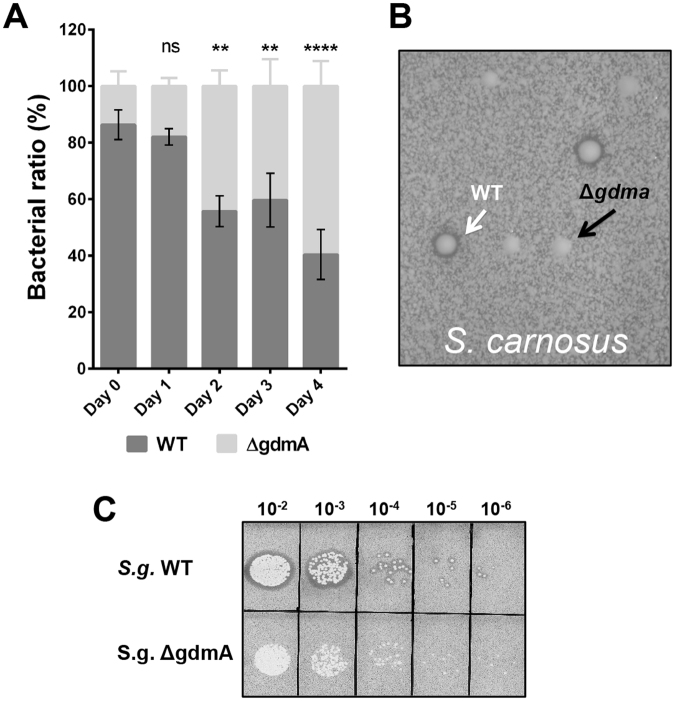
A Gdm deficient mutant can outcompete its parent strain. (A) The Gdm deficient mutant gdmA can overgrow the parent strain (dark or light grey columns). Representative data from two independent experiments are shown. For all graphs, each data point represents the mean value ± SD **p < 0.01 ****p < 0.0001 by two-way ANOVA with Bonferroni posttest. (B) Colonies of the ΔgdmA mutant (white arrow) and the wildtype (black arrow) grown on an agar plate containing S. carnosus as biomarker. (C) CFU comparison of the S. gallinarum parent strain and its gdmA mutant on TSA agar containing S. carnosus.
Figure 3
Figure 3
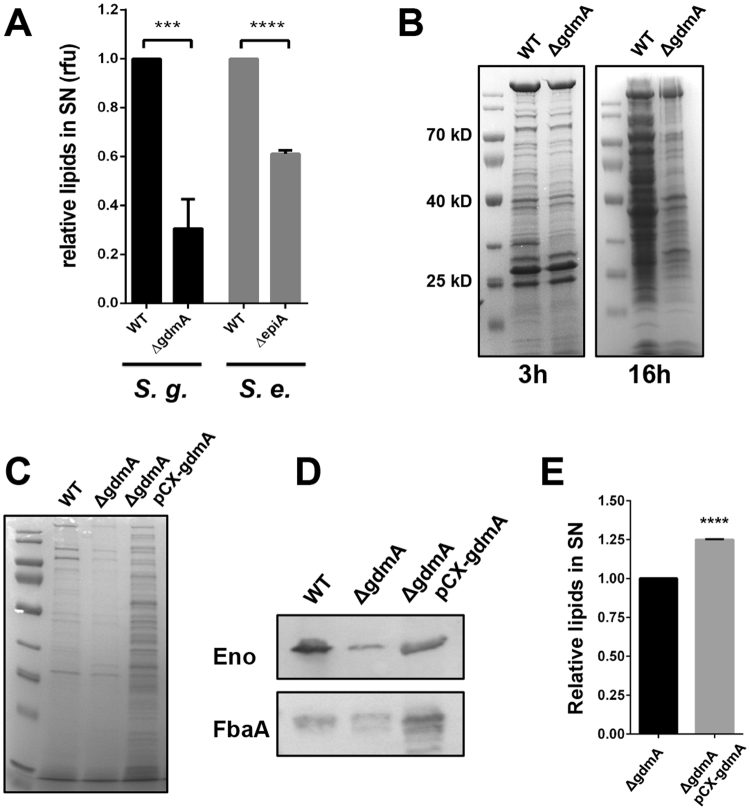
Lantibiotic production causes increased lipid and protein release. (A) Relative amount of lipids in S. gallinarum and S. epidermidis parent strains and their lantibiotic-deficient mutants. Amounts of the mutants are normalized to the corresponding parent strain value. Representative data from three independent experiments are shown, each data point is the mean value ± SD ***p < 0.001 ****p < 0.0001 by students t-test. (B) SDS-PAGE (Coomassie blue staining) of extracellular proteins of S. gallinarum parent strain and gdmA mutant after 3 h and 16 h of growth. (Uncropped gels are shown in Fig. S1). (C) Comparison of the overall protein amount of S. gallinarum parent strain, the gdmA mutant and the complementation pCX-gdmA. (D) Western blotting for FbaA Eno and GAPDH in the supernatant of S. gallinarum parent strain, the gdmA mutant and the complementation pCX-gdmA. (E) Relative extracellular lipids of the S. gallinarum gdmA mutant and the complementation pCX-gdmA.
Figure 4
Figure 4
Lantibiotic-deficient mutants release less cytoplasmic proteins compared to the parent strains. (A) Relative amounts of FbaA, GAPDH and Eno in the supernatant of S. gallinarum and its gdmA deletion mutant after 3, 8 and 16 h. (B) Relative amounts of Eno in the supernatant of S. epidermidis and its epiA deletion mutant after 8 and 16 h. FbaA and GAPDH were not detectable. Note: Protein amounts were normalized to that of the parent strain for every protein at any time point tested. Representative data from at least two independent experiments are shown, each data point is the mean value ± SD *p < 0.05, **p < 0.01, ***p < 0.001 ****p < 0.0001 by students t-test. (C) Enzymatic assay for detection of FbaA (left) and GAPDH (activity) in culture supernatants of 16 h grown cultures of S. epidermidis and its epiA mutant. Representative data from at least two independent experiments are shown, each data point is the mean value ± SD ****p < 0.0001 by paired t-test.
Figure 5
Figure 5
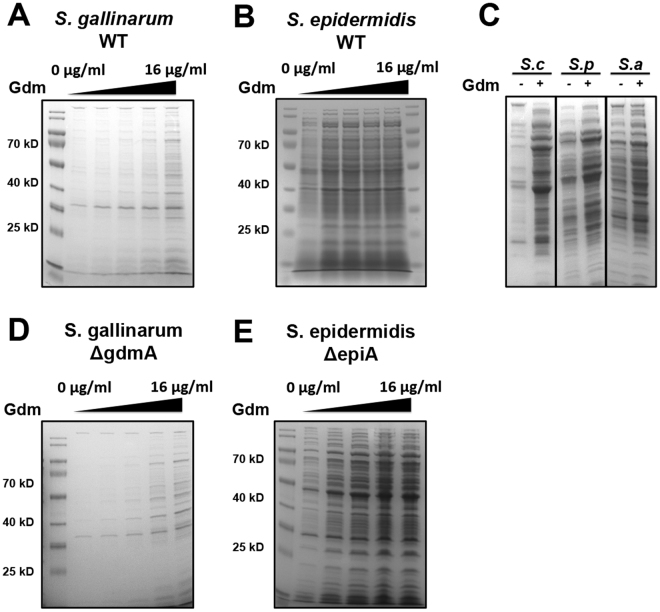
Application of exogenous Gdm increased release of proteins. (A) Extracellular proteins of S. gallinarum untreated (line 1) and treated with increasing concentrations (2, 4, 8 and 16 μg/ml) of Gdm. (B) Extracellular proteins of S. epidermidis untreated (line 1) and treated with increasing concentrations (2, 4, 8 and 16 μg/ml) of Gdm. (C) Influence 8 μg/ml of Gdm on protein release of the non-lantibiotic producers S. carnosus, S. pseudintermedius and S. aureus. (Uncropped gels are shown in Fig. S1). (D) Extracellular proteins of S. gallinarum gdmA mutant untreated (line 1) and treated with increasing concentrations (2, 4, 8 and 16 μg/ml) of Gdm. (E) Extracellular proteins of S. epidermidis epiA mutant untreated (line 1) and treated with increasing concentrations (2, 4, 8 and 16 μg/ml) of Gdm.
Figure 6
Figure 6
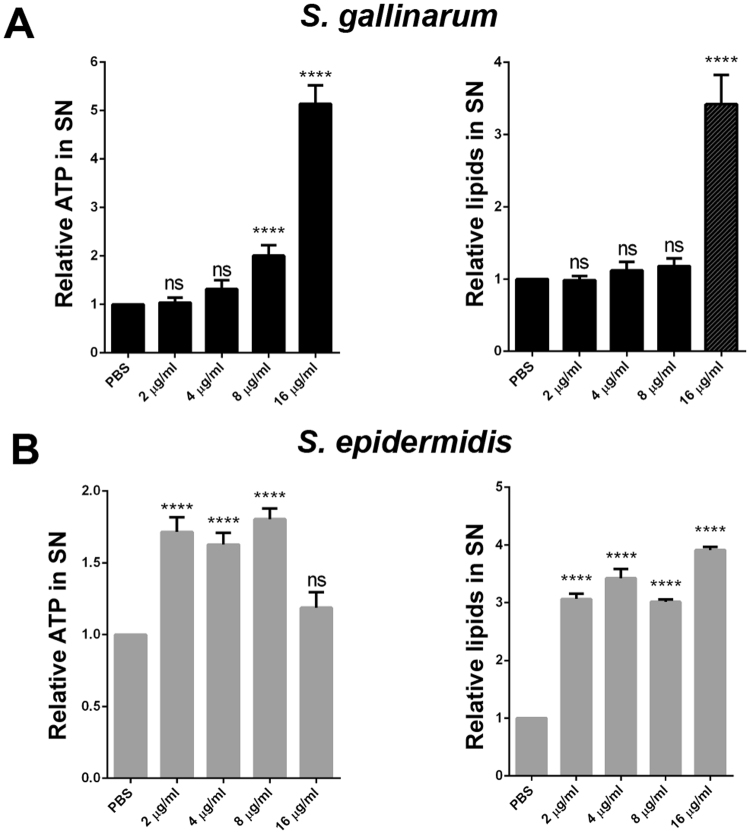
Gdm induced release of ATP and lipids. ATP and lipids were analyzed in the culture supernatants of untreated (PBS) and Gdm treated samples (2, 4, 8, 16 μg/ml) in S. gallinarum (A) and S. epidermidis (B). Amounts of ATP and lipids in treated samples were normalized to the untreated control. Representative data from at least two independent experiments are shown, each data point is the mean value ± SD *p < 0.05, **p < 0.01, ***p < 0.001 ****p < 0.0001 ordinary-one-way-ANOVA with Bonferroni post-test.
Figure 7
Figure 7
Overview on Gdm and Epis mode of action on the producers. Gallidermin/Epidermin are expressed in an inactive pro-form and secreted by the ABC-tranporter GdmHT/EpiHT, the secreted pro-form is processed by specific protease GdmP/EpiP to active Gdm/Epi. Despite the immunity system Gdm/Epi can inhibit the growth of the producer strain causing enhanced excretion of cytoplasmic proteins and the release of ATP and lipids.

References

    1. Schnell N, et al. Prepeptide sequence of epidermin, a ribosomally synthesized antibiotic with four sulphide-rings. Nature. 1988;333:276–278. doi: 10.1038/333276a0. - DOI - PubMed
    1. Willey JM, van der Donk WA. Lantibiotics: peptides of diverse structure and function. Annu Rev Microbiol. 2007;61:477–501. doi: 10.1146/annurev.micro.61.080706.093501. - DOI - PubMed
    1. Diep DB, Nes IF. Ribosomally synthesized antibacterial peptides in Gram positive bacteria. Curr Drug Targets. 2002;3:107–122. doi: 10.2174/1389450024605409. - DOI - PubMed
    1. Götz F, Perconti S, Popella P, Werner R, Schlag M. Epidermin and gallidermin: Staphylococcal lantibiotics. Int J Med Microbiol. 2014;304:63–71. doi: 10.1016/j.ijmm.2013.08.012. - DOI - PubMed
    1. Ortega MA, et al. Structure and mechanism of the tRNA-dependent lantibiotic dehydratase NisB. Nature. 2015;517:509–512. doi: 10.1038/nature13888. - DOI - PMC - PubMed

Publication types

MeSH terms