. 2018 Mar 21:2018:9235605.
doi: 10.1155/2018/9235605. eCollection 2018.

Calibrating Transcriptional Activity Using Constitutive Synthetic Promoters in Mutants for Global Regulators in Escherichia coli

Affiliations

Calibrating Transcriptional Activity Using Constitutive Synthetic Promoters in Mutants for Global Regulators in Escherichia coli

Ananda Sanches-Medeiros et al. Int J Genomics. .

Abstract

The engineering of synthetic circuits in cells relies on the use of well-characterized biological parts that would perform predicted functions under the situation considered, and many efforts have been taken to set biological standards that could define the basic features of these parts. However, since most synthetic biology projects usually require a particular cellular chassis and set of growth conditions, defining standards in the field is not a simple task as gene expression measurements could be affected severely by genetic background and culture conditions. In this study, we addressed promoter parameterization in bacteria in different genetic backgrounds and growth conditions. We found that a small set of constitutive promoters of different strengths controlling a short-lived GFP reporter placed in a low-copy number plasmid produces remarkably reproducible results that allow for the calibration of promoter activity over different genetic backgrounds and physiological conditions, thus providing a simple way to set standards of promoter activity in bacteria. Based on these results, we proposed the utilization of synthetic constitutive promoters as tools for calibration for the standardization of biological parts, in a way similar to the use of DNA and protein ladders in molecular biology as references for comparison with samples of interest.


Figures
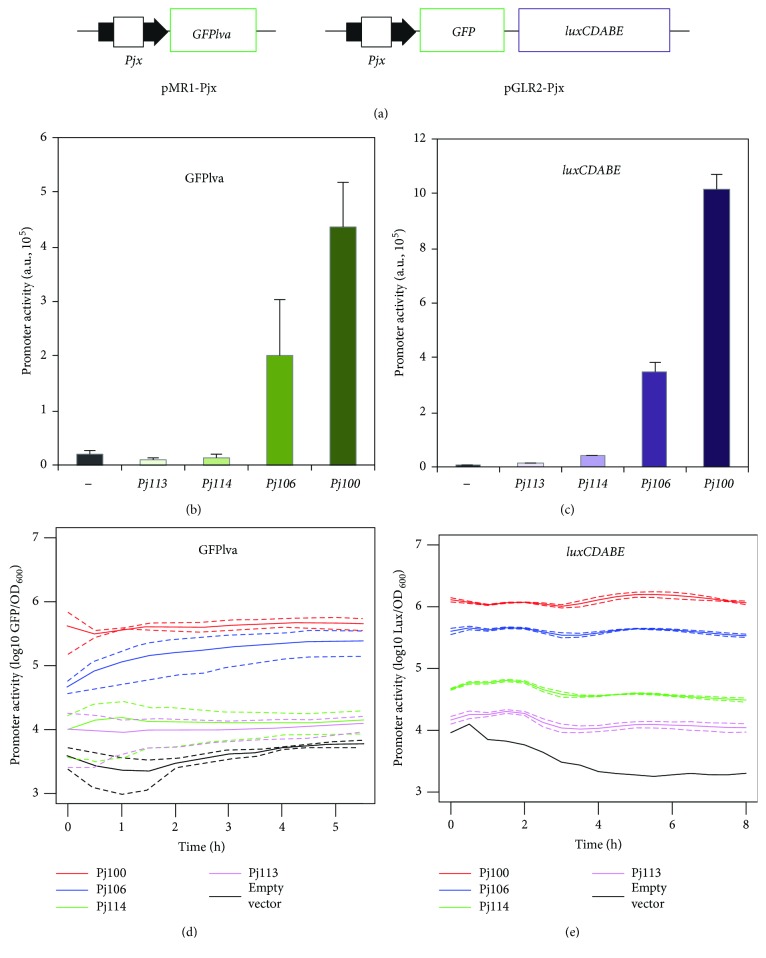
Figure 1
Figure 1
Construction and validation of the reporter systems. (a) Synthetic promoters were cloned into the plasmid pMR1, which contains a short-lived GFPlva variant, and pGLR2, a broad host range vector containing a GFP-luxCDABE reporter system. (b) Maximal promoter activity of the four promoters in pMR1 vector. (c) Maximal promoter activity analyzed by monitoring lux expression using pGLR2 constructions. (d) GFP expression profile along the growth curve from reporters cloned in pMR1 vector. (e) lux expression profile along the growth curve from reporters cloned in pGLR2 vector. The solid lines represent the average values calculated using data from three independent experiments while dashed lines represent standard deviation from the samples.
Figure 2
Figure 2
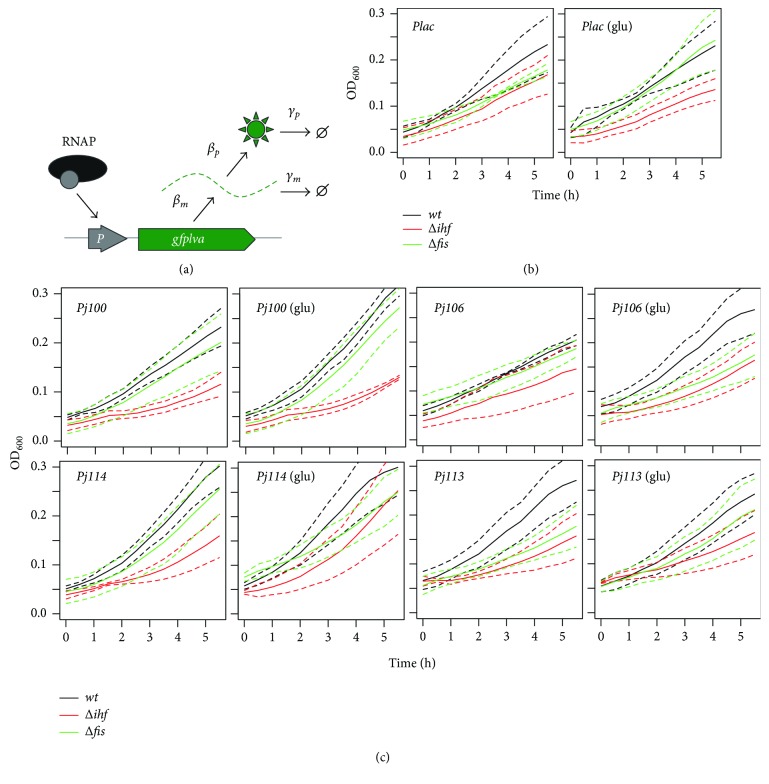
Quantification of growth variation in different E. coli strains under two physiological regimens. (a) Schematic representation of the main steps for gene expression in bacteria. The strength of the interaction between RNA polymerase (RNAP) and target promoter determines the rate of mRNA synthesis (βm), while the RBS sequence determines the rate of protein translation (βp). The rates of mRNA and protein dilution or degradation (γm and γp, resp.) depends on cell growth and physiological regimens of the cells. (b) Growth curve of E. coli strains harboring a Plac::GFPlva fusion in minimal medium with 1% glycerol (left) or 1%glycerol plus 0.4% glucose (right) as carbon source. (c) Growth curve of E. coli strains harboring different promoter fusions (Pj100, Pj106, Pj114, and Pj113) in minimal medium with 1% glycerol or 1%glycerol plus 0.4% glucose (labeled as glu) as carbon source. Solid lines represent average values calculated using data from three independent experiments for wild type (black), Δihf (red), and Δfis (green) strains, while dashed lines represent the upper and lower limits of standard deviations.
Figure 3
Figure 3
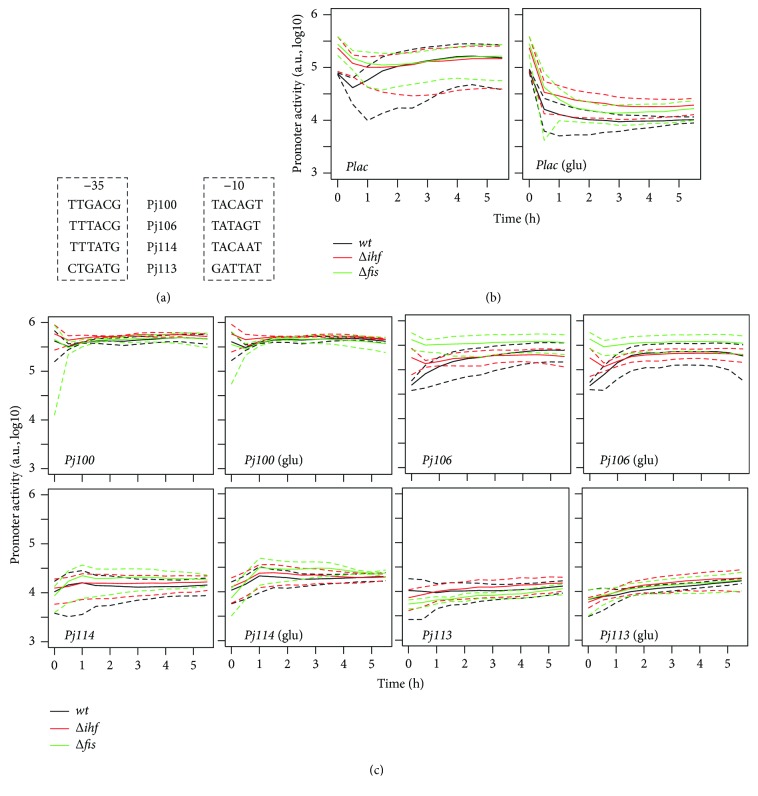
Quantification of promoter activities in different E. coli strains. (a) Representation of the sequences at −10 or −35 for the four constitutive promoters analyzed, using bold letters for bases conserved related to Pj100 reference. (b) Promoter activity of E. coli strains harboring a Plac::GFPlva fusion in minimal medium with 1% glycerol (left) or 1%glycerol plus 0.4% glucose (right) as carbon source. (c) Promoter activity of E. coli strains harboring different promoter fusions (Pj100, Pj106, Pj114, and Pj113) in minimal media with 1% glycerol or 1%glycerol plus 0.4% glucose (labeled as glu) as carbon source. Solid lines represent the average values calculated using data from three independent experiments for wild type (black), Δihf (red), and Δfis (green) strains, while dashed lines represent the upper and lower limits of standard deviations.
Figure 4
Figure 4
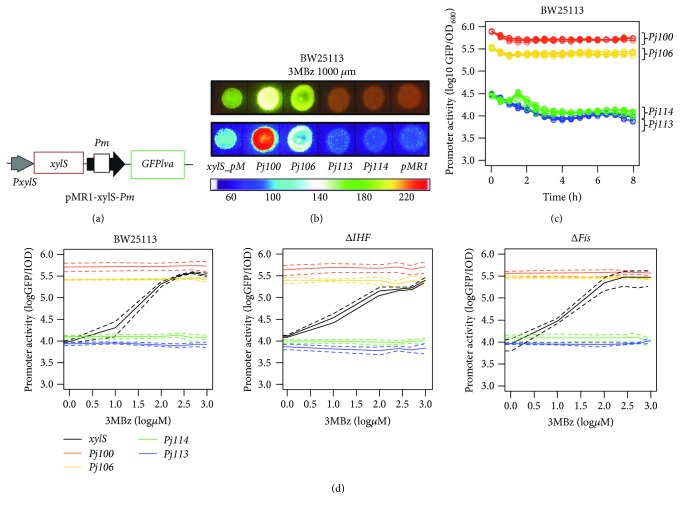
The calibrator can be applied to the induction system xylS-Pm. (a) xylS promoters (PxylS), xylS protein, and Pm promoter were cloned into the plasmid pMR1, which contains a short-lived GFP variant. (b) xylS-Pm calibration in LB solid medium with 1000 μM of 3MBz added. This calibration was performed in BW25113 wt strains. (c) Pjx promoter activity analyzed by 8 hours of experiment by monitoring GFPlva expression using pMR1 constructions. (d) GFP expression profile for 7 different 3MBz concentrations for Pjx and xylS-Pm in pMR1 vector, 4.5 hours after the induction. Solid lines represent the average values calculated using data from three independent experiments for wild type, Δihf, and Δfis strains, while dashed lines represent the upper and lower limits of standard deviations.

References

    1. Silva-Rocha R., de Lorenzo V. Chromosomal integration of transcriptional fusions. Methods in Molecular Biology. 2014;1149:479–489. doi: 10.1007/978-1-4939-0473-0_37. - DOI - PubMed
    1. Zaslaver A., Bren A., Ronen M., et al. A comprehensive library of fluorescent transcriptional reporters for Escherichia coli. Nature Methods. 2006;3(8):623–628. doi: 10.1038/nmeth895. - DOI - PubMed
    1. Browning D. F., Busby S. J. W. Local and global regulation of transcription initiation in bacteria. Nature Reviews Microbiology. 2016;14(10):638–650. doi: 10.1038/nrmicro.2016.103. - DOI - PubMed
    1. Zelcbuch L., Antonovsky N., Bar-Even A., et al. Spanning high-dimensional expression space using ribosome-binding site combinatorics. Nucleic Acids Research. 2013;41(9, article e98) doi: 10.1093/nar/gkt151. - DOI - PMC - PubMed
    1. Klumpp S., Hwa T. Bacterial growth: global effects on gene expression, growth feedback and proteome partition. Current Opinion in Biotechnology. 2014;28:96–102. doi: 10.1016/j.copbio.2014.01.001. - DOI - PMC - PubMed

LinkOut - more resources