


Advanced age results in a diminished endothelial glycocalyx
- PMID: 29750566
- PMCID: PMC6172638
- DOI: 10.1152/ajpheart.00104.2018
Advanced age results in a diminished endothelial glycocalyx
Abstract
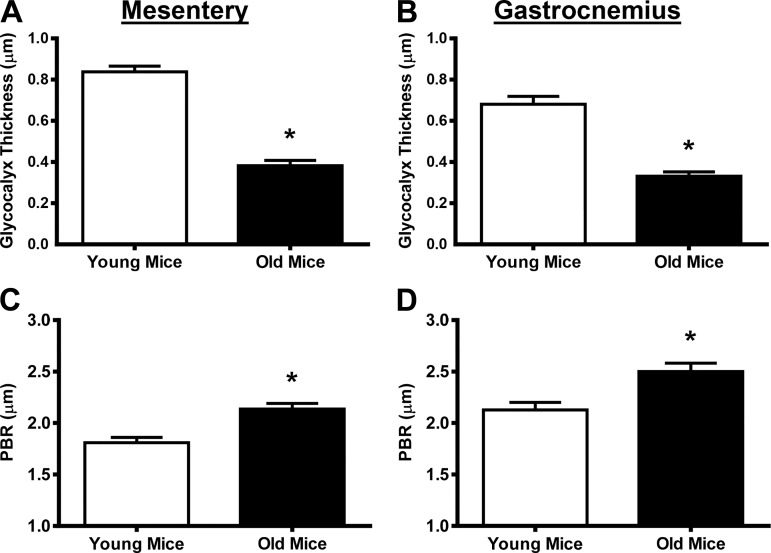
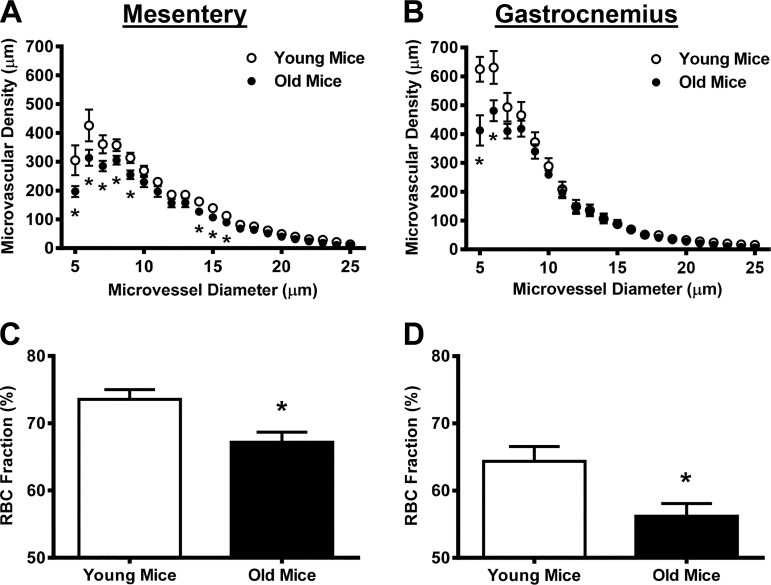
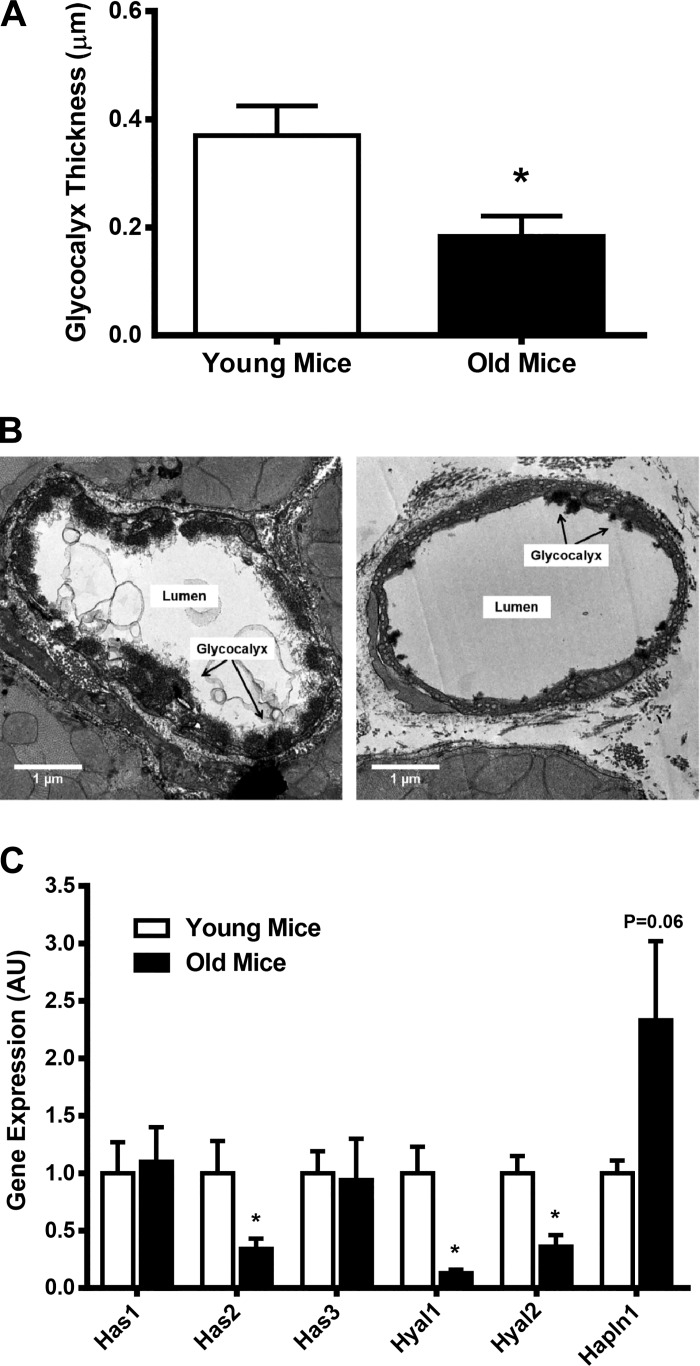
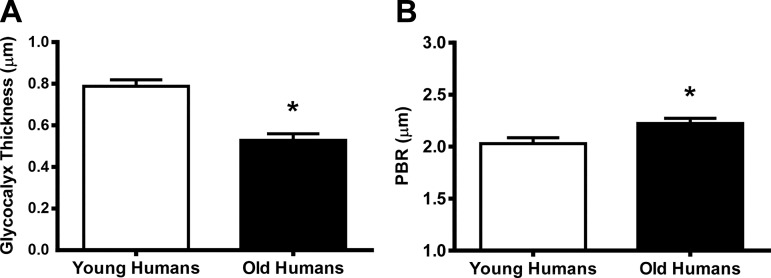
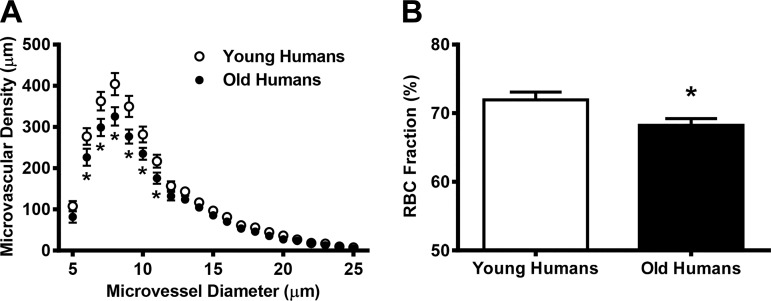
Age-related microvascular dysfunction is well characterized in rodents and humans, but little is known about the properties of the microvascular endothelial glycocalyx in advanced age. We examined the glycocalyx in microvessels of young and old male C57BL6 mice (young: 6.1 ± 0.1 mo vs. old: 24.6 ± 0.2 mo) using intravital microscopy and transmission electron microscopy and in human participants (young: 29 ± 1 yr vs. old: 60 ± 2 yr) using intravital microscopy. Glycocalyx thickness in mesenteric and skeletal muscle microvessels was 51-54% lower in old compared with young mice. We also observed 33% lower glycocalyx thickness in the sublingual microcirculation of humans in advanced age. The perfused boundary region, a marker of glycocalyx barrier function, was also obtained using an automated capture and analysis system. In advanced age, we observed a 10-22% greater perfused boundary region in mice and humans, indicating a more penetrable glycocalyx. Finally, using this automated analysis system, we examined perfused microvascular density and red blood cell (RBC) fraction. Perfused microvascular density is a marker of microvascular function that reflects the length of perfused microvessel segments in a given area; RBC fraction represents the heterogeneity in RBC presence between microvessel segments. Compared with young, the perfused microvascular density was 16-21% lower and RBC fraction was 5-14% lower in older mice and in older humans. These data provide novel evidence that, across mammalian species, a diminished glycocalyx is present in advanced age and is accompanied by markers of impaired microvascular perfusion. Age-related glycocalyx deterioration may be an important contributor to microvascular dysfunction in older adults and subsequent pathophysiology. NEW & NOTEWORTHY Advanced age is characterized by microvascular dysfunction that contributes to age-related cardiovascular diseases, but little is known about endothelial glycocalyx properties in advanced age. This study reveals, for the first time, lower glycocalyx thickness and barrier function that is accompanied by impaired microvascular perfusion in both mice and humans in advanced age.
Keywords: aging; electron microscopy; intravital microscopy; microcirculation; microvascular perfusion.
Figures
Comment in
-
There is no way to sugar coat it, you are getting older.Am J Physiol Heart Circ Physiol. 2018 Sep 1;315(3):H632-H633. doi: 10.1152/ajpheart.00313.2018. Epub 2018 Jun 15. Am J Physiol Heart Circ Physiol. 2018. PMID: 29906230 No abstract available.
References
-
- Broekhuizen LN, Lemkes BA, Mooij HL, Meuwese MC, Verberne H, Holleman F, Schlingemann RO, Nieuwdorp M, Stroes ES, Vink H. Effect of sulodexide on endothelial glycocalyx and vascular permeability in patients with type 2 diabetes mellitus. Diabetologia 53: 2646–2655, 2010. doi:10.1007/s00125-010-1910-x. - DOI - PMC - PubMed
-
- Ceriello A, Giugliano D, Dello Russo P, Passariello N, Saccomanno F, Sgambato S. Glycosaminoglycans in human diabetes. Diabete Metab 9: 32–34, 1983. - PubMed
Publication types
MeSH terms
Grants and funding
LinkOut - more resources
Full Text Sources
Other Literature Sources
Medical
