Review
. 2018 May 11;8(2):46.
doi: 10.3390/bios8020046.

In Vitro and In Vivo SERS Biosensing for Disease Diagnosis

Affiliations
Review

In Vitro and In Vivo SERS Biosensing for Disease Diagnosis

T Joshua Moore et al. Biosensors (Basel). .

Abstract

For many disease states, positive outcomes are directly linked to early diagnosis, where therapeutic intervention would be most effective. Recently, trends in disease diagnosis have focused on the development of label-free sensing techniques that are sensitive to low analyte concentrations found in the physiological environment. Surface-enhanced Raman spectroscopy (SERS) is a powerful vibrational spectroscopy that allows for label-free, highly sensitive, and selective detection of analytes through the amplification of localized electric fields on the surface of a plasmonic material when excited with monochromatic light. This results in enhancement of the Raman scattering signal, which allows for the detection of low concentration analytes, giving rise to the use of SERS as a diagnostic tool for disease. Here, we present a review of recent developments in the field of in vivo and in vitro SERS biosensing for a range of disease states including neurological disease, diabetes, cardiovascular disease, cancer, and viral disease.

Keywords: SERS; biosensing; cancer; cardiovascular disease; diabetes; diagnostics; neurological disease; viral disease.


Conflict of interest statement

The authors declare no conflict of interest.

Figures
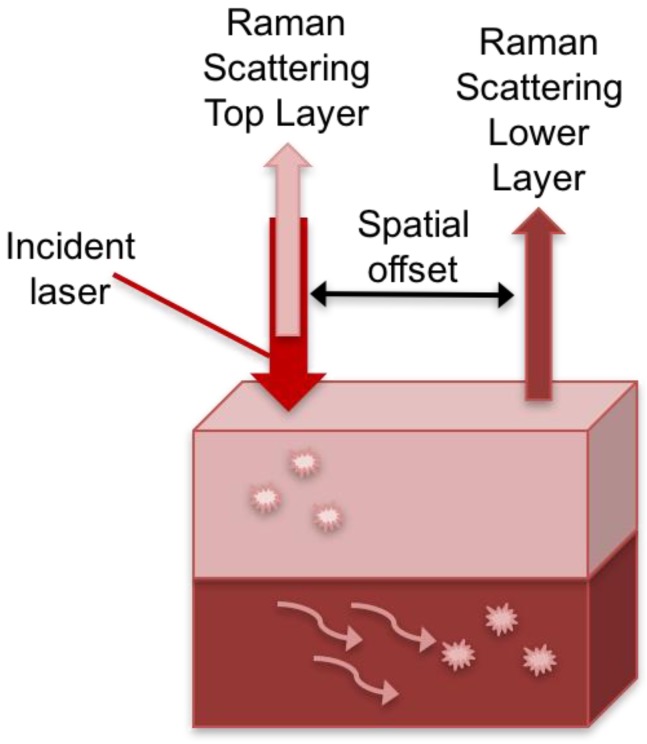
Figure 1
Figure 1
Schematic of spatially offset Raman spectroscopy (SORS) technique. The Raman scattered light collected along the same path as the point of incident illumination is due to the contributions from the surface layer. The Raman scattered light collected at a point spatially offset from the incident illumination point, allows for collection of the signal from subsurface layers where the photons that are deeper in the material migrate laterally before scattering from the surface.
Figure 2
Figure 2
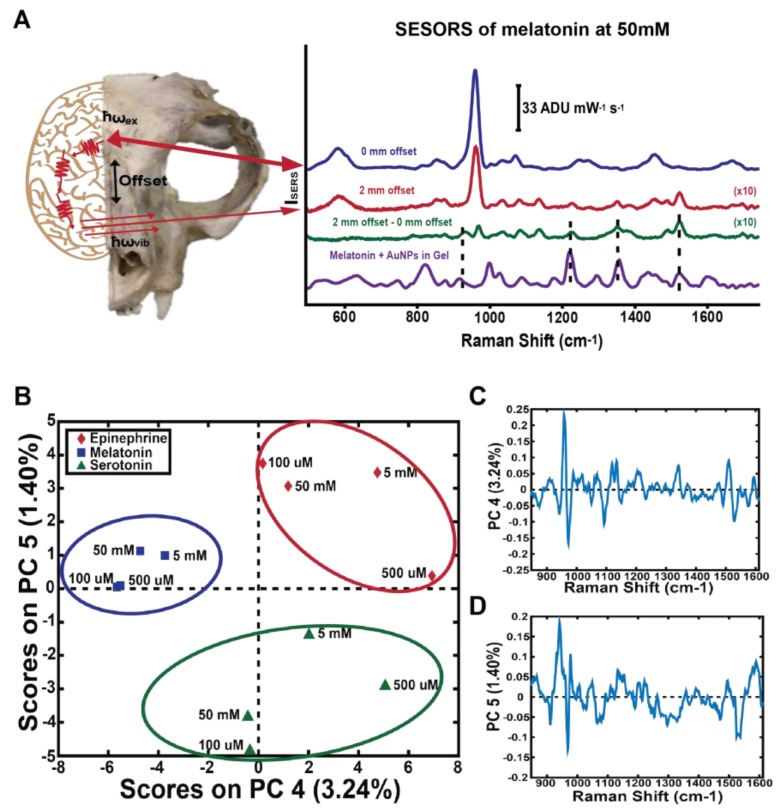
Raman scattered light was collected at a point spatially offset from the incident illumination point, allowing the signal from the neurotransmitter to be acquired through a cat skull (A). PCA was used to show that the individual neurotransmitters are clearly separated from each other in a plot of the scores of PC4 versus PC5 (B) and their corresponding loadings (C,D). Adapted with permission from Ref. [55]. Copyright 2017 American Chemical Society.
Figure 3
Figure 3
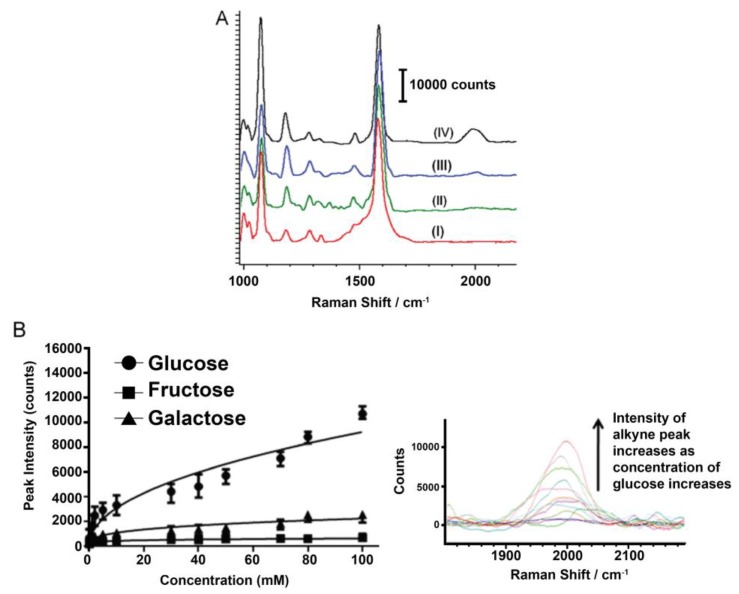
(A) Comparison of SERS spectra of phenylboronic acid-functionalized substrate with (I) no analyte, and 10 mM of (II) fructose, (III) galactose, and (IV) glucose; (B) SERS intensity of alkyne peak at 1996 cm−1 with various concentrations of glucose, galactose, and fructose. Inset is the Raman spectra, showing the alkyne peak with various concentrations of glucose. Reprinted from Ref. [70], Copyright (2014), with permission from Elsevier.
Figure 4
Figure 4
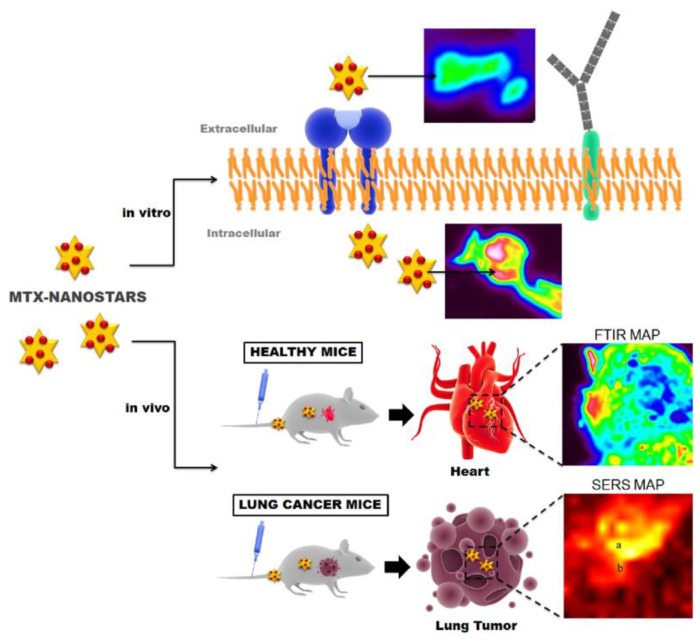
Illustration of the use of mitoxantrone (MTX) nanostars for in vitro and in vivo imaging, as well as nonspecific therapy for patients with cardiovascular diseases. Reprinted from Ref. [84] Copyright (2016), with permission from Elsevier.
Figure 5
Figure 5
(Left) Raman intensity plot of ISERS1325 and ISERS1580 obtained from multiplex imaging of MDA-MB-231 TNBC cells using multibranched gold nanoantennae (inset) showing signals from (i) both probes, (ii) DTNB alone, (iii) 4-MBA alone, and (iv) no signal; (middle) the Raman spectra obtained from (i) both probes, (ii) DTNB only, (iii) 4-MBA only, and (iv) no probes or intracellular lipids; and (right) live cells (green) and dead cells (red) observed via confocal fluorescence imaging after photothermal cell death. Reprinted with permission from Ref. [92]. Copyright 2017 American Chemical Society.
Figure 6
Figure 6
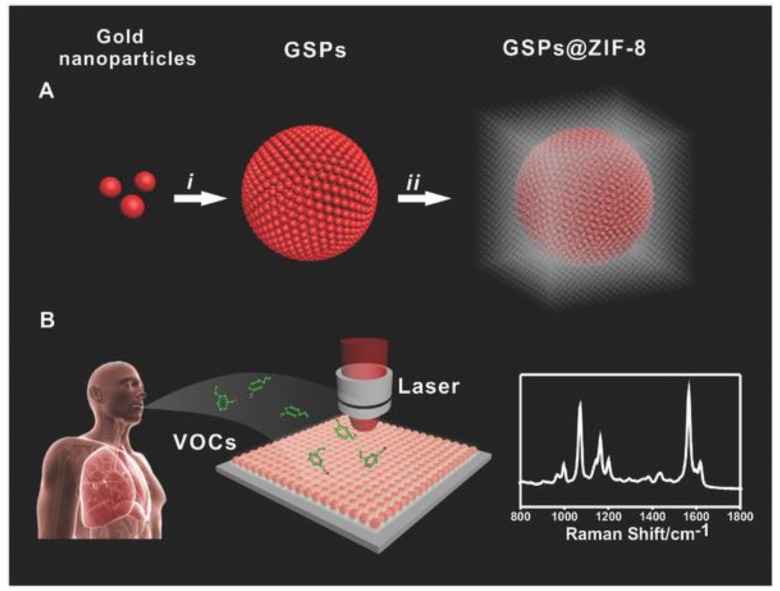
(A) Diagrammatic sketch of synthesizing GSP@ZIF-8 core–shell structure: (i) AuNPs assembled into GSPs, (ii) ZIF-8 shell coated on GSP surface; (B) volatile organic compound (VOC) detection via SERS spectroscopy. Reproduced with permission from Ref. [104] Copyright 2017, Wiley.
Figure 7
Figure 7
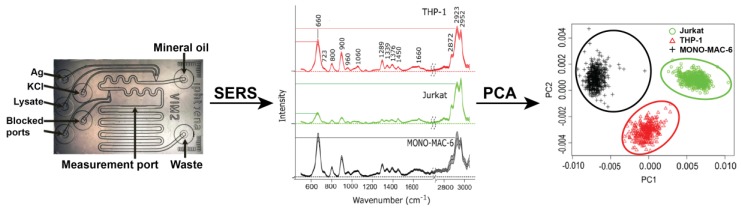
A quartz chip microfluidic device was designed for SERS at 785 nm excitation. At three separate inlets of the microfluidic device, AgNPs, KCl, and the cell lysate are injected and flow to combine together (left). Mineral oil is added to the initial mixture to act as a separation medium for the formation of droplets. SERS measurements (middle) of the droplets are acquired at a midpoint in the device. PCA of SERS spectra clearly shows separation and identification of the three leukemia cell lysates using variations in band intensity between the spectra (right). Figure adapted and reprinted from Ref. [114] by permission from Springer Customer Service Centre GmbH: Springer, Copyright Springer-Verlag GmbH Germany 2017 (2017).
Figure 8
Figure 8
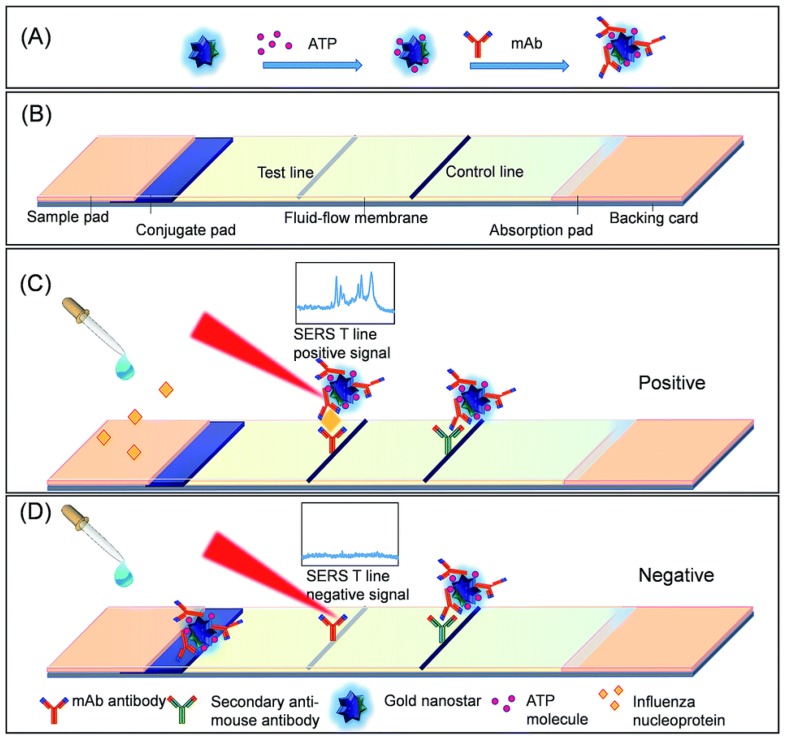
SERS-LFIA test system: (A) AuNS is functionalized with 4-ATP and conjugated to monoclonal antibodies to form the SERS tags; (B) LIFA test strip, and the response of the SERS-LFIA system to (C) influenza A nucleoprotein and (D) a negative control. Reproduced from Ref. [119] with permission of The Royal Society of Chemistry.

References

    1. Sharma B., Frontiera R.R., Henry A.-I., Ringe E., Van Duyne R.P. SERS: Materials, applications, and the future. Mater. Today. 2012;15:16–25. doi: 10.1016/S1369-7021(12)70017-2. - DOI
    1. Fleischmann M., Hendra P.J., McQuillan A.J. Raman spectra of pyridine adsorbed at a silver electrode. Chem. Phys. Lett. 1974;26:163–166. doi: 10.1016/0009-2614(74)85388-1. - DOI
    1. Albrecht M.G., Creighton J.A. Anomalously intense Raman spectra of pyridine at a silver electrode. J. Am. Chem. Soc. 1977;99:5215–5217. doi: 10.1021/ja00457a071. - DOI
    1. Jeanmaire D.L., Van Duyne R.P. Surface Raman spectroelectrochemistry part I. Heterocyclic, aromatic, and aliphatic amines adsorbed on the anodized silver electrode. J. Electroanal. Chem. 1977;8:1–20. doi: 10.1016/S0022-0728(77)80224-6. - DOI
    1. Henry A.-I., Sharma B., Cardinal M.F., Kurouski D., Van Duyne R.P. Surface-enhanced Raman spectroscopy biosensing: In vivo diagnostics and multimodal imaging. Anal. Chem. 2016;88:6638–6647. doi: 10.1021/acs.analchem.6b01597. - DOI - PubMed

MeSH terms

LinkOut - more resources