. 2018 May 11;19(5):1441.
doi: 10.3390/ijms19051441.

Expression of AhDREB1, an AP2/ERF Transcription Factor Gene from Peanut, Is Affected by Histone Acetylation and Increases Abscisic Acid Sensitivity and Tolerance to Osmotic Stress in Arabidopsis

Affiliations

Expression of AhDREB1, an AP2/ERF Transcription Factor Gene from Peanut, Is Affected by Histone Acetylation and Increases Abscisic Acid Sensitivity and Tolerance to Osmotic Stress in Arabidopsis

Baihong Zhang et al. Int J Mol Sci. .

Abstract

Drought stress negatively affects plant growth and development. An increasing number of reports have revealed the involvement of APETALA2/Ethylene Responsive Factor (AP2/ERF) transcription factors (TFs) in biotic and abiotic stress regulation in plants. However, research on these TFs in the peanut plant (Arachis hypogaea) has been limited. Here, we isolated a full-length coding sequence (CDS) of the AP2/ERF family gene AhDREB1 from the peanut plant and showed that its expression was induced by Polyethylene Glycol (PEG) 6000 and exogenous abscisic acid (ABA) treatment. When overexpressed in Arabidopsis, AhDREB1 increased both ABA levels and ABA sensitivity, affected the ABA signaling pathway and increased the expression of downstream drought stress-related genes RD29A, P5CS1, P5CS2 and NCED1. These results demonstrate that AhDREB1 can improve tolerance to drought via the ABA-dependent pathway in Arabidopsis. In the peanut plant, the specific histone deacetylases (HDACs) inhibitor trichostatin A (TSA) promotes AhDREB1 transcription and the enrichment level of H3ac was increased in regions of the AhDREB1 gene during TSA and PEG treatment. In summary, histone acetylation can affect the expression of AhDREB1 under osmotic stress conditions, thereby improving plant drought resistance.

Keywords: APETALA2/Ethylene Responsive Factor; AhDREB1; abscisic acid; drought stresses; histone acetylation; peanut.


Conflict of interest statement

The authors declare that the research was conducted in the absence of any commercial or financial relationships that could be construed as a potential conflict of interest.

Figures
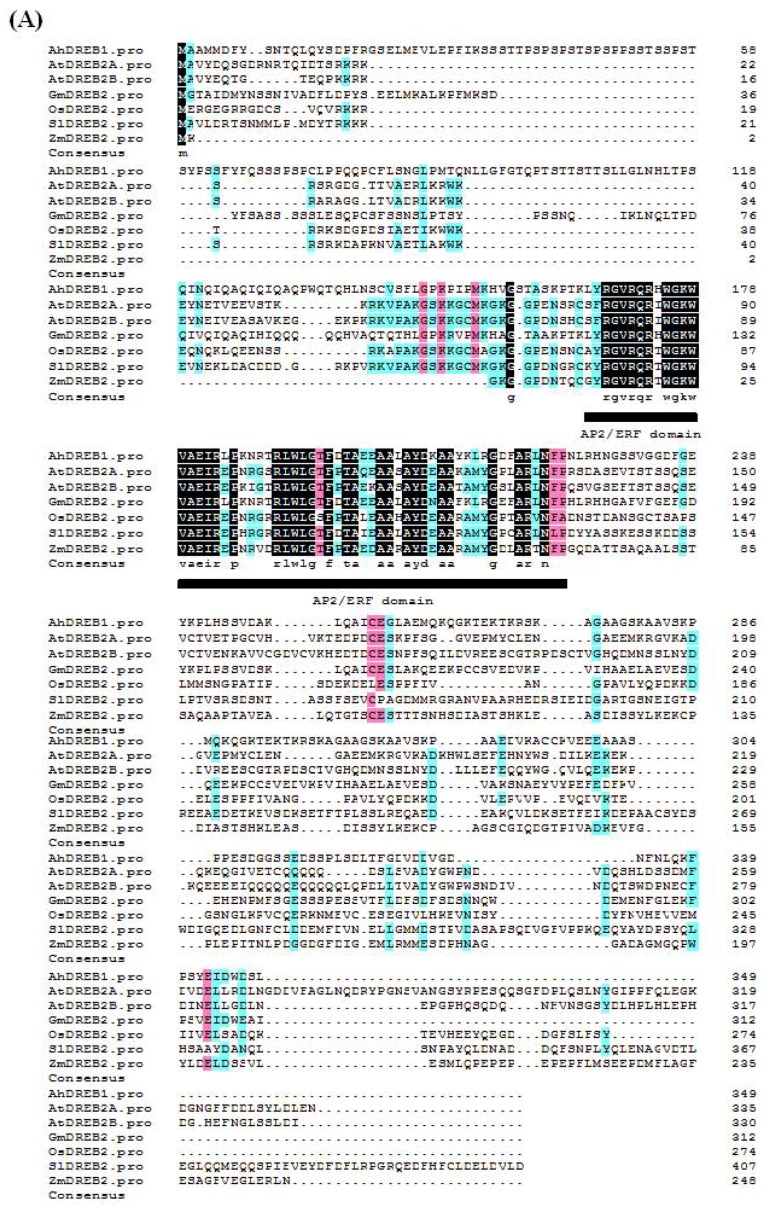
Figure 1
Figure 1
AhDREB1 is a member of the APETALA2/Ethylene Responsive Factor (AP2/ERF) transcription factor family in peanut. (A) Alignment of amino acid sequences of AhDREB1 with six dehydration-responsive element binding protein (DREB) subfamily proteins. AhDREB1: GenBank number API65088.1; AtDREB2A: GenBank number BAA33794.1; AtDREB2B: GenBank number BAA33795.1; GmDREB2: GenBank number AAQ57226.1; OsDREB2: GenBank number AAN02487.2; SlDREB2: GenBank number ADZ15315.1; ZmDREB2: GenBank number AFI71287.1. Identical amino acid residues are shaded in black. Conservative AP2/ERF domain are marked with a black underline. (B) AhDREB1 has no transmembrane domain, transmembrane structure was analyzed using online TMHMM 2.0 (http://www.cbs.dtu.dk/services/). (C) The intracellular localization of AhDREB1 in Arabidopsis protoplasts. Image showed the eGFP protein was observed in the whole Arabidopsis protoplasts cells, which the AhDREB1-eGFP fusion protein was localized in nucleus in Arabidopsis protoplasts cells, determined by confocal and bright-field microscopy.
Figure 1
Figure 1
AhDREB1 is a member of the APETALA2/Ethylene Responsive Factor (AP2/ERF) transcription factor family in peanut. (A) Alignment of amino acid sequences of AhDREB1 with six dehydration-responsive element binding protein (DREB) subfamily proteins. AhDREB1: GenBank number API65088.1; AtDREB2A: GenBank number BAA33794.1; AtDREB2B: GenBank number BAA33795.1; GmDREB2: GenBank number AAQ57226.1; OsDREB2: GenBank number AAN02487.2; SlDREB2: GenBank number ADZ15315.1; ZmDREB2: GenBank number AFI71287.1. Identical amino acid residues are shaded in black. Conservative AP2/ERF domain are marked with a black underline. (B) AhDREB1 has no transmembrane domain, transmembrane structure was analyzed using online TMHMM 2.0 (http://www.cbs.dtu.dk/services/). (C) The intracellular localization of AhDREB1 in Arabidopsis protoplasts. Image showed the eGFP protein was observed in the whole Arabidopsis protoplasts cells, which the AhDREB1-eGFP fusion protein was localized in nucleus in Arabidopsis protoplasts cells, determined by confocal and bright-field microscopy.
Figure 2
Figure 2
Expression analyses of AhDREB1, AhNCED1 and AhAREB1 following 20% PEG treatment in peanut leaves by real-time quantitative PCR (RT-qPCR). Time points of 2, 5, 8, 12, and 24 h were sampled to observe the expression changing trend. The untreated group was used as the control. Mean and SD were obtained from more than three biological replicates. Asterisks indicate significant differences from control (Student’s t test p values, ** p < 0.01).
Figure 3
Figure 3
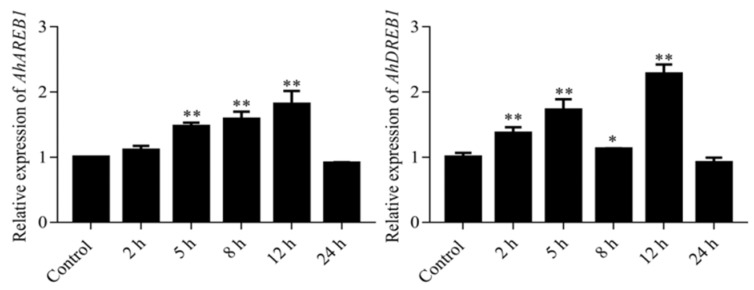
Expression analyses of AhDREB1 and AhAREB1 following 100 μM abscisic acid (ABA) treatment in peanut leaves by RT-qPCR. Time points of 2, 5, 8, 12, and 24 h were sampled to observe the expression changing trend. The untreated group was used as the control. Mean and SD were obtained from more than three biological replicates. Asterisks indicate significant differences from control (Student’s t test p values, * p < 0.05 and ** p < 0.01).
Figure 4
Figure 4
Overexpression of AhDREB1 in Arabidopsis enhances plant tolerance to drought stress. (A) The expression levels of AhDREB1 in AhDREB1-OX lines. (B) Survival rate of 3-week-old wild-type and AhDREB1-OX lines during the drought stress test. (C) Drought tolerance phenotype of 3-week-old wild-type and AhDREB1-OX lines were drought stress for 2 weeks and rehydration 2days. (D) The change in water content in overexpression Arabidopsis thaliana. (E) Stomatal opening in the leaves of 3-week-old wild-type and AhDREB1-OX lines under control conditions or after drought stress for 2 weeks; n = 180. ‘*’ indicates a significant difference at the level of p < 0.05 between AhDREB1-OX lines and Col plants under control treatment or drought stress conditions. (F) ABA content in the leaves of 3-week-old wild-type and AhDREB1-OX lines under control conditions or after drought stress for 2 weeks. All experiments, mean and SD were obtained from more than three biological replicates. Asterisks in (A) to (F), indicate significant differences from Col (Student’s t test P values, * p < 0.05 and ** p < 0.01).
Figure 4
Figure 4
Overexpression of AhDREB1 in Arabidopsis enhances plant tolerance to drought stress. (A) The expression levels of AhDREB1 in AhDREB1-OX lines. (B) Survival rate of 3-week-old wild-type and AhDREB1-OX lines during the drought stress test. (C) Drought tolerance phenotype of 3-week-old wild-type and AhDREB1-OX lines were drought stress for 2 weeks and rehydration 2days. (D) The change in water content in overexpression Arabidopsis thaliana. (E) Stomatal opening in the leaves of 3-week-old wild-type and AhDREB1-OX lines under control conditions or after drought stress for 2 weeks; n = 180. ‘*’ indicates a significant difference at the level of p < 0.05 between AhDREB1-OX lines and Col plants under control treatment or drought stress conditions. (F) ABA content in the leaves of 3-week-old wild-type and AhDREB1-OX lines under control conditions or after drought stress for 2 weeks. All experiments, mean and SD were obtained from more than three biological replicates. Asterisks in (A) to (F), indicate significant differences from Col (Student’s t test P values, * p < 0.05 and ** p < 0.01).
Figure 5
Figure 5
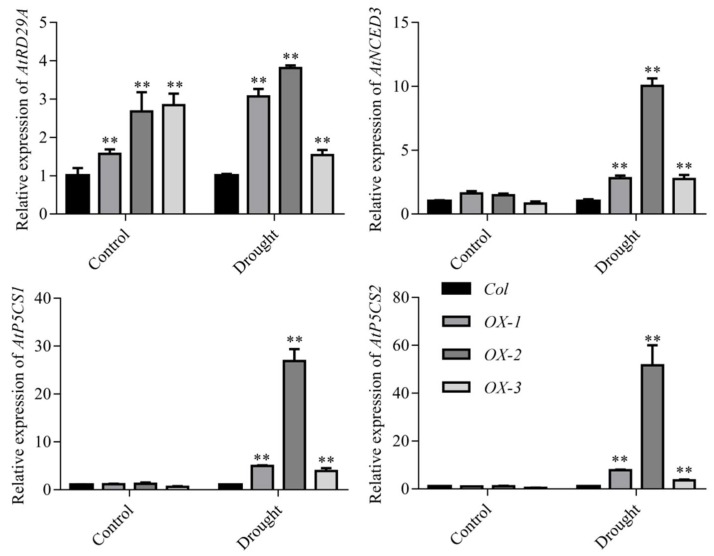
Expression analyses of drought stress-related marker genes: AtRD29A, AtNCED3, AtP5CS1, AtP5CS2 in the wild type and transgenic plants under drought stress. The untreated group was used as the control. Mean and SD were obtained from more than three biological replicates. Asterisks indicate significant differences from control (Student’s t test P values, ** p < 0.01).
Figure 6
Figure 6
AhDREB1 increases ABA sensitivity in Arabidopsis. (AC) Seed germination rate of AhDREB1-OX lines and Col in response to different concentrations of ABA. Numbers of germinated seedlings were recorded from 0 to 192 h after stratification on one-half-strength Murashige and Skoog (1/2 MS) agar plates containing 0, 0.5, or 2 μM ABA, respectively. (D) Photographs of seed germination on agar plates containing 0, 0.5 or 2 μM ABA. Mean and SD were obtained from more than three biological replicates.
Figure 7
Figure 7
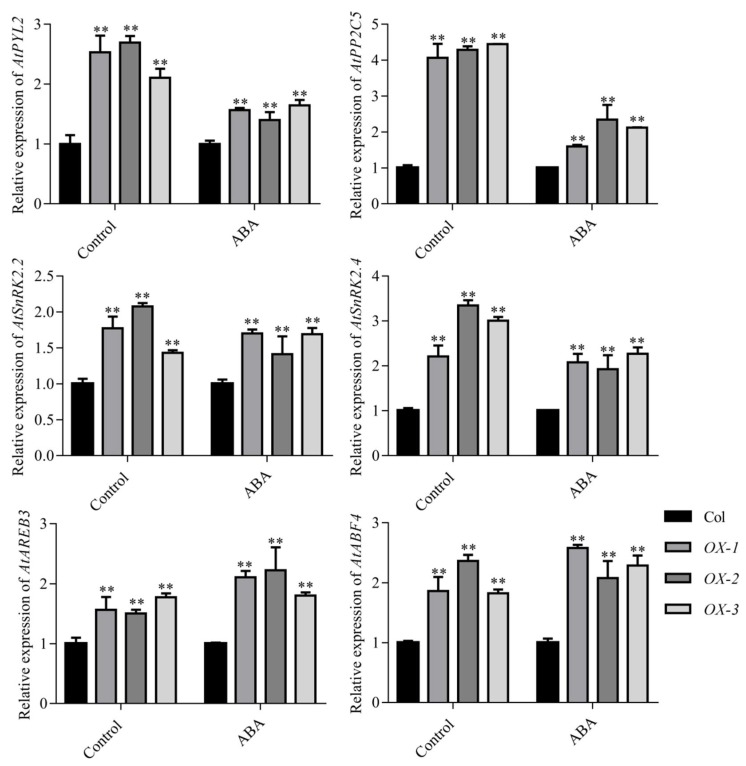
Expression changes of ABA signaling pathway related gene: AtPYL2, AtPP2C5, AtSnRK2.2, AtSnRK2.4, AtAREB3, AtABF4 following 10 μM ABA treatment. The untreated group was used as the control. Mean and SD were obtained from more than three biological replicates. Asterisks indicate significant differences from control (Student’s t test p values, ** p < 0.01).
Figure 8
Figure 8
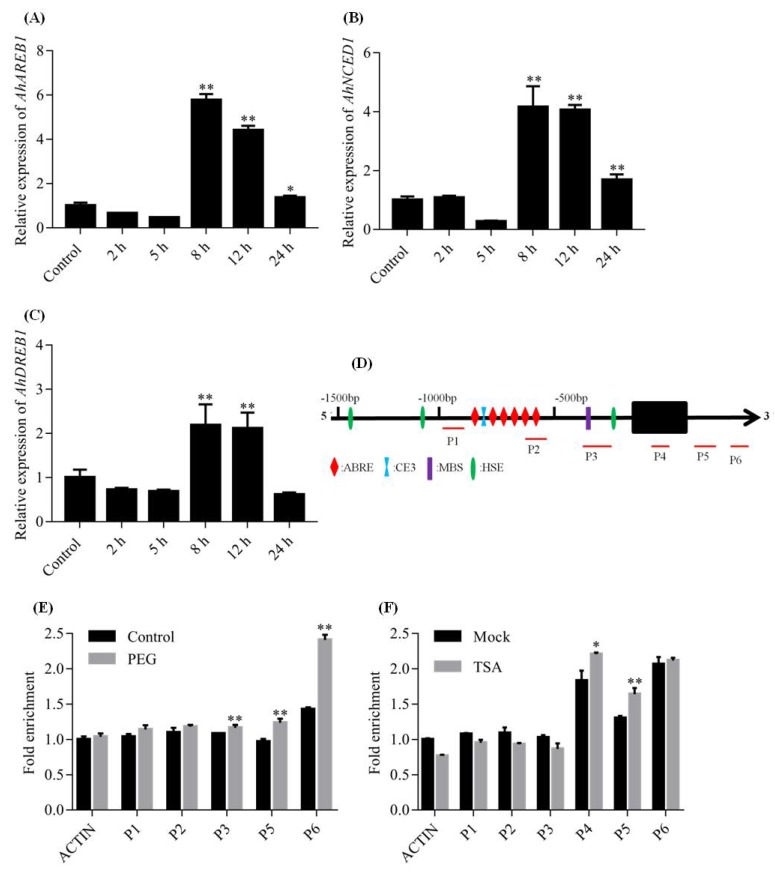
Histone acetylation is involved in AhDREB1 transcriptional regulation. (AC) Expression analyses of AhDREB1 and stress resistance genes following 1 μΜ treatment in peanut leaves by RT-qPCR. Time points of 2, 5, 8, 12, and 24 h were sampled to observe the expression changing trend. The untreated group was used as the control. Mean and SD were obtained from more than three biological replicates. Asterisks indicate significant differences from control (Student’s t test p values, * p < 0.05 and ** p < 0.01). (D) The structure of the AhDREB1 promoter. PCR amplification (P1–P6) for chromatin immunoprecipitation (ChIP) assays are indicated. (E,F) H3ac levels in chromatin of peanut leaves under 1 μM TSA and 20% PEG treatment, respectively. The untreated group was used as the control. Mean and SD were obtained from more than three biological replicates. Asterisks indicate significant differences from control (Student’s t test p values, * p < 0.05 and ** p < 0.01).

References

    1. Agarwal P.K., Gupta K., Lopato S., Agarwal P. Dehydration responsive element binding transcription factors and their applications for the engineering of stress tolerance. J. Exp. Bot. 2017;68:2135–2148. doi: 10.1093/jxb/erx118. - DOI - PubMed
    1. Vinocur B., Altman A. Recent advances in engineering plant tolerance to abiotic stress: Achievements and limitations. Curr. Opin. Biotechnol. 2005;16:123–132. doi: 10.1016/j.copbio.2005.02.001. - DOI - PubMed
    1. Gonzalez-Villagra J., Rodrigues-Salvador A., Nunes-Nesi A., Cohen J.D., Reyes-Diaz M.M. Age-related mechanism and its relationship with secondary metabolism and abscisic acid in Aristotelia chilensis plants subjected to drought stress. Plant Physiol. Biochem. 2018;124:136–145. doi: 10.1016/j.plaphy.2018.01.010. - DOI - PubMed
    1. Liu J., Wang R., Liu W., Zhang H., Guo Y., Wen R. Genome-Wide Characterization of Heat-Shock Protein 70s from Chenopodium quinoa and Expression Analyses of Cqhsp70s in Response to Drought Stress. Genes. 2018;9:35. doi: 10.3390/genes9020035. - DOI - PMC - PubMed
    1. Bohnert H.J., Jensen R.G. Strategies for engineering water-stress tolerance in plants. Trends Biotechnol. 1996;14:89–97. doi: 10.1016/0167-7799(96)80929-2. - DOI

LinkOut - more resources