


The effect of sitting posture on the loads at cervico-thoracic and lumbosacral joints
- PMID: 29758964
- PMCID: PMC6004963
- DOI: 10.3233/THC-174717
The effect of sitting posture on the loads at cervico-thoracic and lumbosacral joints
Abstract
Background: The sitting in an awkward posture for a prolonged time may lead to spinal or musculoskeletal disease. It is important to investigate the joint loads at spine while sitting.
Objective: The purpose of this study was to investigate the joint moment and antero-posterior (AP) reaction force at cervico-thoracic and lumbosacral joint for various sitting postures.
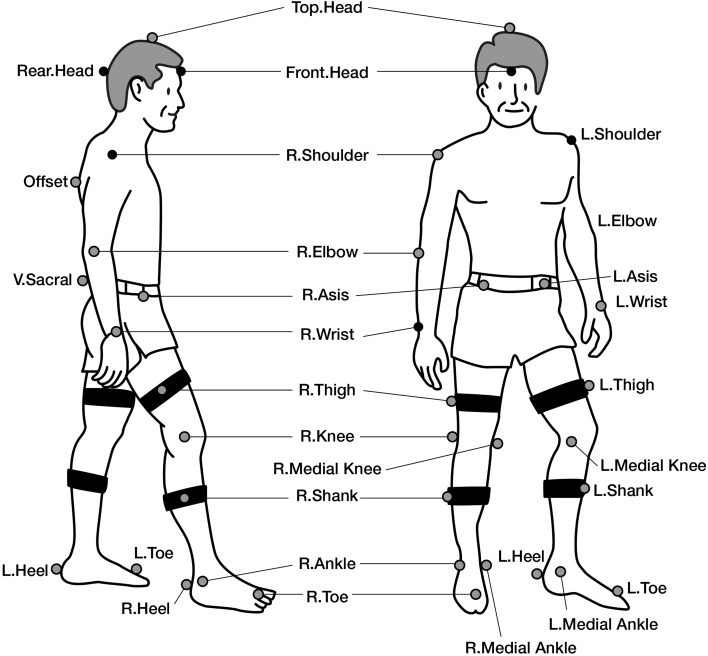
Methods: Twenty healthy males participated in this study. Six sitting postures were defined from three spinal curvatures (slump, flat, and lordosis) and two arm postures (arms-on-chest and arms-forward). Kinematic and kinetic data were measured in six sitting postures from which joint moment and AP reaction force were calculated by inverse dynamics.
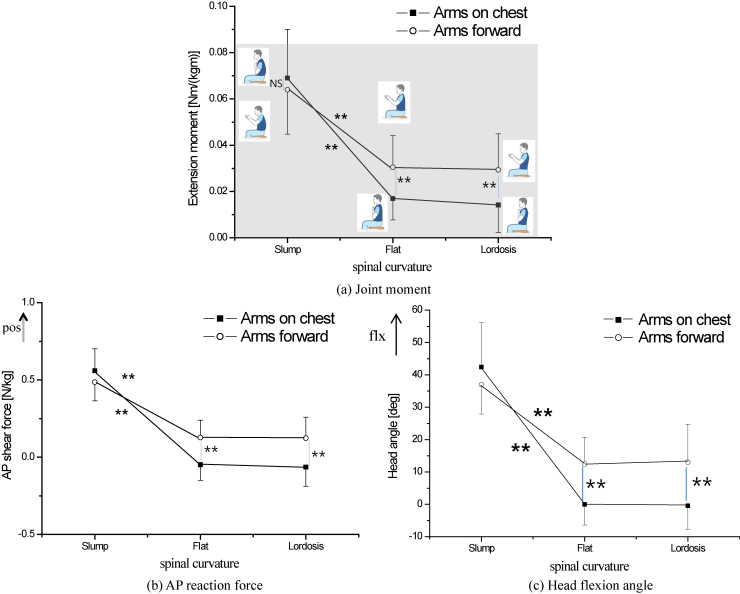
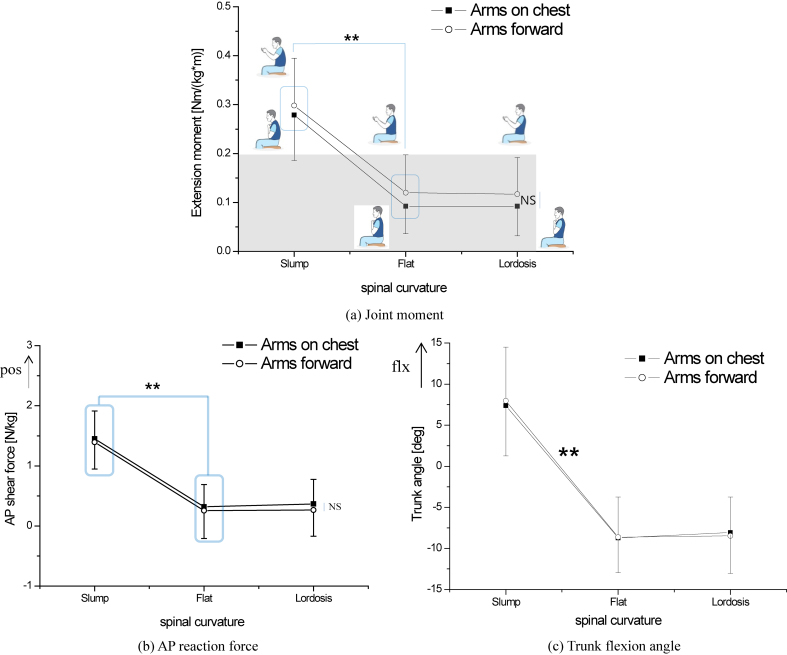
Results: In the cervico-thoracic joint, joint moment and AP reaction force were greater in slump than the flat and lordosis postures (p< 0.001) and also in arms-forward posture compared to arms-on-chest posture. In the lumbosacral joint, joint moment and AP reaction force were greater in slump than flat and lordotic posture (p< 0.001) but there was no difference between different arm postures. The joint loads (moment and AP reaction force) at the cervico-thoriacic joint were closely related to the head flexion angle (r> 0.86) while those at the lumbosacral joint were correlated to the trunk flexion angle (r> 0.77). In slump posture, the joint moments were close to or over the extreme of the daily life such as sit-to-stand and walking. Consequently, if the slump is continued for a long time, it may cause pain and diseases at the cervico-thoracic and lumbosacral joints.
Conclusions: The results of the study indicated that the lordosis or flat would be better spinal postures. Also, keeping arms close to body would be desirable to reduce joint loads.
Keywords: Sitting posture; cervico-thoracic joint; joint moment; joint reaction force; lumbosacral joint.
Conflict of interest statement
None to report.
Figures
References
-
- Colley RC, Garriguet D, Janssen I, Craig CL, Clarke J, Tremblay MS. Physical activity of Canadian adults: accelerometer results from the 2007 to 2009 Canadian Health Measures Survey. Health Rep. 2011; 22(1): 7-14. - PubMed
-
- Wilke HJ, Neef P, Caimi M, Hoogland T, Claes LE. New in vivo measurements of pressures in the intervertebral disc in daily life. Spine. 1999; 24(8): 755-62. - PubMed
-
- Nachemson A, Morris JM. In Vivo Measurements of Intradiscal Pressure. Discometry, a Method for the Determination of Pressure in the Lower Lumbar Discs. J Bone Joint Surg Am. 1964; 46: 1077-92. - PubMed
-
- Pynt J, Higgs J, Mackey M. Historical perspective milestones in the evolution of lumbar spinal postural health in seating. Spine. 2002; 27(19): 2180-9. - PubMed
-
- Sondergaard KH, Olesen CG, Sondergaard EK, de Zee M, Madeleine P. The variability and complexity of sitting postural control are associated with discomfort. J Biomech. 2010; 43(10): 1997-2001. - PubMed
MeSH terms
LinkOut - more resources
Full Text Sources
Other Literature Sources
Medical
