. 2018 May 29;115(22):5652-5657.
doi: 10.1073/pnas.1711220115. Epub 2018 May 14.

Ultrafast nonthermal heating of water initiated by an X-ray Free-Electron Laser

Affiliations

Ultrafast nonthermal heating of water initiated by an X-ray Free-Electron Laser

Kenneth R Beyerlein et al. Proc Natl Acad Sci U S A. .

Abstract

The bright ultrafast pulses of X-ray Free-Electron Lasers allow investigation into the structure of matter under extreme conditions. We have used single pulses to ionize and probe water as it undergoes a phase transition from liquid to plasma. We report changes in the structure of liquid water on a femtosecond time scale when irradiated by single 6.86 keV X-ray pulses of more than 106 J/cm2 These observations are supported by simulations based on molecular dynamics and plasma dynamics of a water system that is rapidly ionized and driven out of equilibrium. This exotic ionic and disordered state with the density of a liquid is suggested to be structurally different from a neutral thermally disordered state.

Keywords: Serial Femtosecond Crystallography; X-ray Free-Electron Laser; molecular dynamics; non-local thermodynamics equilibrium; ultrafast phase transition.


Conflict of interest statement

The authors declare no conflict of interest.

Figures
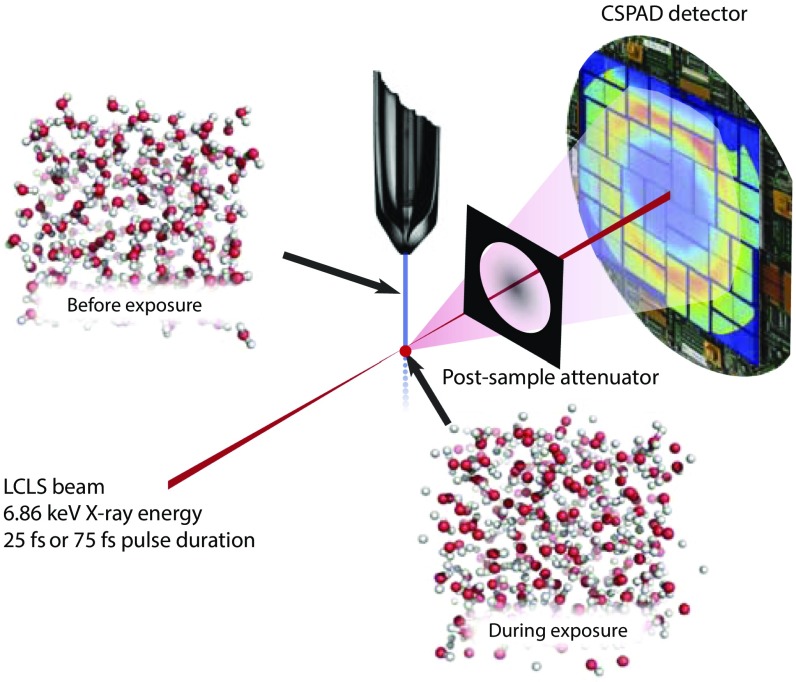
Fig. 1.
Fig. 1.
A narrow jet of room temperature water was injected using a GDVN into the 200 nm X-ray focus of the CXI end station of the LCLS. Diffraction patterns from single pulses were recorded on a CS-PAD detector with a postsample attenuator made of a Tungsten alloy film positioned downstream of the sample. The scattered signals from pulses of short (25 fs) and long (75 fs) duration were processed and analyzed. A combination of NLTE modeling and MD simulations was used to follow the dynamics of the atoms during the exposure to intense X-ray radiation. Upper Left and Lower Right depict the broken bonds found in the simulations. The water transitions into a warm dense matter state during the pulse and leads ultimately to a local explosion of the water jet (12).
Fig. 2.
Fig. 2.
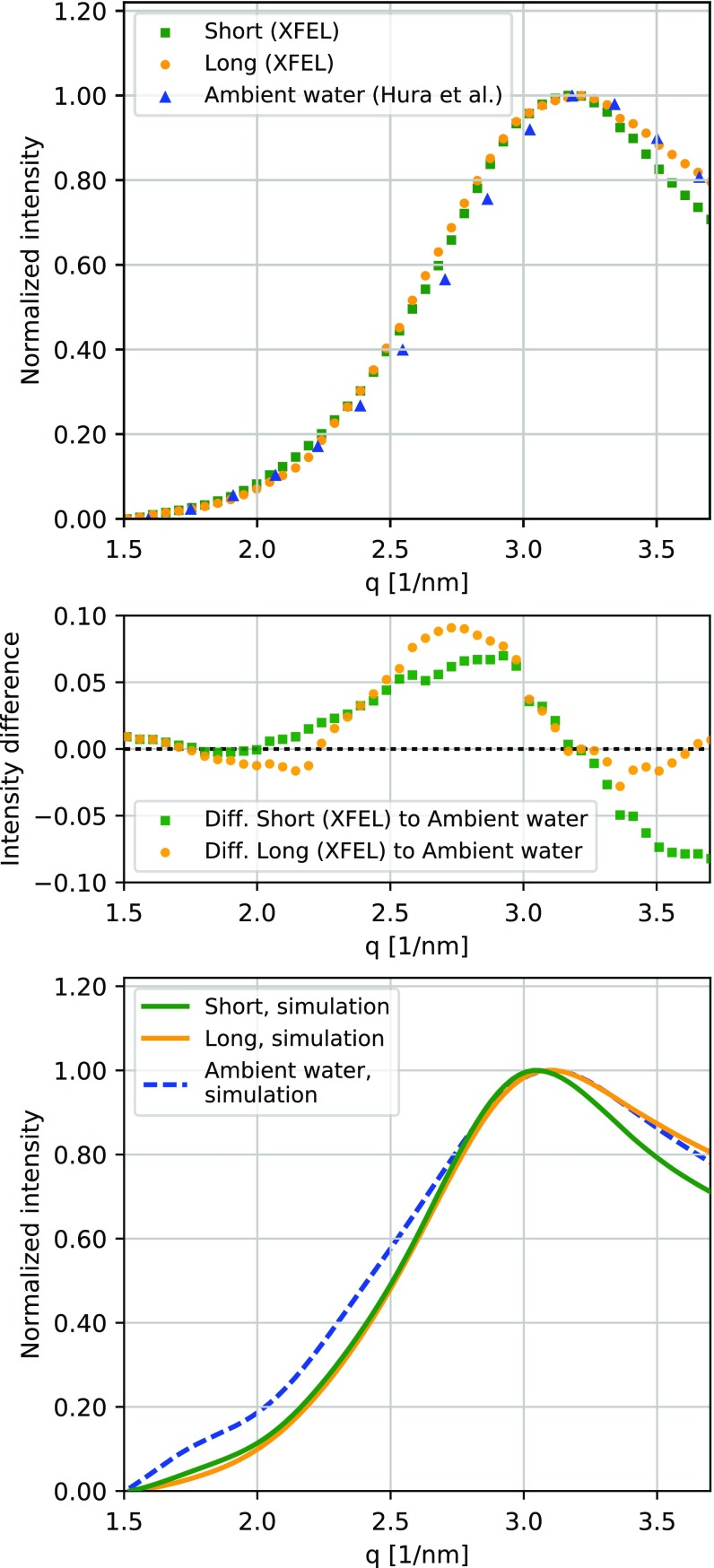
Scattered X-ray intensity from water. (Upper) Measured scattering intensity as a function of scattering vector q=2sin(θ)/λ, for experiments using an XFEL pulse of 25 fs and 75 fs duration (both with a fluence of 1.35106 J/cm2) and data from water at ambient conditions taken from Hura et al. (8). The SE on normalized intensity for all measurements is smaller than 0.2%. All curves are normalized to the maximum of the peak with the minimum subtracted. (Middle) Difference between measured scattering intensity using XFEL pulses and a linear interpolation of the scattering intensity from water at ambient conditions (8). (Lower) Simulated scattered intensities as a function of scattering vector q, based on MD and NLTE simulations, calculated from the O–O radial distribution function (RDF) and the electronic states of the system. The X-ray parameters are chosen to match the experimental. All curves are normalized to 1. Direct comparisons of simulations to experiments are available in SI Appendix, Fig. S1. Tabulated data q vs. intensity are available in SI Appendix.
Fig. 3.
Fig. 3.
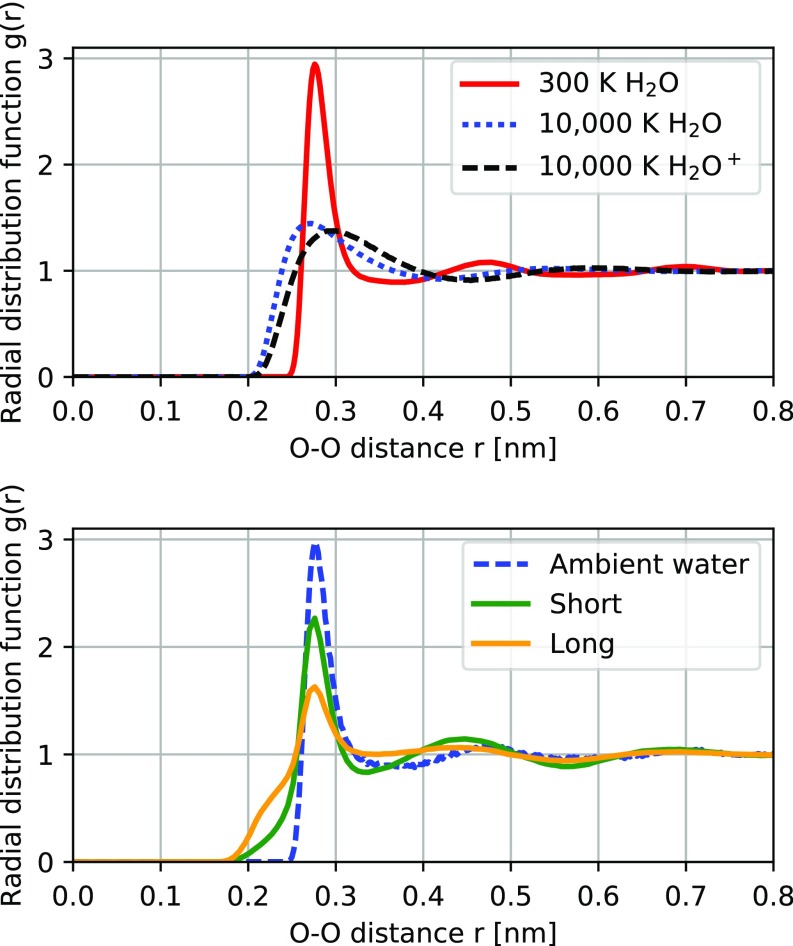
Radial distribution functions of oxygen–oxygen distance in water calculated from MD simulations. (Upper) Test simulations for 300 K and 10,000 K neutral systems and an 10,000 K ionized system (charge +1). Heated systems will have a lower degree of coordination in higher number solvation shells. (Lower) MD simulations using the experimental parameters for the X-ray pulse.
Fig. 4.
Fig. 4.
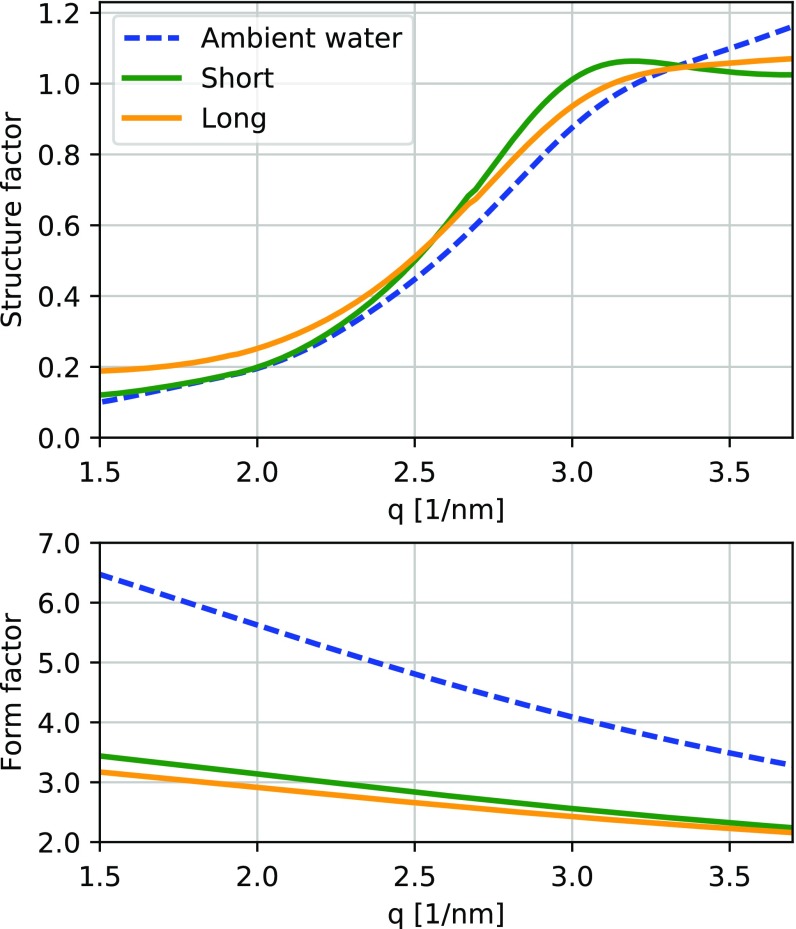
Simulated structure factors and form factors. (Upper) Time integrated simulated structure factor as a function of scattering vector q for the 75 fs (long) and 25 fs (short) XFEL pulses as well as for the ambient case. The structural changes that happen in the last part of the long pulse create distinct differences, especially in the slope at high q, which is of the opposite sign. (Lower) Time integrated simulated form factor as a function of scattering vector for the same cases. The form factors for the intense XFEL pulses are at all q values very close in magnitude and slope. The time integrated product of the squared form factor and the structure factor gives the scattered intensity, which can be directly compared with the experiment. Given the limited range in q and that both factors change during the pulse, these cannot be extracted unambiguously from the experimental data.
Fig. 5.
Fig. 5.
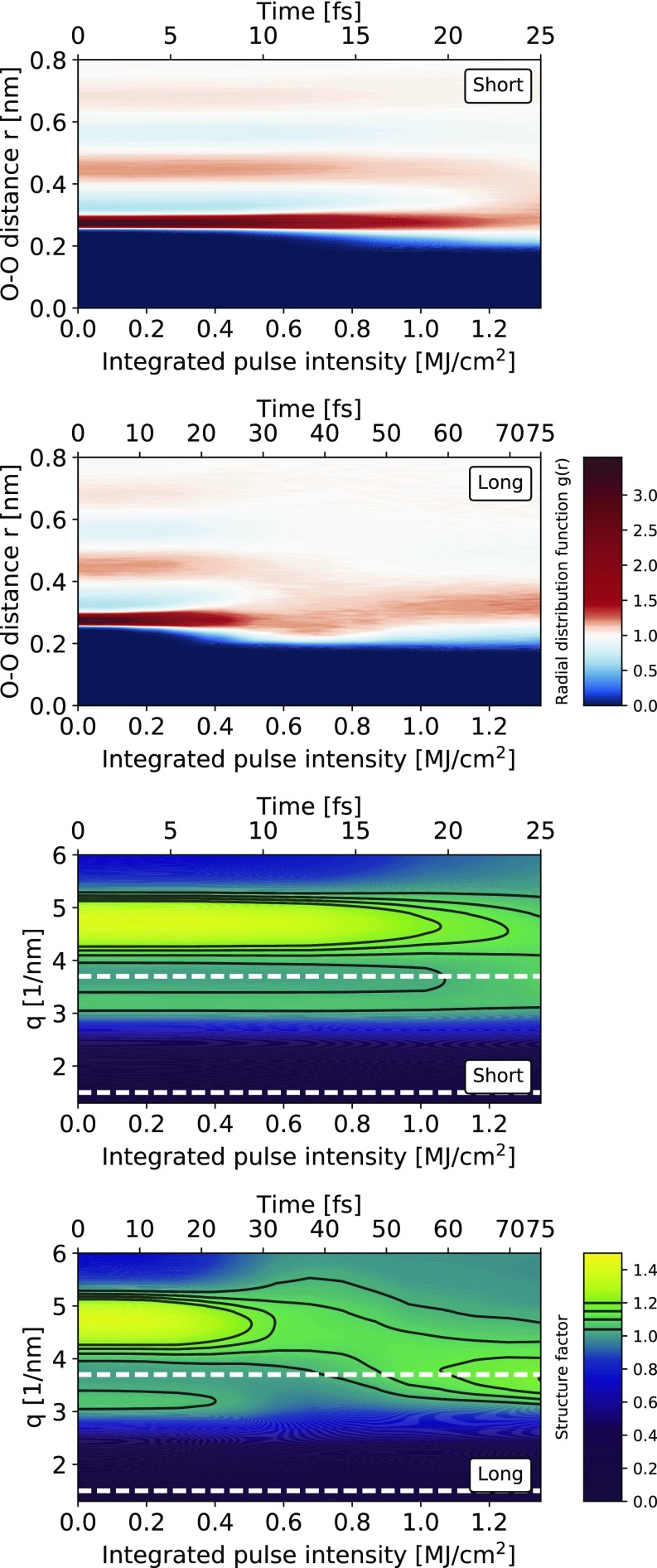
Simulation of the time evolution of the RDF and structure factors. (Top and Upper Middle) Time evolution of the RDF during the X-ray pulse, shown as a function of integrated intensity for the two pulses. The short (25 fs) and long (75 fs) pulses have the same total intensity. In both cases, the structure of water does not appear to change until roughly 20 fs. (Lower Middle and Bottom) Time evolution of the structure factor, calculated from the RDF above. The experimental measurements displayed in Fig. 2 were made from 1.5 to 3.7 nm−1, marked here with dashed white lines.

References

    1. Nagler B, et al. Turning solid aluminum transparent by intense soft X-ray photoionization. Nat Phys. 2009;5:693–696.
    1. Fletcher LB, et al. Ultrabright X-ray laser scattering for dynamic warm dense matter physics. Nat Photonics. 2015;9:274–279.
    1. Medvedev N, Li Z, Ziaja B. Thermal and nonthermal melting of silicon under femtosecond X-ray irradiation. Phys Rev B. 2015;91:054113.
    1. DePonte DP, et al. Gas dynamic virtual nozzle for generation of microscopic droplet streams. J Phys D: Appl Phys. 2008;41:195505.
    1. Weierstall U, Spence JCH, Doak RB. Injector for scattering measurements on fully solvated biospecies. Rev Sci Instrum. 2012;83:035108. - PubMed

Publication types