. 2018 Jul 27;62(8):e00320-18.
doi: 10.1128/AAC.00320-18. Print 2018 Aug.

Evolution of Antibiotic Resistance in Biofilm and Planktonic Pseudomonas aeruginosa Populations Exposed to Subinhibitory Levels of Ciprofloxacin

Affiliations

Evolution of Antibiotic Resistance in Biofilm and Planktonic Pseudomonas aeruginosa Populations Exposed to Subinhibitory Levels of Ciprofloxacin

Marwa N Ahmed et al. Antimicrob Agents Chemother. .

Abstract

The opportunistic Gram-negative pathogen Pseudomonas aeruginosa, known for its intrinsic and acquired antibiotic resistance, has a notorious ability to form biofilms, which often facilitate chronic infections. The evolutionary paths to antibiotic resistance have mainly been investigated in planktonic cultures and are less studied in biofilms. We experimentally evolved P. aeruginosa PAO1 colony biofilms and stationary-phase planktonic cultures for seven passages in the presence of subinhibitory levels (0.1 mg/liter) of ciprofloxacin (CIP) and performed a genotypic (whole-bacterial population sequencing) and phenotypic assessment of the populations. We observed a higher proportion of CIP resistance in the CIP-evolved biofilm populations than in planktonic populations exposed to the same drug concentrations. However, the MICs of ciprofloxacin were lower in CIP-resistant isolates selected from the biofilm population than the MICs of CIP-resistant isolates from the planktonic cultures. We found common evolutionary trajectories between the different lineages, with mutations in known CIP resistance determinants as well as growth condition-dependent adaptations. We observed a general trend toward a reduction in type IV-pilus-dependent motility (twitching) in CIP-evolved populations and a loss of virulence-associated traits in the populations evolved in the absence of antibiotic. In conclusion, our data indicate that biofilms facilitate the development of low-level mutational resistance, probably due to the lower effective drug exposure than in planktonic cultures. These results provide a framework for the selection process of resistant variants and the evolutionary mechanisms involved under the two different growth conditions.

Keywords: Pseudomonas aeruginosa; biofilm; drug resistance evolution.


Figures

FIG 1
FIG 1
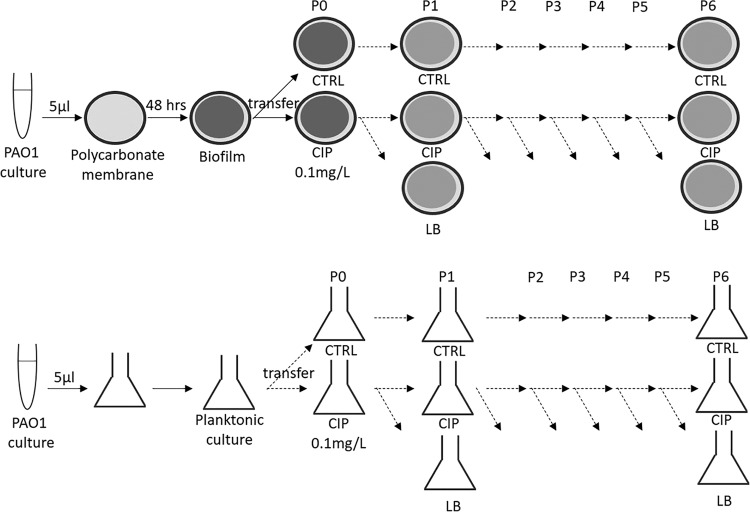
Setup of the experimental evolution in colony biofilms and stationary-phase planktonic cultures. Top, a colony biofilm was formed on polycarbonate membrane from an overnight culture of PAO1. In the step called passage 0 (P0), membranes containing 48-h colony biofilms were transferred to fresh LB plates with either CIP or without CIP for 48 h (CTRL). Every 48 h, the colony biofilms were dispersed, and the bacterial suspension was used to start new biofilms. The bacterial suspensions of CIP biofilms were used to start new biofilms on plates with either CIP or without CIP (LB). The bacterial suspensions of CTRL biofilms were used to start new biofilms on LB plates. This was repeated for 6 passages (P1 to P6) with four replicates per population (A, B, C, and D). Bottom, the same setup was used for planktonic batch cultures. A 48-h stationary culture in LB was started from an overnight culture. From the 48-h culture, two flasks were inoculated: one with 0.1 mg/liter CIP and one in LB (CTRL) (P0). From CIP stationary cultures, every 48 h, new planktonic cultures were established in flasks with CIP or without CIP (LB). From CTRL stationary cultures, every 48 h, new planktonic cultures were established in flasks with LB. This was repeated for 6 passages (P1 to P6), with four replicates per each population (A, B, C, and D).
FIG 2
FIG 2
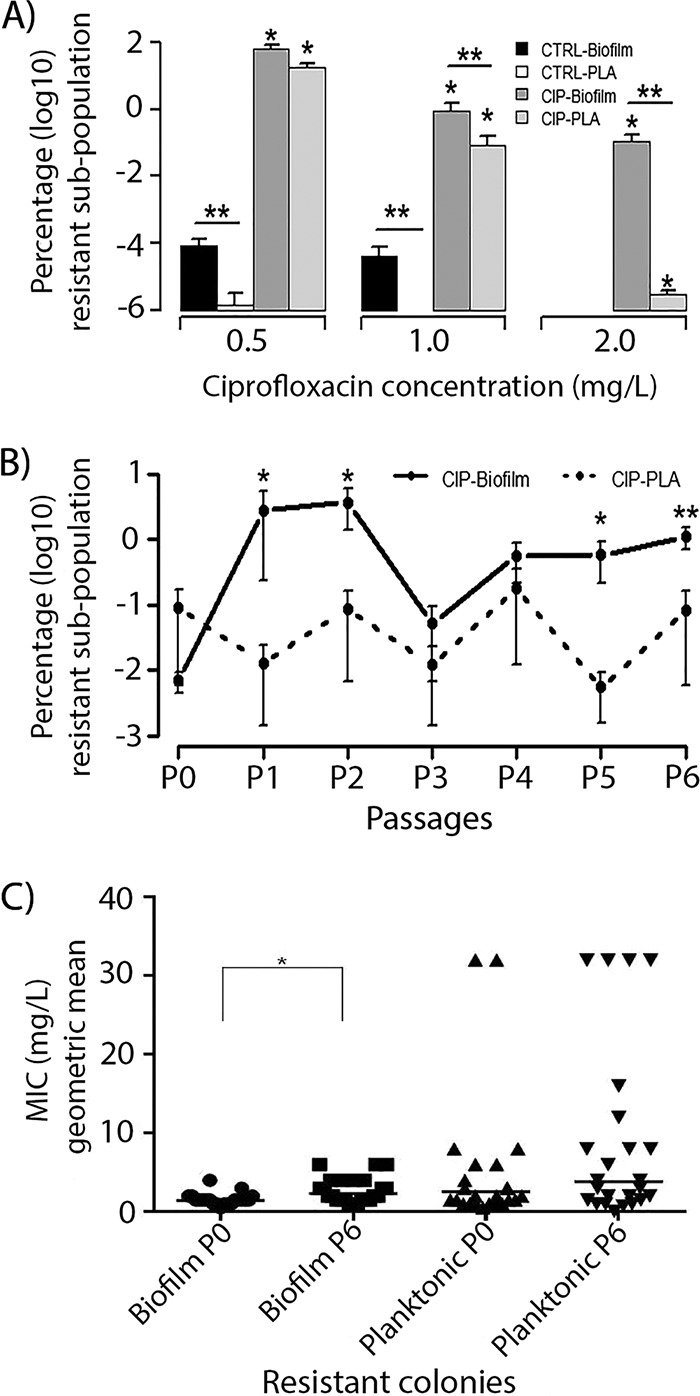
(A) Size of the PAO1 biofilm (biofilm) and planktonic (PLA) populations recovered from 0.5, 1, and 2 mg/liter CIP after evolution in the presence of CIP (0.1 mg/liter) (CIP) or in the absence of antibiotic (CTRL). The values represent the mean (SEM) of eight lineages for each growth condition. *, the size of the resistant population is significantly different in CIP-evolved population compared to the CTRL (P ≤ 0.0001); **, the size of the resistant population was significantly higher in biofilm than in planktonic-evolved populations (P = 0.008 for populations recovered from 1 mg/liter CIP and P = 0.0013 for populations recovered from 2 mg/liter CIP). (B) The development of the resistant population recovered from 1 mg/liter CIP in CIP-evolved biofilm and planktonic cultures during passages (P0 to P6). The values represent the mean (SEM) of eight lineages for each growth condition. *, the sizes of the resistant population in CIP-biofilm populations was significantly higher than that in CIP-planktonic populations at passages 1, 2, 5, and 6 (P = 0.0329, 0.0401, 0.0283, and 0.0084, respectively); **, the size of the resistant population in the last passage was significantly different (P = 0.004) from the first passage (P0). (C) The MIC levels of ciprofloxacin (geometric means) for isolated colonies recovered from CIP-biofilm and planktonic cultures at P0 and P6. The MIC values of 24 independent clones for each growth condition and passage are presented. *, the MIC level was significantly different between the colonies isolated at P0 and P6 in biofilm (P = 0.005).
FIG 3
FIG 3
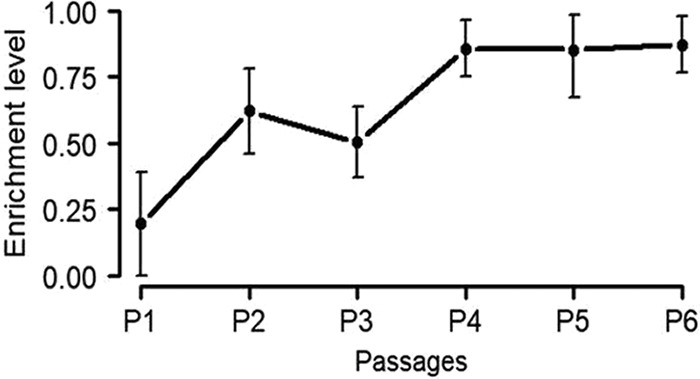
Enrichment of CIP-resistant subpopulation in CIP-evolved biofilm cultures during several passages (passages 1 to 6) in the presence of subinhibitory levels (0.1 mg/liter) of CIP. Enrichment level = 1 − (log10 CFU of CIP population grown on LB plates − log10 CFU of CIP population grown on CIP plates).
FIG 4
FIG 4
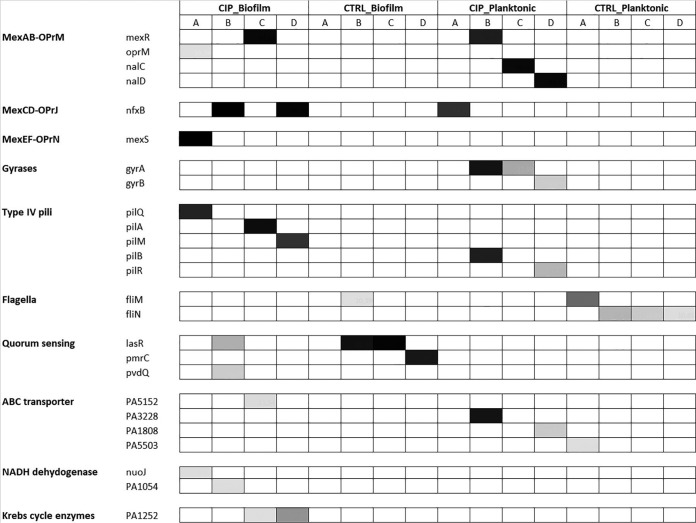
Heatmap showing mutations in in CIP and CTRL-evolved populations in both biofilm and planktonic cultures. Genes are clustered according to their function reported in the Pseudomonas Genome Database (26). The intensity of color reflects the frequency of mutations in each replicate population.

References

    1. Hoiby N, Bjarnsholt T, Moser C, Bassi GL, Coenye T, Donelli G, Hall-Stoodley L, Hola V, Imbert C, Kirketerp-Moller K, Lebeaux D, Oliver A, Ullmann AJ, Williams C, ESCMID Study Group for Biofilms and Consulting External Expert Werner Zimmerli . 2015. ESCMID guideline for the diagnosis and treatment of biofilm infections 2014. Clin Microbiol Infect 21(Suppl 1):S1–S25. doi: 10.1016/j.cmi.2014.10.024. - DOI - PubMed
    1. Lebeaux D, Ghigo JM, Beloin C. 2014. Biofilm-related infections: bridging the gap between clinical management and fundamental aspects of recalcitrance toward antibiotics. Microbiol Mol Biol Rev 78:510–543. doi: 10.1128/MMBR.00013-14. - DOI - PMC - PubMed
    1. Stewart PS. 2015. Antimicrobial tolerance in biofilms. Microbiol Spectr 3:. doi: 10.1128/microbiolspec.MB-0010-2014. - DOI - PMC - PubMed
    1. Walters MC III, Roe F, Bugnicourt A, Franklin MJ, Stewart PS. 2003. Contributions of antibiotic penetration, oxygen limitation, and low metabolic activity to tolerance of Pseudomonas aeruginosa biofilms to ciprofloxacin and tobramycin. Antimicrob Agents Chemother 47:317–323. doi: 10.1128/AAC.47.1.317-323.2003. - DOI - PMC - PubMed
    1. Zhang Q, Lambert G, Liao D, Kim H, Robin K, Tung CK, Pourmand N, Austin RH. 2011. Acceleration of emergence of bacterial antibiotic resistance in connected microenvironments. Science 333:1764–1767. doi: 10.1126/science.1208747. - DOI - PubMed

Publication types

MeSH terms